
Specialties › Knee & Leg › PCL Injury

A PCL injury occurs when the ligament at the back of the knee is stretched or torn, reducing knee stability. It usually happens when a strong force pushes the shinbone backward, such as during a car accident, fall, or sports impact. Although less common than ACL injuries, it can often occur alongside other knee damage.
With proper care, most people recover well. However, untreated injuries can lead to long-term instability or arthritis. In this guide, you’ll learn how PCL injuries happen, what symptoms to watch for, how they are diagnosed, and the most effective treatment and recovery strategies.
Book a consultation and receive expert orthopedic guidance.
A Posterior Cruciate Ligament (PCL) injury is a sprain or tear of the ligament located at the back of the knee. It connects the thighbone (femur) to the shinbone (tibia) and plays a key role in stabilizing the knee by preventing the tibia from moving too far backward.
This type of injury occurs when a strong force pushes the shinbone backward while the knee is bent. A common example is a “dashboard injury,” where the knee hits the dashboard during a car accident. It can also happen when someone falls directly onto a bent knee or lands awkwardly during sports.
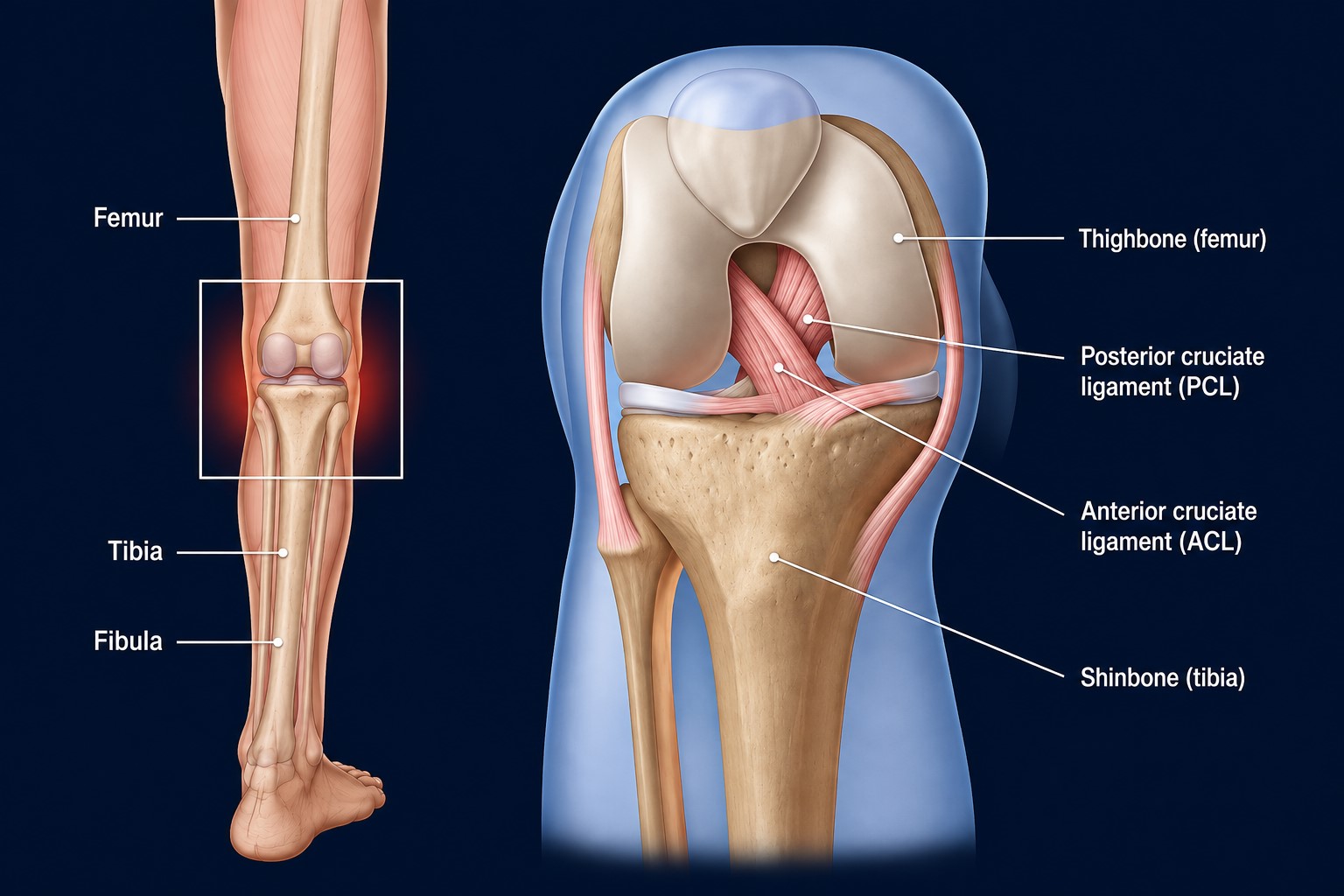
PCL injuries are much less common than other knee ligament injuries, especially ACL tears. They account for roughly 5% to 20% of all knee ligament injuries, although some studies report figures as high as 23%.
In the general population, these injuries are relatively rare. The incidence is estimated at about 2 cases per 100,000 people per year, and they make up only around 3% of outpatient knee injuries. In the United States, fewer than 20,000 cases are diagnosed annually.
Most PCL injuries do not occur in isolation. In fact, over 90% are associated with other knee injuries, such as damage to the ACL, MCL, or meniscus. Truly isolated PCL injuries are uncommon.
Certain patterns have also been observed:
Sports injuries and falls onto a bent knee also contribute, but they are less frequent compared to high-energy trauma.
Posterior Cruciate Ligament (PCL) injuries are classified by type (how the injury occurs) and grade (how severe it is). This classification is based on the extent of ligament damage and the degree of posterior tibial movement (posterior translation). These injuries are commonly caused by direct impact, such as a “dashboard injury,” and may lead to pain, swelling, and knee instability.
A PCL injury occurs when a strong force pushes the shinbone (tibia) backward while the knee is bent. Unlike many other knee injuries, PCL injuries are more often caused by direct impact rather than simple twisting.
A PCL injury causes pain at the back of the knee, swelling within a few hours, and a feeling of instability or looseness. You may have difficulty walking or bearing weight, especially when going downhill or downstairs.
The knee may feel stiff, making it harder to fully bend or straighten, and the back of the knee can be tender. Pain often worsens during activities such as kneeling, squatting, or running. Some people also experience a sense of pressure behind the knee.
Symptoms are often mild at first and may develop gradually, which is why the injury is sometimes overlooked. If left untreated, it can lead to ongoing discomfort—often felt at the front of the knee—as well as reduced confidence in knee stability during daily activities or sports.
Doctors diagnose a PCL injury by combining your medical history, a physical examination, and imaging tests. The goal is to confirm the injury, determine its severity, and identify any associated damage to other knee structures.
A careful clinical examination combined with appropriate imaging helps guide treatment decisions and ensures that no associated injuries are overlooked.
Treatment depends on the severity of the injury and whether other parts of the knee are involved. Most PCL injuries—especially mild to moderate cases—are treated without surgery. The main goals are to reduce pain, restore stability, and return to normal movement.
This is the first-line approach for most people, particularly those with Grade I and II injuries, as well as some isolated Grade III cases.
Many people recover well with this approach and return to normal daily activities without surgery.
Surgery is considered in more severe cases or when symptoms do not improve with rehabilitation. You may need surgery if:
PCL Reconstruction: In this procedure, the surgeon replaces the damaged ligament with a graft, often using tendon tissue. It is performed using minimally invasive techniques.
The choice between non-surgical and surgical treatment depends on the severity of the injury, your activity level, and how stable your knee feels during daily activities.
Recovery from a PCL injury depends on the severity of the damage and whether surgery is required. Mild injuries may heal within a few weeks, while more severe cases can take several months to a year.
Recovery focuses on protecting the knee while gradually rebuilding strength and stability. Bracing helps maintain proper alignment, and rehabilitation emphasizes quadriceps strengthening while avoiding excessive early strain. Activities are reintroduced progressively, with running often beginning around 3 months and full return to sports after 6 months or more, depending on recovery progress.
A PCL injury can lead to long-term complications, especially if it is severe or not properly treated. Common issues include knee instability, persistent pain, swelling, and stiffness. Muscle weakness and changes in walking (gait) may also develop, making daily activities or sports more difficult.
Over time, there is an increased risk of osteoarthritis, particularly in untreated or poorly managed cases, due to altered knee mechanics.
If surgery is performed, potential complications may include knee stiffness, ongoing pain, infection (rare), or residual looseness (laxity) in the joint.
With appropriate treatment and a structured rehabilitation program, many of these complications can be minimized or prevented.
PCL injuries are rare in children and differ from adult injuries due to developing bones. Younger children are more likely to sustain avulsion injuries, where the ligament pulls off a piece of bone, while adolescents tend to experience ligament tears similar to adults.
Diagnosis can be challenging because symptoms may be subtle, and standard X-rays do not always detect these injuries. As a result, MRI is often important for confirming the diagnosis.
Treatment depends on the severity of the injury. Mild cases are managed with rest, bracing, or sometimes casting. More severe or unstable injuries may require surgical treatment. Special care is needed to protect the growth plates (physes) during management. With early diagnosis and appropriate treatment, most children achieve good outcomes.
You can reduce your risk of a PCL injury by keeping your knee strong, stable, and well-protected. Focus on strengthening the quadriceps, along with the hamstrings, glutes, and core muscles.
Use proper movement techniques, such as landing with bent knees and avoiding sudden or uncontrolled motions. Warming up before physical activity and maintaining good flexibility can also help reduce strain on the knee.
Wear appropriate footwear and use protective gear when necessary. Follow safety measures, such as wearing a seatbelt, to reduce the risk of high-impact injuries. Maintaining a healthy weight and addressing early symptoms promptly can also help lower the risk of more serious injury.
You should see a doctor if you suspect a PCL injury, especially after a fall, sports impact, or car accident. Seek immediate medical care if you experience severe pain, significant swelling, knee instability, difficulty walking, or numbness or tingling in the leg.
You should also get evaluated if mild symptoms do not improve over time, such as persistent pain, stiffness, or limited movement. Early diagnosis helps confirm the injury, identify any associated damage, and ensure appropriate treatment for optimal recovery.
It causes pain at the back of the knee, along with mild swelling and a feeling of looseness or instability.
Yes, many mild to moderate PCL injuries can heal with proper non-surgical treatment, including rest, bracing, and physical therapy.
Yes, many people can still walk, but they may experience discomfort or a sense of instability, especially during certain movements.
No, most PCL injuries are treated without surgery. Surgical treatment is considered for severe tears or when multiple ligaments are involved.
An untreated PCL injury can lead to chronic knee instability, ongoing pain, and an increased risk of early osteoarthritis.
Yes, many people recover well and return to normal activities with appropriate treatment and rehabilitation.

We use cookies to improve your experience on our site. By using our site, you consent to cookies.
Manage your cookie preferences below:
Essential cookies enable basic functions and are necessary for the proper function of the website.