
Specialties › Knee & Leg › Patella Dislocation

A patella dislocation is a common knee injury that occurs when the kneecap moves out of its normal position in the groove at the end of the thighbone. It often happens after a sudden twist, awkward landing, or direct impact during sports or other activities. The injury can cause sudden knee pain, swelling, and difficulty moving the leg. Some people also experience recurrent dislocations due to underlying knee anatomy or ligament damage.
This article explains what a patella dislocation is and what causes it. You will learn about the different types, common symptoms, how doctors diagnose the injury, and the available treatment options. We also cover when surgery may be necessary, recovery timelines, possible complications, ways to prevent another dislocation, and answers to common patient questions.
Book a consultation and receive expert orthopedic guidance.
A patella dislocation occurs when the kneecap moves out of its normal position in the groove at the end of the thighbone, called the femoral trochlea. The kneecap usually shifts toward the outer side of the knee, disrupting its normal alignment with the thighbone. It may return to its original position on its own or require a healthcare professional to guide it back.
There are two main forms of patellar displacement:
A patella dislocation can happen for the first time after a sudden injury or recur when underlying instability persists. Damage to the ligaments that support the kneecap, particularly the medial patellofemoral ligament (MPFL), can increase the risk of another episode. Anatomical factors, such as a shallow trochlear groove or a high-riding kneecap, can also contribute to patellar instability.
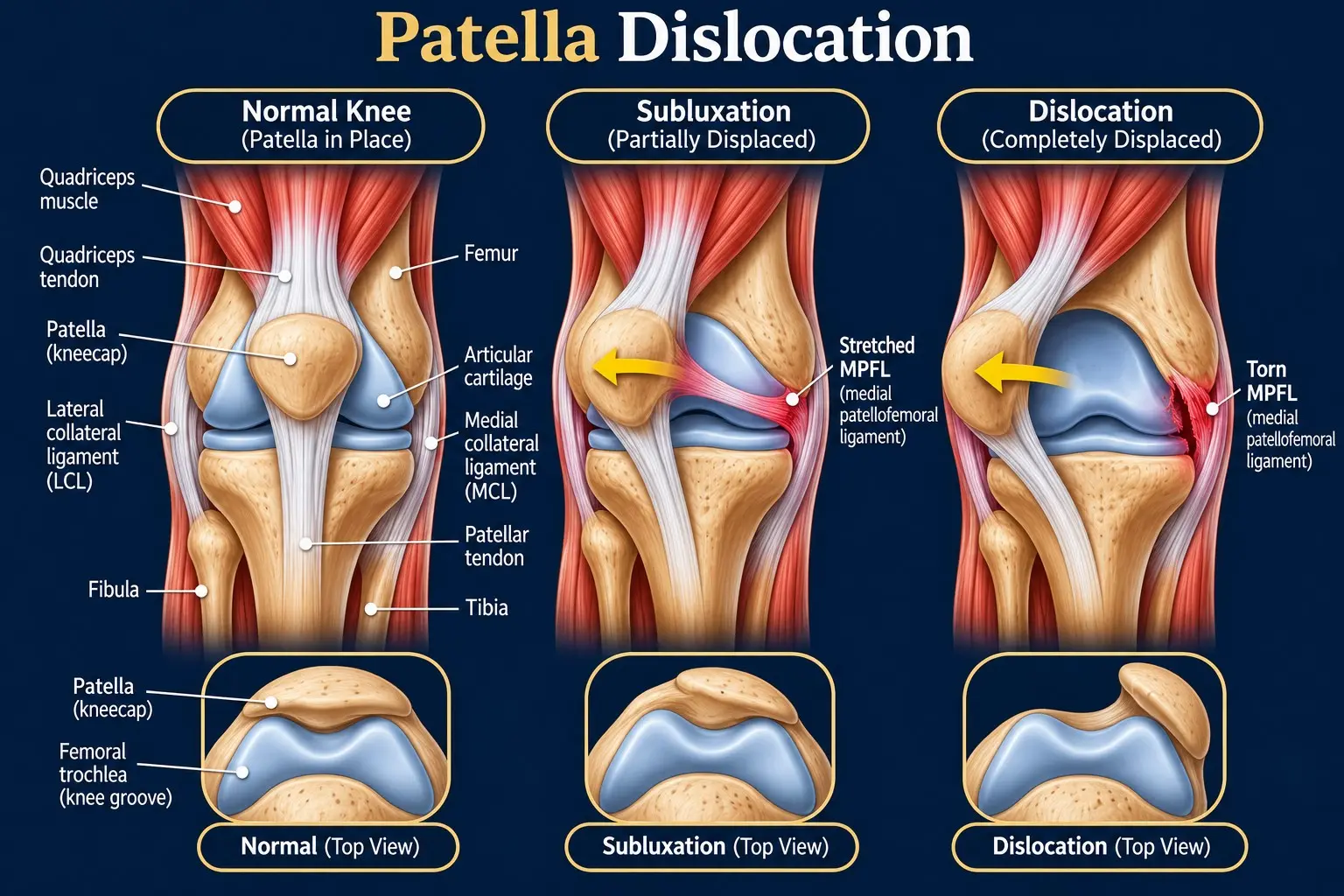
The kneecap, also called the patella, sits at the front of the knee and moves within a groove at the lower end of the thighbone. This movement helps the quadriceps muscles straighten the knee during walking, running, and other activities. Several bones, ligaments, tendons, and muscles work together to maintain proper kneecap alignment and prevent excessive movement.
The main structures that support patellar stability include:
These structures work together to maintain patellofemoral stability, which refers to the ability of the kneecap to remain properly aligned as the knee moves. Problems with the trochlear groove, supporting ligaments, muscle control, or overall leg alignment can disrupt normal patellar tracking. This can increase the risk of a dislocated kneecap, particularly during twisting movements or sudden changes in direction.
A patella dislocation can occur when a twisting movement, direct impact, or underlying knee instability forces the kneecap out of its normal position. The injury often involves sudden lateral displacement, meaning the kneecap moves toward the outer side of the knee. Some people experience a dislocation after a significant injury, while others are more vulnerable because of their knee anatomy or previous ligament damage.
Several movements and injuries can cause the kneecap to slip out of its normal position.
Some people have structural differences that make the kneecap more likely to become unstable. These factors can increase the risk of a first-time dislocation or contribute to repeated episodes.
These causes and risk factors can occur together. A sudden twisting injury may trigger a dislocation in someone with otherwise stable knees, while a person with underlying anatomical differences may experience one during a less forceful movement. Identifying the contributing factors helps doctors choose appropriate treatment and assess the risk of recurrent patellar instability.
Patella dislocations can be classified by how far the kneecap moves, the direction of displacement, and whether the injury occurs once or repeatedly. These categories help describe the pattern of patellar instability and identify factors that may affect treatment.
These types describe different features of patellar displacement rather than a single scale of injury severity. A doctor evaluates the displacement pattern, associated ligament or cartilage damage, and any history of previous dislocations to determine the most appropriate treatment.
A dislocated kneecap can cause sudden knee pain, swelling, visible deformity, and difficulty moving the leg. Symptoms often begin after a twisting movement, awkward landing, fall, or direct impact. Their severity depends on how far the kneecap moves and whether the injury damages surrounding ligaments, cartilage, or bone.
Common symptoms of a dislocated kneecap include:
Symptoms can differ between a complete dislocation and a patellar subluxation, in which the kneecap only partially slips out of its groove. Sometimes, the kneecap returns to its normal position before a medical examination, so visible deformity may no longer be present.
A patella dislocation can cause sudden pain, swelling, and difficulty moving the knee. You should protect the injured leg and seek urgent medical assessment, even if the kneecap returns to its normal position on its own. The injury may damage surrounding ligaments, cartilage, or bone, even when the kneecap appears normal again.
Follow these steps while arranging medical care.
These warning signs may indicate a serious injury that needs immediate treatment. A healthcare professional can assess blood circulation, nerve function, bone alignment, and possible damage to the ligaments or cartilage.
Do not assume the injury is minor just because the kneecap moves back into place. Early assessment helps identify associated injuries and guides the next steps in treatment and recovery.
Doctors diagnose a patella dislocation by reviewing how the injury happened, examining the knee, and using appropriate imaging tests. These assessments help confirm the dislocation, evaluate patellar alignment, and identify damage to the surrounding ligaments, cartilage, or bone. The findings also help determine the most suitable treatment.
The doctor asks how the injury occurred and which symptoms developed afterward. This information helps identify the likely cause and determine whether the kneecap has dislocated before.
Your doctor may ask questions such as:
Your answers help the doctor understand the injury mechanism and assess the possibility of recurrent patellar instability.
The doctor examines the knee for swelling, bruising, tenderness, deformity, and abnormal kneecap positioning. They may check the inner edge of the patella, where the medial patellofemoral ligament (MPFL) can be injured.
The examination may include:
The doctor avoids forceful movements that could worsen the injury. Some stability tests may be delayed until pain and swelling improve.
X-rays are commonly used to assess a suspected acute patella dislocation. They show bone alignment and can reveal fractures or small bone fragments that may have broken away during the injury.
The doctor may request front, side, and specialized kneecap views. These images can also help identify anatomical features that contribute to patellar instability.
Normal X-rays do not rule out cartilage damage or other soft-tissue injuries. Further imaging may be needed if the doctor suspects damage that X-rays cannot show.
An MRI provides detailed images of the ligaments, cartilage, and other soft tissues around the knee. Your doctor may recommend this test if the examination or symptoms suggest associated internal damage.
An MRI can help identify:
MRI is particularly useful when significant swelling, persistent pain, or suspected cartilage and bone injuries raise concern. Not every patient needs an MRI, but doctors may recommend one when the findings suggest an associated injury.
A computed tomography (CT) scan may be appropriate when the doctor needs more detailed information about fractures, bone alignment, or rotational abnormalities. It can also help assess anatomical factors in patients with recurrent patella dislocations when the results may influence surgical planning.
The doctor selects imaging tests according to the injury, examination findings, and suspected structural problems. Together, the medical history, physical examination, and imaging results help determine the extent of damage and guide an appropriate treatment plan.
Treatment for a patella dislocation aims to restore the kneecap’s position, reduce pain and swelling, and improve knee stability. The approach depends on the severity of the injury, associated damage, and whether the dislocation has happened before. Many first-time dislocations can be treated without surgery when significant cartilage or bone injuries do not require an operation.
If the kneecap remains dislocated, a trained healthcare professional may perform a procedure called closed reduction. During this procedure, the clinician carefully guides the kneecap back into its normal position. Pain relief or sedation may be provided when necessary.
An untrained person should never attempt to force a visibly displaced kneecap back into place. After reduction, the doctor checks the knee and assesses possible injuries to the surrounding ligaments, cartilage, and bone.
Initial treatment focuses on reducing discomfort and protecting the injured knee. Your doctor may recommend several measures to support early recovery.
These measures help manage symptoms while the knee begins to recover. Persistent or worsening symptoms may require further assessment.
A knee brace, splint, or crutches may help protect the knee during early recovery. The doctor determines the type and duration of support based on knee stability, pain, and any associated injuries.
Some patients need only brief support, while others require longer protection. Prolonged immobilization can cause joint stiffness and muscle weakness. Your treatment plan should allow safe knee movement when appropriate.
Physiotherapy helps restore knee movement, rebuild muscle strength, and improve patellar stability. A physiotherapist introduces exercises gradually according to pain, swelling, and healing progress.
A rehabilitation program may include:
Your physiotherapist adjusts the program as strength, mobility, and stability improve. Returning to demanding activities too early may increase the risk of another dislocation.
Not every patient with a dislocated kneecap needs surgery. Doctors often recommend non-surgical treatment for a first-time dislocation without significant associated damage. Surgery may be appropriate when structural injuries or persistent instability make conservative treatment less suitable.
A surgical assessment may be necessary for:
The decision depends on imaging findings, symptoms, age, activity level, knee anatomy, and personal goals. Your orthopedic specialist can explain the benefits and risks of each option.
When surgery is necessary, the surgeon selects a procedure based on the underlying cause of patellar instability. Common surgical options include:
Some patients also need treatment for associated cartilage or bone injuries. The most appropriate procedure depends on the specific injury, knee anatomy, and degree of instability.
The main goal of treatment is to restore stable knee function and reduce the risk of another dislocation. Early medical assessment and an individualized rehabilitation plan help guide recovery, whether treatment involves physiotherapy alone or surgery.
A patella dislocation can damage the cartilage, ligaments, and bone surrounding the kneecap. Some people recover without lasting problems, while others develop persistent pain, reduced knee movement, or recurrent instability. The risk of complications depends on the initial injury, associated damage, and whether further dislocations occur.
Possible complications include:
These complications are possible, but they do not affect everyone who experiences a patella dislocation. Appropriate medical assessment, individualized treatment, and rehabilitation can help restore knee function and address instability.
Seek further medical evaluation if you experience persistent pain, repeated dislocations, or locking of the knee. These symptoms may indicate an associated injury that needs additional treatment.
Recovery from a patella dislocation depends on the severity of the injury, associated damage, treatment, and rehabilitation progress. A first-time dislocation treated without surgery may allow a return to everyday activities within 6–8 weeks. Returning to high-impact sports often takes 3–4 months or longer. Recurrent dislocations, significant cartilage injuries, or surgical treatment can extend recovery to 4–6 months or more.
Recovery usually progresses through several stages. The timing varies according to pain, swelling, knee stability, and healing.
The initial goal is to reduce pain and swelling while protecting the injured knee. Treatment may include ice, appropriate pain relief, leg elevation, and temporary knee support. Your doctor may recommend a brace or crutches, depending on the injury and your ability to bear weight safely.
As pain and swelling improve, you may begin gentle knee movements and prescribed rehabilitation exercises. Your healthcare professional will determine when to increase weight-bearing and whether you need continued bracing. The timing depends on knee stability and any associated injuries.
Physiotherapy focuses on restoring knee movement and strengthening the quadriceps, hip, and gluteal muscles. Balance and coordination exercises also help improve kneecap control. Your physiotherapist adjusts the program according to your strength, symptoms, and response to exercise.
Many people with an uncomplicated first-time dislocation return to everyday activities within 6–8 weeks. Running, jumping, pivoting, and other high-impact activities place greater demands on the knee and commonly require 3–4 months or longer.
You should return to sports only when your knee has regained adequate strength, stability, movement, and functional control. Your healthcare professional can assess your readiness and help reduce the risk of another injury.
Recovery timelines vary depending on the injury and the treatment required.
A patella dislocation affects the kneecap, while a true knee joint dislocation involves displacement between the thighbone and shinbone. A true knee joint dislocation is a much more serious injury that can damage blood vessels, nerves, and multiple ligaments. Recovery may take 9–15 months or longer, depending on the injuries and treatment required.
These timelines are estimates, not guarantees. Follow your orthopedic specialist's and physiotherapist's guidance throughout recovery. Returning to demanding activities before your knee regains adequate strength and stability can increase the risk of another dislocation.
Preventing another patella dislocation involves strengthening the muscles around the knee, improving movement control, and following an appropriate rehabilitation program. The risk of recurrence depends on the initial injury, previous dislocations, ligament damage, and individual knee anatomy. These strategies can help reduce the risk, although they cannot guarantee that another dislocation will never occur.
Consistent rehabilitation and appropriate movement training can help improve knee stability and reduce recurrence risk. If you have experienced repeated dislocations, an orthopedic assessment can help identify contributing factors and determine whether additional treatment is needed.
A dislocated kneecap may return to its normal position without assistance, and symptoms can gradually improve. Still, suspected patella dislocation requires medical assessment because associated ligament tears, cartilage damage, or fractures may need treatment. Returning to position on its own does not guarantee that the knee is fully healed.
Returning to sports depends on knee strength, stability, range of motion, and functional recovery. Many patients need three to four months or longer before resuming high-impact sports. Your doctor or physiotherapist should assess your readiness through functional testing and confirm that you can perform sports-specific movements safely.
Walking may be difficult or impossible when the kneecap remains dislocated because of pain, swelling, and instability. Some people can walk after the kneecap returns to position, but this does not rule out significant damage. Avoid putting weight on the injured leg until a healthcare professional assesses it.
A patella dislocation often causes sudden, intense pain around the front or outer side of the knee. Swelling, tenderness, and difficulty bending or straightening the leg may follow. Pain levels vary, and the intensity alone cannot determine whether the injury has damaged cartilage, ligaments, or bone.
A patella dislocation occurs when the kneecap moves out of its normal groove at the end of the thighbone. A true knee joint dislocation involves displacement between the thighbone and shinbone. A knee joint dislocation is a serious emergency because it can damage major blood vessels, nerves, and ligaments.