
Specialties › Knee & Leg › Osgood-Schlatter Disease

Osgood-Schlatter disease is a common cause of knee pain in growing children and adolescents. It affects the tibial tubercle, the bony bump just below the kneecap where the patellar tendon attaches to the shinbone. The condition develops when repeated pulling from the tendon irritates this growing area, often during sports or periods of rapid growth.
This article explains what Osgood-Schlatter disease is and what causes it. You will learn about common symptoms, who is most at risk, how doctors diagnose the condition, and the available treatment options. We also cover how long recovery may take, whether a permanent bump can remain after symptoms resolve, possible long-term effects, ways to reduce symptom flare-ups, and answers to common patient questions.
Book a consultation and receive expert orthopedic guidance.
Osgood-Schlatter disease is an overuse condition that causes pain and swelling where the patellar tendon attaches to the tibial tubercle. The tibial tubercle is the bony bump at the front of the shinbone, just below the kneecap. This area contains a developing growth region that remains vulnerable to repeated stress during childhood and adolescence.
The condition commonly affects growing children and adolescents, particularly during growth spurts. Repeated pulling from the patellar tendon can irritate this developing area, especially during activities such as running, jumping, kicking, and sudden changes in direction. This irritation can cause tenderness, localized swelling, and a noticeable bump below the kneecap.
Most cases improve as the tibial tubercle matures and the growth area gradually becomes solid bone. Activity modification and appropriate rehabilitation can help manage symptoms during recovery. A bony bump may remain even after the pain and swelling have resolved.
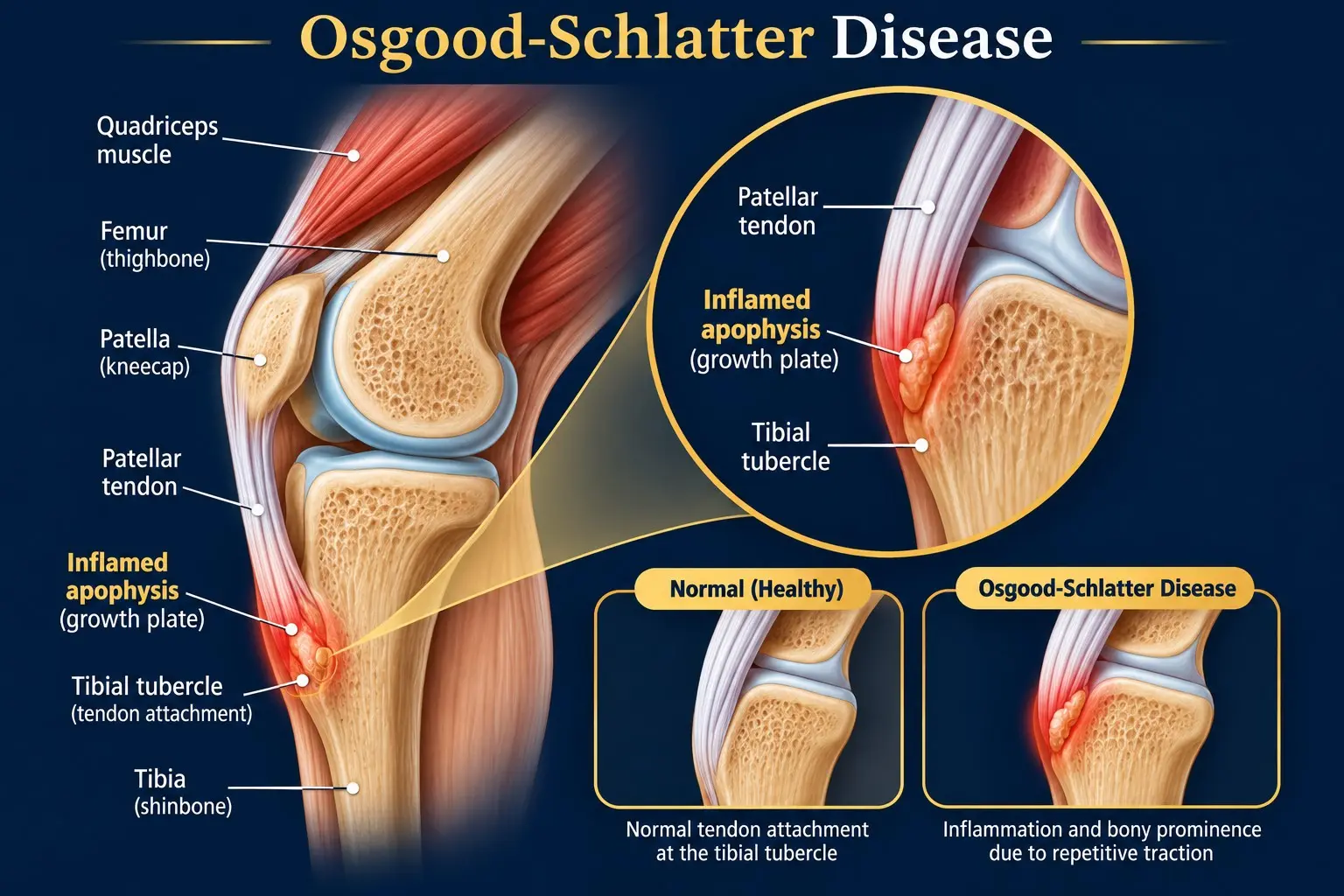
Osgood-Schlatter disease develops when repeated tension from the patellar tendon irritates the developing tibial tubercle. The patellar tendon connects the kneecap to the tibial tubercle, a bony prominence at the top of the shinbone. Repetitive pulling can irritate this developing growth area, causing pain, swelling, and sometimes a noticeable bony bump below the kneecap.
The main causes and contributing factors include:
Osgood-Schlatter disease usually develops through repeated mechanical stress during growth rather than a single traumatic event. These factors can work together, and not every adolescent who participates in high-impact sports develops the condition.
Several factors may increase the likelihood of developing Osgood-Schlatter disease:
These factors do not guarantee that someone will develop Osgood-Schlatter disease. Growth and repetitive physical stress both contribute to risk, and the condition can occur even in young athletes who train carefully.
Osgood-Schlatter disease commonly affects growing children and adolescents, particularly during growth spurts. Repeated pulling from the patellar tendon places stress on the developing tibial tubercle below the kneecap. Young athletes who participate in sports involving frequent running, jumping, kicking, and sudden changes in direction face a higher risk of developing symptoms.
The main risk groups include:
The condition has historically been reported more often in boys, although the difference may vary with sports participation. It can affect one or both knees, with both knees involved in approximately 20–30% of cases.
Growth and repetitive physical stress both contribute to the risk, but not every young athlete develops Osgood-Schlatter disease. The condition can also occur in adolescents who train carefully and allow adequate recovery between activities.
Osgood-Schlatter disease commonly causes pain, tenderness, and swelling over the bony bump below the kneecap. Symptoms develop around the tibial tubercle, where the patellar tendon attaches to the shinbone. They often worsen during or after physical activity and improve with rest, although the severity varies between individuals.
Common symptoms include:
Osgood-Schlatter disease can affect one or both knees. Symptoms may be mild and occur only during sports, or they may interfere with everyday activities. Their severity often depends on individual growth patterns, activity levels, and the degree of irritation around the tibial tubercle.
Doctors usually diagnose Osgood-Schlatter disease through the patient’s symptoms, activity history, and physical examination. The diagnosis primarily relies on clinical findings and a review of the patient's medical history and activity level. Most typical cases do not require laboratory tests or imaging.
Doctors assess the location of the pain, activities that trigger symptoms, and tenderness around the tibial tubercle, the bony prominence just below the kneecap. They also check for swelling, movement limitations, and other signs that may suggest a different condition. X-rays or other imaging tests may be recommended when symptoms are unusual, severe, or persistent, or when the diagnosis remains uncertain.
The doctor asks about the patient's symptoms, age, physical activities, and growth stage. Osgood-Schlatter disease most commonly affects active children and adolescents during growth spurts. The doctor may ask questions such as:
Gradually developing pain below the kneecap that worsens during physical activity often supports the diagnosis. The doctor also considers whether the patient's activity level involves repeated stress on the patellar tendon.
The doctor examines the knee to identify the source of pain and check for signs of other conditions.
The combination of localized tibial tubercle tenderness, characteristic activity-related pain, and a typical age and activity history usually helps the doctor establish the diagnosis.
Routine X-rays are not usually required when the symptoms and physical examination strongly suggest Osgood-Schlatter disease.
A doctor may order an X-ray when the pain is constant, severe, unusual, or not limited to the tibial tubercle. Imaging may also help when the diagnosis is uncertain or the doctor suspects a stress fracture, tibial tubercle fracture, infection, bone tumor, or another bone condition.
An X-ray may show fragmentation or irregularity around the tibial tubercle. These findings must be interpreted alongside the patient's symptoms and examination because normal developmental changes can sometimes produce similar appearances.
MRI and ultrasound are rarely needed for typical Osgood-Schlatter disease. Doctors may consider these tests when symptoms persist despite appropriate treatment, the diagnosis remains uncertain, or an associated injury or another condition is suspected.
The doctor selects additional imaging based on the patient's symptoms and examination findings. Advanced imaging is unnecessary for most straightforward cases.
The doctor considers alternative diagnoses when the symptoms do not match the typical pattern of Osgood-Schlatter disease.
Possible alternatives include:
Seek prompt medical assessment if knee pain begins suddenly and severely, the person cannot bear weight, the knee cannot be actively straightened, or fever occurs with a hot, swollen knee. These symptoms should not automatically be attributed to Osgood-Schlatter disease.
Treatment for Osgood-Schlatter disease focuses on reducing pain, managing symptoms, and maintaining strength and flexibility while the tibial tubercle matures. Most children and adolescents improve with conservative treatment, without surgery. The treatment plan depends on symptom severity, activity levels, and how much the condition affects daily activities and sports.
Physical therapy can help maintain flexibility, improve strength, and support a gradual return to physical activity. A physiotherapist can recommend exercises based on the patient's symptoms and functional ability.
Surgery is rarely necessary for children and adolescents with Osgood-Schlatter disease. Most cases improve as the tibial tubercle matures and the growth area becomes solid bone.
In uncommon cases, an orthopedic specialist may consider surgery for adults who have reached skeletal maturity but continue to experience pain from residual bone fragments, known as ossicles, or a prominent tibial tubercle. Surgery is generally considered only when appropriate non-surgical treatment has not provided sufficient relief.
A persistent bony bump does not automatically mean surgery is necessary. The decision depends on whether the bump causes ongoing pain or functional limitations and whether other treatments have failed.
Osgood-Schlatter disease symptoms often improve as the tibial tubercle matures, although recovery time varies. Symptoms may last for several months and can persist for 12–24 months or longer in some adolescents. Most cases improve as the growth area below the kneecap matures and the bones reach skeletal maturity.
Daily pain and activity-related flare-ups may improve within several weeks to a few months with appropriate activity modification and rehabilitation. However, symptom improvement does not necessarily mean the underlying growth-related process has finished.
Most cases become inactive once the tibial tubercle growth area matures and closes. A firm bony bump below the kneecap may remain even after the pain resolves, and kneeling directly on it can still cause discomfort in some people.
There is no fixed recovery timeline for everyone. Growth stage, symptom severity, sports participation, and response to treatment all influence how long symptoms last. A gradual return to demanding activities should depend on pain and functional improvement rather than a specific deadline.
The long-term outlook for Osgood-Schlatter disease is generally favorable. Symptoms usually improve as the adolescent growth spurt ends and the tibial tubercle matures. Most people eventually return to their usual activities without lasting disability. However, some individuals continue to experience knee pain or tenderness after reaching skeletal maturity.
The possible long-term outcomes include:
Most people recover without lasting disability, but persistent symptoms can occur. A remaining bony bump is different from active disease because the bump may remain after pain and swelling have resolved. Adults who experience ongoing pain or functional limitations should seek medical assessment. Surgery is rarely necessary and may be considered for selected adults whose symptoms persist despite appropriate non-surgical treatment.
Osgood-Schlatter disease cannot always be prevented because growth spurts and individual physical factors contribute to its development. However, healthy training habits and appropriate activity management can help reduce repetitive stress on the developing tibial tubercle and minimize symptom flare-ups. These measures are particularly useful for children and adolescents who participate in sports involving frequent running and jumping.
Practical strategies include:
These measures may help reduce symptom flare-ups and manage repetitive stress, but they cannot guarantee prevention. Normal growth and individual development also influence the likelihood of developing Osgood-Schlatter disease.
Yes, a bony bump below the kneecap may remain after Osgood-Schlatter symptoms resolve. This prominence can persist into adulthood and does not necessarily indicate active inflammation or ongoing disease.
Yes, Osgood-Schlatter disease can affect one or both knees. When both knees are involved, pain and swelling may vary between sides.
Yes, many people can walk normally when symptoms are mild. Severe pain, limping, or difficulty bearing weight requires medical assessment to rule out other conditions.
Yes, some adolescents can continue playing sports with activity modifications. Reduce activities that cause significant pain and return to full training gradually as symptoms and function improve.
Yes, adults can experience persistent pain related to Osgood-Schlatter disease after skeletal maturity. A residual bone fragment or prominent tibial tubercle may cause discomfort, particularly when kneeling or exercising. Persistent symptoms warrant an orthopedic assessment.