
Specialties › Knee & Leg › Knee Arthritis

Knee arthritis is a common joint condition that causes pain, stiffness, and swelling. It affects the tissues inside the knee joint, including the cartilage that helps bones move smoothly against each other. The condition can develop gradually with age, follow a previous knee injury, or result from an inflammatory disease.
This article explains the main types, causes, symptoms, and treatment options for knee arthritis. It also covers how doctors diagnose the condition, lifestyle changes, helpful exercises, medications, knee replacement surgery, recovery timelines, and ways to slow disease progression. You will also learn when to see a doctor and find answers to common questions.
Book a consultation and receive expert orthopedic guidance.
Knee arthritis affects the tissues inside the knee joint. It can involve the breakdown of cartilage, inflammation of the joint lining, or changes in the underlying bone. These changes may cause pain, stiffness, swelling, and difficulty moving the knee.
Osteoarthritis is the most common type. Other forms include rheumatoid arthritis, psoriatic arthritis, gout, and post-traumatic arthritis. Each type develops differently and may require a different treatment approach.
The symptoms depend on the type of arthritis and how severely the joint is affected. Some people experience mild discomfort, while others develop persistent pain and difficulty with everyday activities.
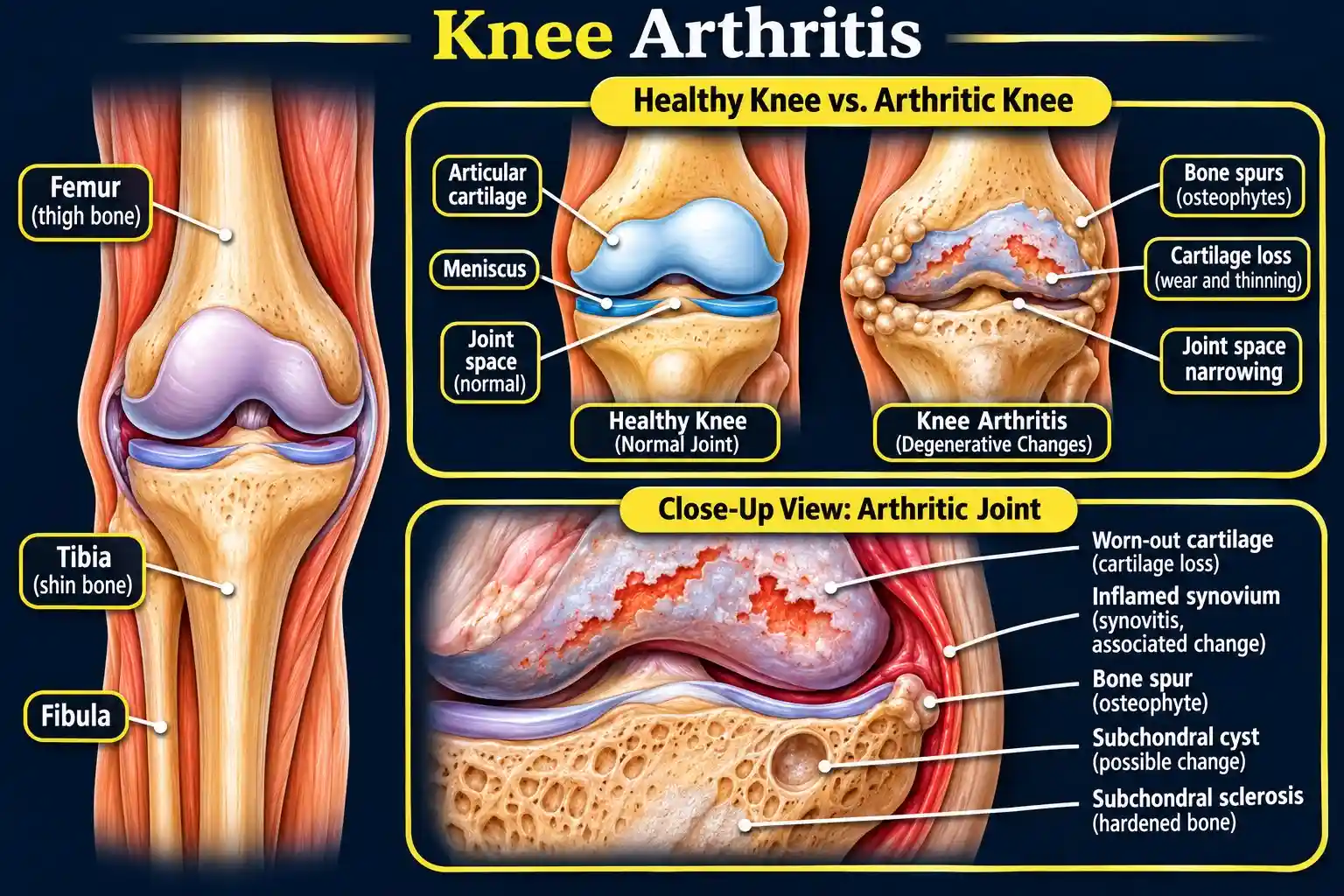
The knee is the largest joint in the human body. It functions primarily as a modified hinge joint, allowing the leg to bend and straighten. It also permits a small amount of rotation during certain movements.
Several bones, cartilage structures, ligaments, and soft tissues work together to support body weight and maintain joint stability.
The knee contains several structures that support movement and joint function:
The femur, tibia, and patella form the knee's bony framework. Articular cartilage and synovial fluid help the joint surfaces move smoothly. The menisci distribute pressure, while ligaments maintain stability during movement.
These structures allow the knee to support body weight while performing activities such as walking, bending, climbing stairs, and standing. Damage or inflammation affecting them can interfere with normal joint function.
Several forms of arthritis can affect the knee joint. They differ in their underlying causes and how they affect joint tissues. The main types include:
The main difference is how each condition develops. Osteoarthritis involves gradual changes in joint cartilage and other tissues. Rheumatoid and psoriatic arthritis involve immune system-related inflammation. Post-traumatic arthritis follows joint injury, while gout and pseudogout result from crystal deposits.
Identifying the specific type helps doctors determine the most appropriate treatment.
Knee arthritis can develop through several different processes. Some affect the joint gradually, while others involve inflammation or damage following an injury.
Common contributing factors include:
The underlying cause varies according to the type of knee arthritis. Identifying it helps doctors determine which treatment approach is most appropriate.
Knee arthritis can cause several symptoms that affect joint movement and everyday activities. The symptoms may develop gradually or appear during flare-ups, depending on the type of arthritis and the extent of joint involvement.
Common symptoms include:
Knee arthritis pain often feels like a deep, dull ache in or around the knee joint. Its pattern can vary depending on the type and severity of arthritis.
Common pain patterns include:
Inflammatory arthritis, such as rheumatoid or psoriatic arthritis, may cause prolonged morning stiffness, warmth, and swelling. It can also affect multiple joints.
Knee pain alone cannot confirm arthritis. Other conditions, including meniscus injuries, ligament problems, tendinitis, and bursitis, can cause similar discomfort. A proper medical assessment helps identify the underlying cause.
Doctors diagnose knee arthritis by reviewing your symptoms, examining the knee, and using imaging or laboratory tests when needed. The evaluation helps identify the type of arthritis and determine whether another condition may be causing your symptoms.
Your doctor will ask about your symptoms, when they started, and how they affect your daily activities. They may ask about:
The pattern and duration of your symptoms can provide clues about the type of arthritis. For example, osteoarthritis often causes activity-related pain and brief stiffness after rest. Inflammatory arthritis may cause prolonged morning stiffness and joint swelling.
Your doctor will examine the affected knee and may compare it with the other knee. The examination may include:
Your doctor may recommend imaging or laboratory tests based on your symptoms and examination findings. Each test provides different information about the knee joint.
Doctors do not need every test to diagnose knee arthritis. Medical history, physical examination, and X-rays are often sufficient to diagnose knee osteoarthritis. Suspected inflammatory arthritis, crystal-related disease, or joint infection may require additional tests.
An accurate diagnosis helps your doctor identify the underlying condition and choose an appropriate treatment plan.
Knee arthritis treatment aims to relieve pain, maintain joint movement, and improve your ability to perform daily activities. The appropriate approach depends on the type of arthritis, symptom severity, joint damage, overall health, and personal goals.
Doctors usually begin with nonsurgical treatments. These approaches help many people manage their symptoms. Surgery may be considered when other treatments no longer provide sufficient relief.
Daily habits can help reduce stress on the knee and make movement more comfortable. Your doctor may recommend:
Regular exercise helps strengthen the muscles around the knee, maintain flexibility, and support joint function. A physical therapist can develop an exercise program based on your symptoms and physical abilities.
Common options include:
Start gradually and adjust the exercise intensity to your comfort level. Modify an activity if it causes sharp pain or significantly increases swelling.
Doctors may recommend medications to control pain and inflammation. The choice depends on your medical history, other medications, and symptom severity.
Common options include:
Do not use pain medications regularly without medical guidance. Supplements such as glucosamine, turmeric, and Boswellia have limited or inconsistent evidence. Discuss their potential benefits and risks with your doctor.
Doctors may consider joint injections when exercise, lifestyle changes, and medications do not provide sufficient relief. The choice depends on your arthritis type and individual circumstances.
Common injection options include:
These treatments do not restore lost cartilage or cure arthritis. Your doctor can assess whether an injection is appropriate for your condition.
Doctors may recommend an orthopedic surgical assessment when knee pain remains severe despite appropriate nonsurgical treatment. Surgery may become an option when arthritis significantly affects daily activities and joint function.
Possible procedures include:
Knee arthroscopy is not routinely recommended for uncomplicated knee osteoarthritis. Research generally shows that it does not provide lasting benefits for arthritis-related pain.
Some forms of knee arthritis require treatment that addresses the underlying disease, rather than pain alone.
The best treatment plan depends on your arthritis type, symptoms, joint function, and personal goals. Many people manage knee arthritis without surgery through appropriate medical care and nonsurgical treatments. Surgery may be considered when these approaches no longer provide enough relief.
Small changes to your daily routine can make knee arthritis easier to manage. Focus on habits that reduce unnecessary joint stress, support general health, and help you remain active.
These habits can support long-term symptom management and make daily activities more comfortable. They work best alongside an appropriate medical and exercise plan.
The best exercises for knee arthritis combine muscle strengthening, gentle joint movements, and low-impact aerobic activities. These exercises help maintain mobility, improve muscle support, and make everyday movements easier.
These exercises target the muscles that support your knee and help maintain comfortable joint movement.
These activities improve cardiovascular fitness while placing relatively little impact on your knee joints.
Follow these guidelines to make your exercise routine safer and more comfortable:
Choose activities you can perform comfortably and consistently. A suitable exercise routine can help maintain strength, mobility, and independence over time.
Medications can help reduce knee arthritis pain and make daily activities more comfortable. Your doctor will choose an option based on your symptoms, medical history, other medications, and potential side effects.
Some medications may not be suitable for everyone. For example, oral NSAIDs can pose additional risks for people with kidney disease, stomach ulcers, cardiovascular conditions, or those taking blood-thinning medicines.
Always consult your doctor or pharmacist before starting, combining, or regularly using pain-relieving medicines. They can help you understand possible interactions, side effects, and suitable treatment options.
Medications can help control symptoms, but they do not restore cartilage already lost through arthritis. They are often used alongside exercise, physical therapy, and other recommended treatments.
Knee replacement surgery may be considered when arthritis causes persistent pain and limits daily activities despite appropriate nonsurgical treatment. The decision depends on how much your symptoms affect your quality of life and whether other treatments provide sufficient relief.
An orthopedic surgeon evaluates your symptoms, physical function, overall health, and imaging results before recommending surgery.
Your doctor may discuss knee replacement if you experience the following problems:
An orthopedic surgeon considers several factors before recommending surgery:
Surgical assessment does not automatically mean you need knee replacement. The decision should reflect your symptoms, overall health, personal goals, and clinical findings. Some people with advanced X-ray changes manage their condition without surgery, while others experience substantial limitations that justify considering an operation.
Recovery time depends on the treatment, severity of arthritis, overall health, and individual response. Some treatments provide relief within hours or days, while others require several weeks or months to show noticeable improvements.
Nonsurgical treatments generally focus on controlling symptoms and maintaining joint function. Knee replacement involves a longer recovery period with structured rehabilitation.
Different nonsurgical treatments have different recovery and response times:
Recovery after partial or total knee replacement generally takes several months. Rehabilitation begins soon after surgery and gradually improves knee movement, muscle strength, and daily function.
The following timeline provides a general overview of recovery after knee replacement:
| Recovery stage | Typical progress |
|---|---|
| First 2 weeks | You begin walking with assistance and start basic rehabilitation exercises. Swelling and discomfort are common during this period. |
| Weeks 3–6 | Walking, knee movement, and daily independence gradually improve. Some people transition from a walker to a cane. Returning to desk-based work may be possible within this period, depending on recovery and medical advice. |
| Weeks 6–12 | You gradually resume everyday activities, such as shopping and household tasks. Low-impact exercise increases according to rehabilitation progress. Driving may be possible once your surgeon confirms that you can control the vehicle safely. |
| 3–4 months | Many people experience substantial improvements in muscle strength, knee movement, and daily function. |
| 6–12 months | Strength, comfort, and mobility may continue to improve. Some people still experience occasional swelling or stiffness. |
These timeframes are general estimates, not guaranteed recovery milestones. Partial and total knee replacements can involve different recovery experiences. Your progress depends on the procedure, rehabilitation, and overall health.
Follow your surgeon's and physical therapist's instructions throughout recovery. Avoid rushing back into demanding activities before your knee is ready.
Knee arthritis cannot always be prevented, particularly when age, genetics, or previous injuries contribute to its development. Some risk factors are beyond your control, but certain measures may reduce the likelihood of developing osteoarthritis or help manage an existing condition.
You cannot eliminate every risk factor for knee arthritis. Aging, family history, and biological sex can influence the likelihood of developing osteoarthritis. Women also have a higher risk, particularly after menopause.
You can address some modifiable factors:
If you already have knee osteoarthritis, appropriate management may help control symptoms and preserve joint function. These measures cannot reverse established cartilage damage.
No single measure can guarantee that knee arthritis will not develop or progress. A consistent management plan can help control symptoms, maintain mobility, and support long-term joint function.
You should see a doctor when knee pain persists, interferes with daily activities, or does not improve with appropriate home care. Medical assessment can help identify the underlying cause and determine whether you need further treatment.
Arrange a medical appointment if you experience any of the following:
Some knee problems require urgent medical evaluation. Seek immediate care if you experience:
The appropriate specialist depends on your symptoms and their suspected cause.
Persistent or worsening knee pain deserves medical attention. Not all knee pain is caused by arthritis, so an accurate diagnosis is essential before choosing a treatment plan.
No. Knee pain can result from several conditions, including meniscus tears, ligament injuries, tendinitis, bursitis, and joint infections. Arthritis is one possible cause, but a proper medical assessment helps identify the underlying problem.
No. Knee arthritis does not progress at the same rate in everyone. Some people experience gradual changes, while others have long periods with stable symptoms. Appropriate management can help maintain mobility and physical function.
Yes. Some people have signs of knee osteoarthritis on X-rays without noticeable pain or stiffness. Imaging findings do not always match symptoms, so doctors consider clinical examination and your symptoms when assessing the condition.
Yes. Knee arthritis can affect both knees, although one knee may be more severely affected. Previous injuries, joint alignment, and individual differences can influence how the condition develops in each knee.
Not necessarily. Age alone does not determine whether someone can undergo knee replacement surgery. Doctors consider pain severity, joint damage, mobility, general health, and how much symptoms affect daily activities.
Yes. Physical therapy can improve muscle strength, flexibility, balance, and joint movement. A physical therapist can also develop an exercise program that matches your symptoms, physical abilities, and treatment goals.
Yes. Walking is generally a suitable low-impact activity for people with knee arthritis. Start with a comfortable distance and gradually increase your walking time. Adjust the activity if it causes significant or persistent discomfort.
Knee arthritis may lead to persistent pain, stiffness, reduced mobility, and increasing difficulty with daily activities. The effects vary depending on the arthritis type and severity. Appropriate management can help control symptoms and maintain joint function.
Yes. Certain injections may provide temporary symptom relief. Corticosteroid injections can reduce inflammation and pain in some patients. Hyaluronic acid and PRP injections have less consistent evidence of benefit, so discuss their suitability with your doctor.