
Specialties › Knee & Leg › Total Knee Replacement Surgery

Total knee replacement surgery is one of the most effective treatments for advanced knee arthritis and severe joint damage. It helps relieve chronic pain, restore knee function, and improve mobility when non-surgical treatments no longer provide enough relief. Each year, millions of people undergo this procedure to regain independence and return to everyday activities with greater comfort.
This guide explains everything you need to know about total knee replacement surgery, including who may need it, when doctors recommend it, how the procedure is performed, available surgical options, expected benefits, possible risks, recovery milestones, rehabilitation exercises, implant lifespan, and practical ways to protect your new knee. It also answers common questions to help you understand what to expect before, during, and after surgery, so you can make informed decisions about your treatment.
Book a consultation and receive expert orthopedic guidance.
Total knee replacement surgery, also called total knee arthroplasty (TKA), is a procedure that replaces damaged cartilage and a small amount of worn bone in the knee with artificial components called prosthetic implants. Doctors recommend this surgery to relieve chronic pain, improve knee function, and restore mobility when non-surgical treatments no longer provide enough relief.
During the procedure, the surgeon reshapes the damaged surfaces of the femur (thighbone), tibia (shinbone), and sometimes the patella (kneecap). These surfaces are then covered with metal and medical-grade plastic components that create a smooth, low-friction joint.
The prosthetic knee is designed to restore stability, distribute body weight evenly, and improve natural knee movement. While an artificial joint cannot fully match a healthy knee, modern implants can provide excellent pain relief and long-lasting function. Many people return to walking, climbing stairs, low-impact exercise, and other everyday activities with greater comfort after rehabilitation.
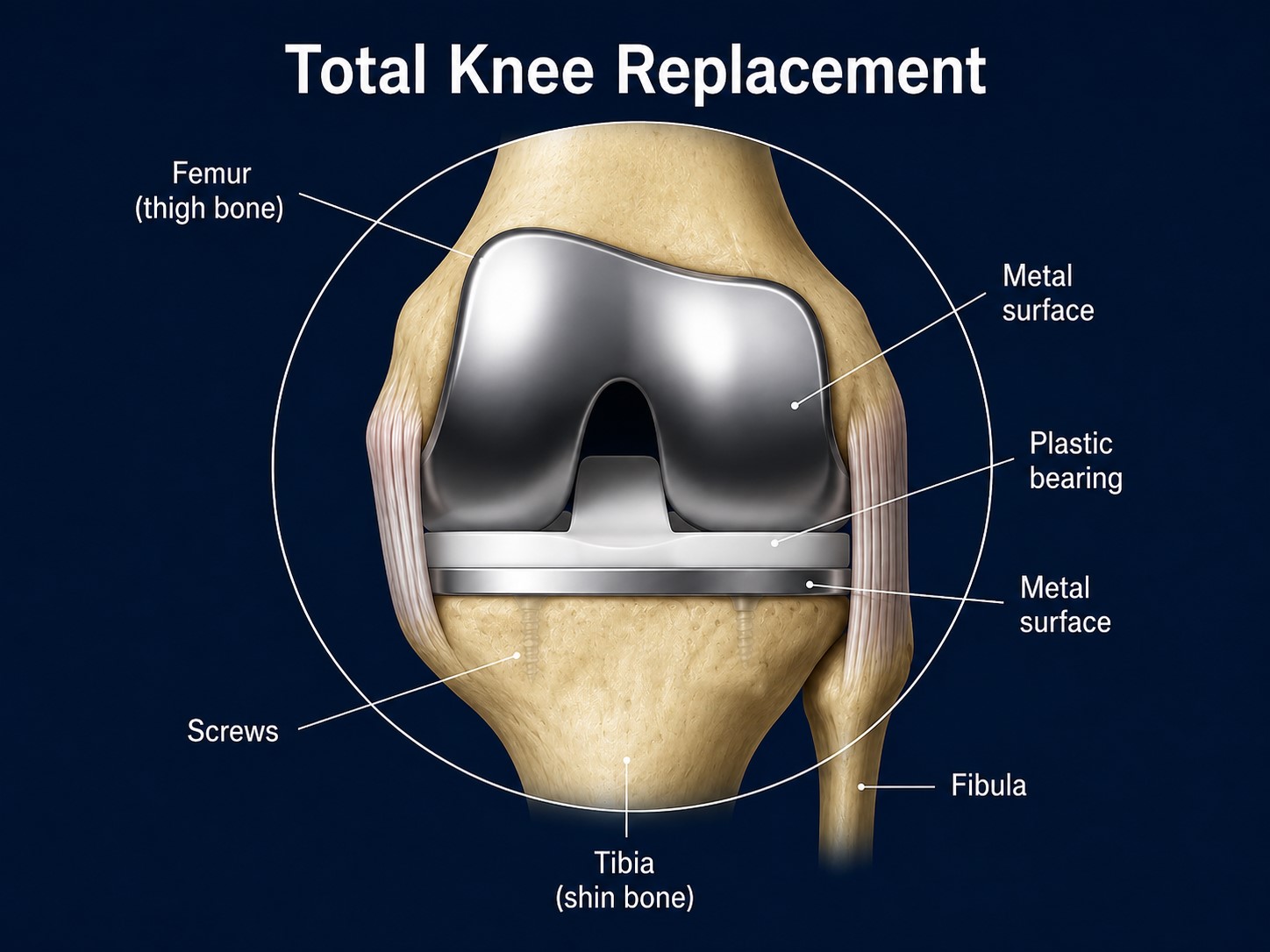
Total knee replacement surgery may be recommended for people with severe knee pain, advanced joint damage, and reduced mobility that no longer improve with non-surgical treatment. The goal is to relieve pain, restore knee function, and help people return to daily activities with greater comfort and confidence. The most common conditions requiring knee replacement are listed below.
Your orthopedic surgeon will review your symptoms, physical examination findings, medical history, imaging studies, and previous treatments before recommending surgery. The decision is based on how much the damaged knee affects your daily life and whether knee replacement is likely to provide lasting improvement, rather than on your age alone.
Doctors usually recommend total knee replacement when severe knee joint damage causes ongoing pain, limits daily activities, and reduces quality of life despite appropriate non-surgical treatment. The decision is based on a combination of your symptoms, physical examination, imaging findings, and how much the condition affects your everyday life. In most cases, age alone does not determine whether you need surgery.
Total knee replacement is commonly recommended in the following situations:
Most orthopedic surgeons recommend exhausting appropriate non-surgical options before considering total knee replacement. When these treatments no longer control pain or restore function, surgery can offer lasting pain relief, improve mobility, correct deformity, and help you return to a more active and independent lifestyle.
Proper preparation before knee replacement surgery includes a complete medical evaluation, reviewing your medications, preparing your home, and understanding the recovery process. Taking these steps before surgery can reduce the risk of complications, support a smoother recovery, and improve the long-term success of your new knee. The following steps help prepare for surgery.
Preparing both your body and your home before surgery can make a meaningful difference in your recovery. A well-planned approach helps you regain mobility more confidently, reduces potential setbacks, and supports the long-term success of your knee replacement.
During total knee replacement surgery, the orthopedic surgeon removes the damaged cartilage and a small amount of worn bone from the knee joint and replaces them with artificial implants. The procedure is carefully planned to restore smooth joint movement, improve stability, and relieve pain. It is performed under sterile conditions and usually takes about 1 to 2 hours, although the exact time may vary depending on the complexity of the surgery. The main stages of total knee replacement surgery are outlined below.
After surgery, you are moved to a recovery area where your healthcare team monitors your blood pressure, heart rate, breathing, and pain levels. Most people begin standing and walking with assistance within 24 hours, and physical therapy usually starts on the same day or the following day. Early movement helps improve circulation, reduces the risk of complications, and begins the rehabilitation process that supports a successful recovery.
Different types of knee replacement procedures include surgeries that vary in the amount of the knee joint replaced, the fixation method used, and the surgical technique. Your orthopedic surgeon recommends the most appropriate option based on the extent of joint damage, the condition of your ligaments and bones, your activity level, and your overall health.
Your surgeon will recommend the most appropriate type of knee replacement after evaluating your symptoms, imaging studies, knee stability, bone quality, and treatment goals. Choosing the right procedure helps improve pain relief, restore function, and support the long-term success of your new knee.
Total knee replacement surgery offers several important benefits for people with advanced knee arthritis or severe joint damage. By replacing worn joint surfaces with artificial implants, the procedure can reduce pain, improve knee function, and help many people return to a more active and independent lifestyle. While every recovery is different, most patients experience meaningful improvements after completing rehabilitation. The major benefits of knee replacement surgery include:
Although total knee replacement cannot restore a knee to its original condition, it can provide lasting pain relief and meaningful improvements in mobility and function. Following your rehabilitation program, maintaining a healthy weight, and staying active with low-impact exercise can help you achieve the best possible long-term outcome.
Although total knee replacement is one of the most successful orthopedic procedures, every surgery carries some risk. Most people recover without serious complications, especially when the operation is performed by an experienced orthopedic surgeon and followed by a structured rehabilitation program. Understanding the possible risks can help you recognize warning signs early and take an active role in your recovery. Possible complications of total knee replacement surgery are listed below.
Most complications are uncommon and can often be prevented or managed with careful surgical planning, preventive medications, early mobilization, and regular follow-up care. Following your surgeon's instructions, attending physical therapy sessions, and reporting unusual symptoms without delay can significantly improve your chances of a safe recovery and a successful long-term outcome.
Recovery after total knee replacement usually occurs in stages, with each stage focusing on healing, restoring movement, rebuilding strength, and returning to everyday activities. Most people notice steady improvement during the first few months, although full recovery can take 6 to 12 months. Your progress depends on factors such as your overall health, age, muscle strength before surgery, and commitment to rehabilitation.
The recovery timeline below provides a general idea of what you can expect after surgery.
| Recovery Stage | Typical Timeline | What to Expect |
|---|---|---|
| Hospital stay | 1–3 days | Most patients stand and begin walking with a walker or crutches within 24 hours. Physical therapy usually starts on the day of surgery or the following day. |
| Early recovery | Weeks 1–2 | Pain and swelling gradually decrease. You will continue using walking aids while focusing on gentle exercises to improve knee motion, strengthen the muscles, and increase walking distance. |
| Functional recovery | Weeks 2–6 | Walking becomes more comfortable, and many people progress from a walker to a cane. Daily activities such as dressing, preparing meals, and moving around the house become easier. |
| Return to routine activities | Weeks 6–12 | Most patients regain greater independence, improve muscle strength, and return to low-impact activities. Many people with office-based jobs can return to work during this period, depending on their recovery. |
| Advanced recovery | 3–6 months | Knee strength, flexibility, and endurance continue to improve. Many people comfortably resume activities such as walking, cycling, swimming, and golf after receiving their surgeon's approval. |
| Full recovery | 6–12 months | Healing continues as swelling gradually resolves, scar tissue matures, and the knee adapts to the artificial joint. Most people achieve their maximum improvement in mobility, strength, and function during this stage. |
Your rehabilitation program plays a major role in determining how well and how quickly you recover. Attending physical therapy sessions, performing your prescribed home exercises, and increasing activity gradually help restore knee function and reduce the risk of stiffness or weakness.
Recovery is different for everyone, so it is important not to compare your progress with someone else's. Following your surgeon's recommendations, maintaining a healthy lifestyle, and staying consistent with rehabilitation can help you achieve the best possible long-term outcome after total knee replacement surgery.
Rehabilitation exercises help restore knee movement, rebuild muscle strength, reduce stiffness, and improve balance after total knee replacement surgery. Most patients begin a supervised physical therapy program within 24 hours of surgery, followed by a home exercise routine that progresses as healing continues. Performing these exercises consistently is one of the most important factors in achieving a successful recovery. The following exercises are commonly recommended during recovery.
As your recovery progresses, your physical therapist may introduce additional exercises such as balance training, resistance exercises, and low-impact aerobic activities like swimming or elliptical training. Each stage of rehabilitation is designed to match your healing progress, so it is important to increase activity gradually rather than too quickly.
Always perform rehabilitation exercises exactly as instructed by your surgeon or physical therapist. Exercising regularly while avoiding overexertion can improve flexibility, strengthen the muscles around your knee, and help you return to everyday activities with greater confidence and stability.
Modern knee implants generally last 15 to 20 years, and many continue to function well for 20 to 25 years or longer. Improvements in implant materials, surgical techniques, and rehabilitation have increased the long-term success of total knee replacement surgery. While no artificial joint lasts forever, most people enjoy many years of pain relief, improved mobility, and better quality of life after the procedure.
The lifespan of a knee replacement varies from person to person. Several factors influence how long an artificial knee continues to perform well.
Long-term research has shown excellent durability for modern knee replacements.
| Time After Surgery | Implants Still Functioning Well |
|---|---|
| 15 years | More than 90% |
| 20 years | Approximately 80–90% |
| 25 years or longer | Many modern implants continue to perform successfully, depending on patient-related factors. |
Although most knee replacements last for decades, some eventually require revision knee replacement surgery. This may become necessary if the implant wears out, loosens, becomes infected, or no longer functions properly. Revision surgery is less common than primary knee replacement, but it remains an effective option when problems develop.
You can help maximize the lifespan of your knee replacement by maintaining a healthy weight, staying active with low-impact exercise, avoiding repetitive high-impact activities, completing your rehabilitation program, and attending regular follow-up appointments with your orthopedic surgeon. These habits support long-term joint function and help protect your new knee for many years.
Protecting your new knee involves following your rehabilitation plan, staying active with appropriate exercise, maintaining a healthy weight, and adopting habits that reduce stress on the artificial joint. While modern knee implants are designed to last for many years, your daily choices play an important role in preserving their function and supporting long-term success.
Here are some practical ways to care for your new knee after surgery:
Protecting your knee replacement is a lifelong commitment. Following your surgeon's recommendations, exercising consistently, and making healthy lifestyle choices can help preserve the implant, maintain comfortable movement, and support an active, independent life for many years.
Yes, many people can kneel after a total knee replacement once the knee has fully healed. Kneeling may feel uncomfortable because of scar sensitivity or numbness, but it usually does not harm the implant. Your surgeon or physical therapist can advise when it is safe to begin.
Most people can return to driving within 4 to 6 weeks, depending on which knee was operated on, pain control, muscle strength, and reaction time. You should only drive after your surgeon confirms that you can safely control the vehicle.
Yes, you can usually travel by air after knee replacement surgery, but the timing depends on your recovery and overall health. During long flights, walk periodically, perform ankle exercises, stay hydrated, and follow your doctor's advice to reduce the risk of blood clots.
You should avoid high-impact activities such as running, jumping, and contact sports because they can increase implant wear. Low-impact exercises like walking, swimming, cycling, and golf are generally safer choices for protecting your new knee.
It may. Knee implants contain metal components that can trigger airport security scanners. Inform the security officer that you have a knee replacement. Medical implant cards are usually not required, as airport screening procedures are designed to manage these situations.
Yes, many people can sleep on their side after surgery once it is comfortable to do so. During the early recovery period, placing a pillow between your knees may improve comfort and help maintain proper leg alignment.
You can reduce swelling by elevating your leg, applying ice packs, wearing compression stockings if recommended, and performing your prescribed exercises. Gentle walking and regular movement also help improve circulation during recovery.
Contact your surgeon if you develop a fever, increasing redness, warmth, drainage from the incision, severe swelling, worsening pain, calf pain, chest pain, or sudden shortness of breath. These symptoms may require prompt medical evaluation.

We use cookies to improve your experience on our site. By using our site, you consent to cookies.
Manage your cookie preferences below:
Essential cookies enable basic functions and are necessary for the proper function of the website.