
Specialties › Knee & Leg › Quadriceps Tendon Tear

A quadriceps tendon tear is a serious knee injury that affects the tendon connecting the quadriceps muscles to the kneecap. It can occur after a sudden fall, forceful muscle contraction, or awkward landing during sports. The injury may also develop when the tendon weakens over time due to aging or underlying medical conditions.
This article explains what a quadriceps tendon tear is and what causes it. You will learn about its different types, common symptoms, how doctors diagnose the injury, and the available treatment options. We also cover when surgery may be necessary, how doctors perform quadriceps tendon repair, recovery timelines, possible complications, ways to reduce your risk of injury, and answers to common patient questions.
Book a consultation and receive expert orthopedic guidance.
A quadriceps tendon tear occurs when the tendon connecting the quadriceps muscles to the kneecap becomes partially or completely torn. This tendon helps straighten the knee and supports everyday movements, including walking, climbing stairs, and standing up from a seated position.
A tear can cause pain, swelling, and bruising above the kneecap. Severe tears may disrupt the knee’s extensor mechanism, making it difficult or impossible to straighten the knee actively.
A quadriceps tendon tear can range from a partial tear, in which some tendon fibers remain intact, to a complete rupture that separates the tendon entirely. Treatment depends on the severity of the tear and whether normal knee extension remains possible.
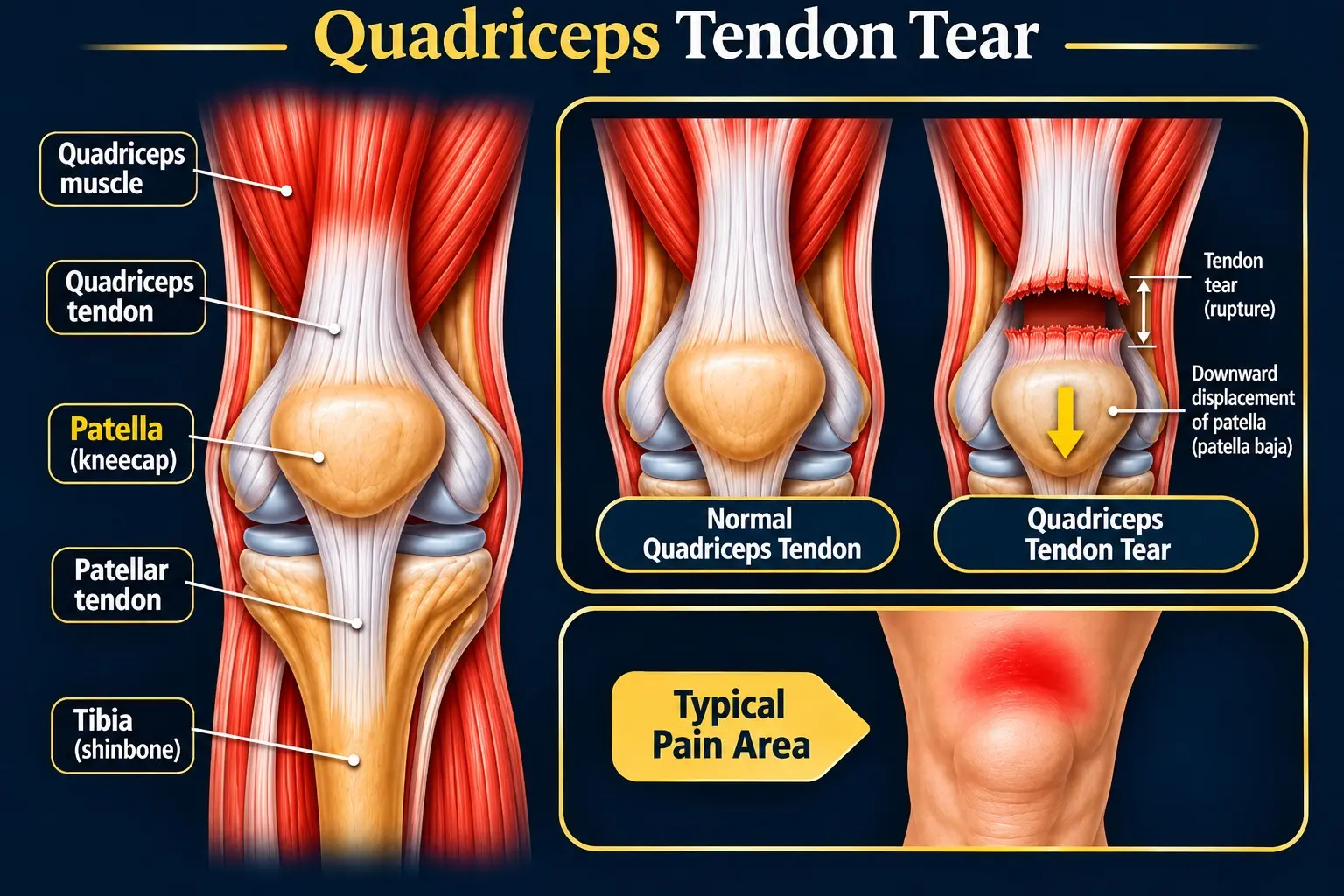
A quadriceps tendon tear can occur when excessive force places more stress on the tendon than it can withstand. It often happens when the quadriceps muscles contract forcefully while the knee bends.
Common causes include:
A quadriceps tendon tear can affect anyone, but certain factors increase the likelihood of this injury. Men over age 40, particularly adults between 50 and 60, have a higher risk, partly because tendon strength and tissue quality can decline with age.
Risk Factors for a Quadriceps Tendon Tear
Having these risk factors does not mean you will develop a quadriceps tendon tear. Managing underlying health conditions and discussing medication-related risks with your healthcare professional may help protect tendon health.
Quadriceps tendon tears are classified by the extent of tendon damage, the location of the tear, and the time since injury. These factors help doctors assess tendon function and determine the appropriate treatment.
1. Classification by Extent of Tear
2. Classification by Location
3. Classification by Duration
These classifications can overlap. Doctors consider the extent and location of the tear, time since injury, knee-extension function, and overall health when planning treatment.
A quadriceps tendon tear can cause sudden pain above the kneecap, swelling, bruising, and difficulty straightening the knee. Symptoms often begin immediately after a fall, awkward landing, or forceful muscle contraction. Their severity depends on the extent of the tear.
Common Symptoms of a Quadriceps Tendon Tear
Symptoms vary from person to person. If you experience sudden knee pain with swelling or difficulty straightening your leg, seek prompt medical assessment to determine the extent of the injury.
A quadriceps tendon tear often feels like a sudden pop or sharp pain just above the kneecap. Swelling, weakness, and difficulty straightening the knee may follow. The exact sensations depend on the severity of the injury.
Not everyone experiences the same symptoms. Partial tears may cause pain and weakness while preserving some knee movement. A medical examination is needed to determine whether the tendon is torn and how severely it is damaged.
Doctors diagnose a quadriceps tendon tear using your injury history, a physical examination, and imaging tests when needed. These assessments help determine the tear's severity and how well your knee can straighten.
How Doctors Diagnose a Quadriceps Tendon Tear
Your doctor selects imaging tests based on the examination findings and suspected injury. Early diagnosis helps guide appropriate treatment and supports the recovery of knee strength and function.
Treatment for a quadriceps tendon tear depends on the severity of the injury and how well you can straighten your knee. Small partial tears may respond to nonsurgical treatment, while complete tears usually require surgical repair.
Nonsurgical treatment is typically used for small partial tears when the knee's extensor mechanism remains intact and knee extension is adequate.
Not every partial tear requires the same treatment. Larger partial tears or injuries that cause persistent weakness may need surgical evaluation.
Surgery is generally recommended for complete quadriceps tendon ruptures, severe partial tears with substantial functional loss, or injuries that prevent adequate knee extension.
Doctors consider the extent of the tear, knee-extension ability, tendon quality, activity level, and overall health. An orthopedic specialist can assess these factors and recommend the most appropriate treatment for your injury.
Quadriceps tendon repair surgery reconnects the torn tendon to the kneecap (patella) to restore the knee's ability to straighten. The surgeon uses strong sutures and selects a repair technique based on the tear's location, severity, and tendon quality.
The knee is usually protected in a brace that keeps it straight during the initial healing period. Your surgeon will determine when to begin controlled knee movement and physical therapy. Rehabilitation gradually restores knee flexibility, quadriceps strength, and everyday function.
The surgical technique and rehabilitation plan vary according to the injury, tendon quality, and individual healing progress.
Recovery from a quadriceps tendon tear depends on the injury's severity, treatment approach, and rehabilitation progress. Recovery after surgical repair typically takes 6 to 12 months, although some patients need longer to regain strength and function. Partial tears treated without surgery may recover sooner, depending on tendon damage and knee function.
Recovery after surgical repair progresses through several stages. The following timeline provides general estimates, but your surgeon may adjust it according to tendon healing and knee function.
| Recovery Stage | Typical Timeline | Main Goals |
|---|---|---|
| Initial Protection | Weeks 1–2 | Protect the repair, manage pain and swelling, and use crutches as directed. |
| Early Healing and Movement | Weeks 2–6 | Protect the tendon and introduce controlled knee movement when permitted. |
| Progressive Mobility and Strengthening | Weeks 6–12 | Improve knee movement, activate the quadriceps, and gradually progress exercises. |
| Functional Strengthening | Months 3–6 | Build muscle strength, improve balance, and restore everyday activities. |
| Advanced Recovery | Months 6–12 or longer | Regain strength and control for demanding activities and return to sports when cleared. |
These stages may overlap, and recovery varies between patients. Follow your surgeon's rehabilitation plan to protect the healing tendon.
Several factors influence how quickly you recover from a quadriceps tendon tear:
You can gradually resume daily activities as pain decreases, knee movement improves, and quadriceps strength returns. Walking, climbing stairs, driving, and returning to work each require individual assessment.
High-impact sports and heavy physical work require greater strength and control. Your surgeon or physical therapist will assess your knee movement, strength, and functional progress before clearing you for these activities.
Follow your individualized recovery plan rather than a fixed deadline. Returning to strenuous activities too early can overload the healing tendon and increase the risk of reinjury.
A quadriceps tendon tear can cause persistent weakness, knee stiffness, reduced movement, and difficulty straightening the leg. Surgical repair also carries risks, including infection, blood clots, delayed healing, and re-rupture. Not every patient experiences complications, and recovery depends on the injury's severity, overall health, and rehabilitation progress.
Following your surgeon's instructions and rehabilitation plan can help protect the repair and support recovery. Seek prompt medical attention if you develop concerning symptoms, such as increasing redness around the incision, sudden worsening pain, or new calf swelling.
You can help reduce the risk of a quadriceps tendon tear by keeping your leg muscles strong, increasing physical activity gradually, and managing conditions that affect tendon health. These measures cannot prevent every injury, especially when age-related tendon changes or underlying medical conditions increase your risk.
These measures support tendon and knee health but cannot eliminate the risk of injury. If you have previous tendon problems or a medical condition that affects tendon strength, consult a healthcare professional for advice tailored to your needs.
A quadriceps strain affects the muscle or its fibers, while a quadriceps tendon tear damages the tendon connecting the thigh muscles to the kneecap. A tear may be partial or complete, and severe tears can significantly impair the ability to straighten the knee.
Yes, some people can walk with a quadriceps tendon tear, particularly if it is partial. Complete tears can make walking difficult or unsafe because the knee may buckle. Being able to walk does not rule out a serious injury, so prompt medical assessment is important.
Small partial tears may heal with bracing, activity modification, and physical therapy when knee-extension function remains intact. Complete tears usually require surgical repair to restore tendon continuity and knee function. A doctor must assess the injury to determine the appropriate treatment.
Seek prompt medical assessment if you experience sudden pain above the kneecap, significant swelling, or difficulty straightening your knee after an injury. Inability to lift the straight leg or suspected complete tendon rupture requires urgent evaluation because early treatment can improve the chances of restoring knee function.