
Specialties › Knee & Leg › Patellofemoral Pain Syndrome

Patellofemoral pain syndrome (PFPS) is a common cause of anterior knee pain. It affects the area around or behind the kneecap, especially during activities that place stress on the patellofemoral joint. The condition is sometimes called runner’s knee and can develop with repeated loading, changes in activity, or altered movement patterns.
This article explains everything you need to know about patellofemoral pain syndrome. You will learn how the patellofemoral joint works, what causes PFPS, its common symptoms, how doctors diagnose it, and the available treatment options. We also cover recovery, long-term outlook, prevention, when surgery may be considered, how PFPS differs from patellofemoral arthritis, and answers to common patient questions.
Book a consultation and receive expert orthopedic guidance.
Patellofemoral pain syndrome is pain around or behind the kneecap that commonly occurs during activities that load the patellofemoral joint. It is a common cause of anterior knee pain and is sometimes called runner’s knee.
The condition affects the area where the patella (kneecap) meets the femur (thighbone). As you bend and straighten your knee, the patella normally glides through a groove at the end of the femur. Repeated stress, changes in activity, or altered movement patterns can increase stress around this joint and contribute to pain.
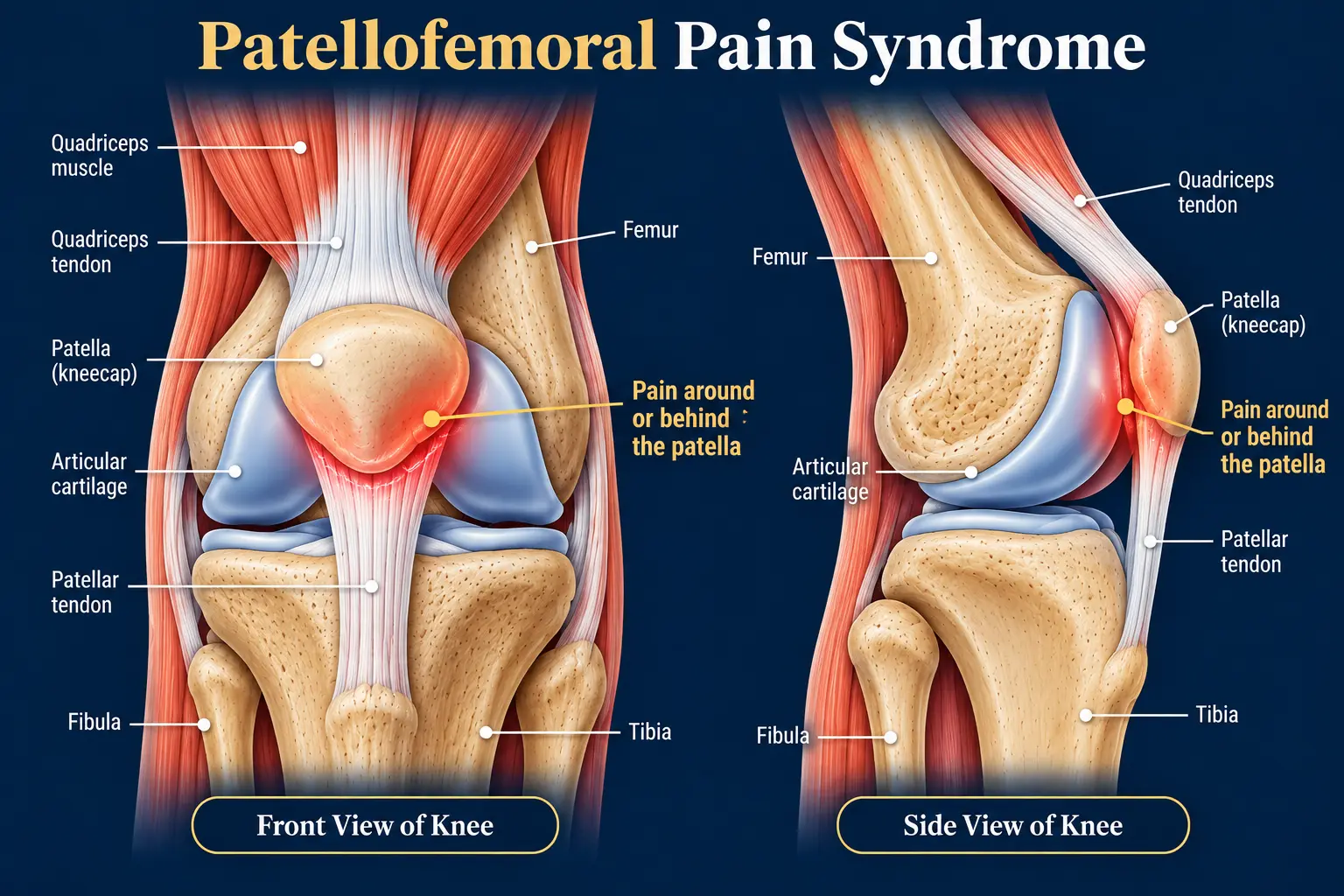
The patellofemoral joint connects the patella (kneecap) with the femur (thighbone). It helps the knee move efficiently during walking, running, squatting, climbing stairs, and other activities. As the knee bends and straightens, the patella glides along the trochlea, a groove at the lower end of the femur.
The main structures involved include:
As the knee bends, the patella generally moves downward along the trochlea. As the knee straightens, it moves upward. Contact between the patella and femur increases as the knee bends, especially during activities that place greater loads on the joint.
Patellofemoral pain syndrome can develop when changes in activity, biomechanics, or muscle function increase stress around the patellofemoral joint. PFPS usually develops from several contributing factors rather than one specific injury. These factors can affect how the knee handles repeated loading and how the patella moves during activity.
Common contributing factors include:
The exact combination of contributing factors varies between individuals. PFPS does not have one single cause, and an abnormal movement pattern or alignment factor does not necessarily mean it will cause pain.
Patellofemoral pain syndrome commonly causes pain around the kneecap that worsens during activities that increase patellofemoral loading. The pain is usually felt around or behind the kneecap and may develop gradually. Repeated knee bending or activities that place greater stress on the joint can make symptoms more noticeable.
Common symptoms include:
Symptoms can vary between individuals. True mechanical locking is not typical of PFPS and may point to another knee problem, such as a meniscus injury or loose body.
Doctors diagnose patellofemoral pain syndrome primarily from the symptom history and physical examination. The diagnosis is based on the typical pattern of pain and whether familiar pain can be reproduced during activities that load the knee.
PFPS is primarily a clinical diagnosis. Doctors combine the patient's symptoms with physical and functional examination findings rather than relying on a single imaging test.
Treatment focuses on reducing aggravating loads, improving strength and movement control, and gradually restoring activity. PFPS is mainly treated with a combination of activity modification, physical therapy, strengthening, and pain management. The approach depends on your symptoms, contributing factors, activity demands, and functional limitations.
Overall, conservative treatment and rehabilitation are the main approaches to PFPS. The combination of activity modification, physical therapy, strengthening, flexibility work, pain management, and supportive treatments should be adjusted to the individual's symptoms and functional needs.
Treatment for patellofemoral pain syndrome is generally conservative, with activity modification, physical therapy, and progressive strengthening forming the main approach. Specialist assessment may become relevant when symptoms remain severe and persistent despite appropriate non-surgical treatment or when an underlying structural abnormality is suspected.
Surgery is considered a last resort for selected patients with severe symptoms that do not improve after an adequate course of non-surgical treatment. Some clinical sources use around six months of dedicated conservative treatment as a general reference point, but the appropriate timeframe varies between patients.
Surgical treatment may be considered when:
The specific procedure depends on the identifiable structural problem rather than the PFPS diagnosis alone. Possible surgical approaches include:
These procedures are not routine treatments for uncomplicated PFPS. A specialist should first confirm the diagnosis, identify the contributing structural problem, and determine whether the potential benefits of surgery outweigh its risks.
Overall, surgical treatment is reserved for selected patients with persistent, function-limiting symptoms and an identifiable problem that has not responded adequately to appropriate conservative care.
Patellofemoral pain syndrome usually improves gradually with appropriate treatment, but the recovery timeline varies between individuals. Some people notice symptom improvement within several weeks, while others need several months of rehabilitation. Recovery can depend on how long symptoms have been present, contributing factors, activity demands, response to treatment, and consistency with rehabilitation.
Approximate recovery patterns may include:
Several factors can affect how quickly symptoms improve:
Symptoms can return if running, jumping, or other demanding activities increase too quickly. A gradual return to activity and continued attention to strength and movement control can help support long-term function. If symptoms remain persistent or worsen despite appropriate rehabilitation, further assessment may be appropriate.
The long-term outlook for patellofemoral pain syndrome varies between individuals. Symptoms may improve with appropriate treatment, but PFPS can also become a persistent condition rather than one that always resolves on its own. Long-term studies have reported ongoing pain or functional limitations in some adults and adolescents after several years.
The long-term outlook may include:
Several factors may influence the long-term outlook. Longer symptom duration, particularly symptoms lasting more than 12 months, higher baseline pain severity, and lower baseline knee function have been associated with a greater likelihood of persistent symptoms.
Structured rehabilitation can support better function. Physical therapy commonly focuses on strengthening the quadriceps, hip, and gluteal muscles, improving movement control, and managing activity loads appropriately.
Overall, PFPS can improve with consistent rehabilitation and appropriate load management, but it should not always be considered a short-term condition. Persistent or worsening symptoms may require further assessment to identify contributing factors or another knee condition.
You cannot prevent every case of patellofemoral pain syndrome. Still, gradually increasing activity, strengthening the lower-body muscles, managing workload, and addressing contributing factors can help reduce excessive stress on the patellofemoral joint.
Practical prevention strategies include:
Overall, prevention focuses on helping the knee gradually adapt to physical demands. Training progression, strength training, workload management, appropriate movement mechanics, supportive footwear, and early attention to symptoms can all help reduce the risk of PFPS
Patellofemoral pain syndrome and patellofemoral arthritis can both cause anterior knee pain around or behind the kneecap, but they describe different conditions. PFPS primarily refers to pain associated with the patellofemoral joint, while patellofemoral arthritis involves structural cartilage degeneration and other degenerative changes within the joint.
| Feature | PFPS | Patellofemoral Arthritis |
|---|---|---|
| Underlying pathology | Pain associated with patellofemoral loading and contributing factors such as activity changes, muscle weakness, or movement mechanics | Degenerative changes affecting the patellofemoral joint |
| Cartilage degeneration | Not required for diagnosis | Typically involves cartilage loss or degeneration |
| Symptoms | Anterior knee pain that often worsens with running, stairs, squatting, jumping, or prolonged sitting | Anterior knee pain that may worsen with stairs, squatting, walking, or other weight-bearing activities |
| Stiffness | Stiffness may occur, particularly after prolonged sitting, but significant morning stiffness is less typical | Stiffness is more common and may occur after periods of rest or inactivity |
| Crepitus | Clicking, popping, or grinding may occur | Grinding or crackling may occur as degenerative joint changes develop |
| Imaging | Imaging may be normal and is not routinely required for diagnosis | X-rays may show joint-space narrowing or other degenerative changes |
| Terminology | Patellofemoral pain syndrome, often called runner’s knee | Patellofemoral osteoarthritis or patellofemoral arthritis |
The two conditions can have overlapping symptoms, so pain around the kneecap does not automatically indicate either diagnosis. PFPS can occur without significant cartilage damage, while patellofemoral arthritis involves structural joint degeneration. A clinical evaluation and, when appropriate, imaging can help determine the underlying cause of symptoms.
Yes, patellofemoral pain syndrome can improve, especially when aggravating activities are reduced and contributing factors are addressed. Recovery varies between individuals, and some people need structured rehabilitation, strengthening, and gradual activity modification to achieve lasting symptom improvement.
You may be able to continue running with PFPS, but this depends on your symptoms, training load, strength, and functional capacity. Reducing aggravating activity and gradually increasing running as symptoms and movement control improve can help support a safer return to running.
Mild swelling can occur after activity, but significant or recurrent knee swelling is less typical of uncomplicated PFPS. Noticeable swelling or joint effusion may suggest another knee condition and should be assessed rather than automatically attributed to PFPS.
You should seek professional assessment when knee pain persists, worsens, or limits daily activities despite appropriate rehabilitation. Significant swelling, true locking, instability, or symptoms following a major injury also warrant further evaluation to check for other knee problems.