MCL Injury: Symptoms, Causes, Diagnosis, Treatment and Recovery

Prof. Dr. Haluk Çabuk

Prof. Dr. Haluk Çabuk

Professor of Orthopedics & Traumatology
Medically Reviewed Updated October 14, 2026 18 min read

An MCL injury affects the medial collateral ligament, a strong band of tissue that stabilizes the inner side of the knee. The injury can range from a mild sprain to a partial or complete tear. It often happens after a direct blow, sudden twist, awkward landing, or other force that pushes the knee inward.

This article explains everything you need to know about MCL injuries. You will learn what causes them, the different injury grades, common symptoms, who is at risk, how doctors diagnose the injury, and the available treatment options. We also cover rehabilitation, recovery timelines, when surgery may be considered, ways to reduce your risk of another injury, the long-term outlook, and answers to common patient questions.

Book Appointment

Need a personalized treatment plan?

Book a consultation and receive expert orthopedic guidance.

What Is an MCL Injury?

An MCL injury is a stretch, partial tear, or complete tear of the medial collateral ligament on the inner side of the knee. The MCL connects the femur (thighbone) to the tibia (shinbone) and helps keep the knee stable during movement.

The ligament mainly prevents the knee from moving too far inward. It also helps control rotation and supports knee stability during activities such as walking and running. An MCL sprain means the ligament is stretched or has minor fiber damage, while a partial or complete tear involves greater damage to the ligament.
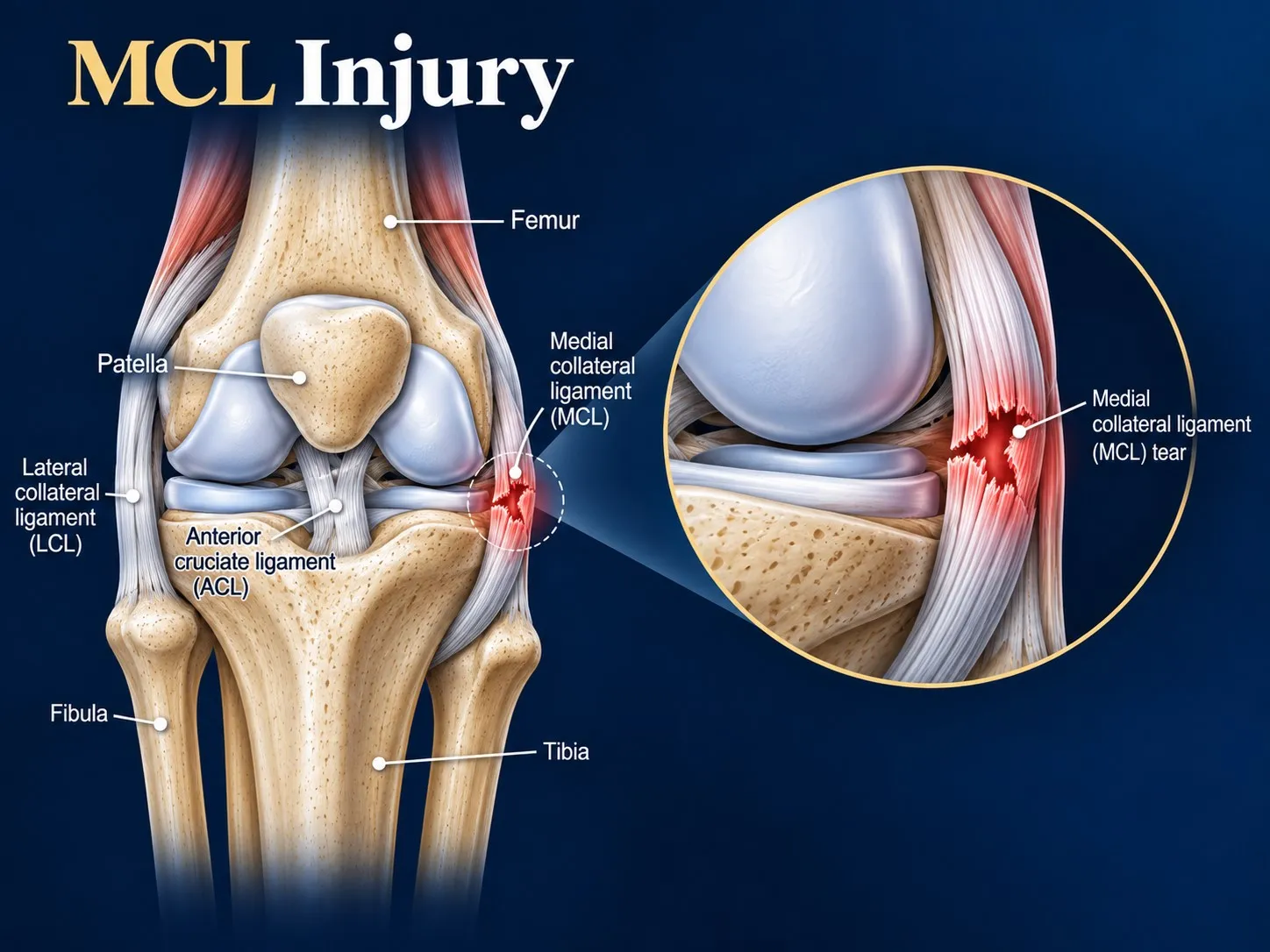
Medial collateral ligament (MCL) injury of the knee

What Causes an MCL Injury?

An MCL injury usually occurs when excessive force stresses the ligament on the inner side of the knee. The injury often happens when a force pushes the knee inward while the foot remains planted.

The most common causes of MCL injuries are listed below.

  1. Direct Blow to the Outside of the Knee: A hard impact can push the knee inward and overstretch the MCL. This commonly occurs during contact sports such as football, soccer, rugby, and hockey.
  2. Sudden Twisting or Pivoting: Twisting the knee while the foot remains planted can place excessive stress on the MCL. Sudden stops and direction changes can also cause injury.
  3. Awkward Landings: Landing incorrectly after a jump can force the knee inward. This movement may stretch or tear the MCL during jumping sports.
  4. Skiing Injuries: A fixed ski can cause the knee to twist during a fall or sudden direction change. This movement can place substantial stress on the MCL.
  5. Falls: A fall can create inward or rotational forces around the knee. The risk increases when the foot remains planted while the body moves in another direction.
  6. Hyperextension: Forcing the knee beyond its normal straight position can overstretch the MCL. This may occur during falls, contact sports, or sudden movements.
  7. Motor Vehicle Accidents: High-energy trauma can place substantial force on the knee. MCL injuries may occur alongside ACL, PCL, meniscus, or other knee injuries.
  8. Non-Contact Movements: Sudden direction changes, loss of balance, or rapid lateral movements can create enough force to damage the MCL without direct contact.
  9. Combined Knee Injuries: The MCL can tear along with other knee structures, including the ACL, PCL, medial meniscus, or articular cartilage.

What Are the Different Grades of an MCL Injury?

MCL injuries are classified into three grades based on the extent of ligament damage and knee instability.

The three grades of MCL injuries are described below.

  1. Grade 1 MCL Injury: The ligament is mildly stretched with microscopic fiber damage, causing tenderness but little or no knee instability.
  2. Grade 2 MCL Injury: The ligament has a partial tear, causing moderate pain, swelling, tenderness, and some knee instability.
  3. Grade 3 MCL Injury: The ligament is completely torn, causing significant knee instability, swelling, pain, and difficulty bearing weight.

What Are the Symptoms of an MCL Injury?

MCL injury symptoms can vary according to the severity of ligament damage. Mild injuries may cause localized pain, while severe tears can cause instability and difficulty walking.

The most common symptoms of an MCL injury include:

  • Pain on the Inner Side of the Knee: Pain usually occurs along the inside of the knee. Walking or twisting may make it worse.
  • Tenderness: The area along the MCL may feel tender or painful when touched.
  • Swelling: Swelling can develop around the inner knee, especially after partial or complete tears.
  • Knee Instability: Moderate or severe injuries may make the knee feel loose, buckle, or give way.
  • Bruising: Bruising may develop around the inner side of the knee after ligament damage.
  • Difficulty Walking: Pain, swelling, or instability can make weight-bearing and walking difficult.
  • Reduced Range of Motion: Pain and swelling may make it difficult to fully bend or straighten the knee.
  • Popping Sensation: Some people may hear or feel a pop when the MCL tears during a sudden injury.
  • Pain During Twisting: Pivoting, cutting, or other movements that stress the MCL may increase pain.
  • Stiffness: The knee may feel stiff because of swelling, pain, or reduced movement after the injury.

Who Is at Risk of an MCL Injury?

Several factors can increase the risk of an MCL injury. Contact sports, pivoting activities, previous knee injuries, and poor knee stability can raise the risk.

  • Contact-Sport Athletes: Football, soccer, rugby, hockey, and wrestling involve collisions that can force the knee inward.
  • Pivoting-Sport Athletes: Basketball, tennis, volleyball, and similar sports involve cutting, pivoting, and sudden direction changes.
  • Skiers: Falls and twisting movements while skis remain attached can place significant stress on the MCL.
  • People With Previous Knee Injuries: Previous MCL, ACL, or meniscus injuries may increase the risk of future knee injuries.
  • People With Weak Leg Muscles: Weak quadriceps, hamstrings, glutes, or core muscles can provide less support during movement.
  • People With Poor Balance: Poor balance and coordination can increase the likelihood of movements that stress the MCL.
  • People With Poor Movement Technique: Incorrect landing, cutting, or pivoting techniques can place excessive inward force on the knee.
  • People Who Skip Warm-Ups: Starting intense physical activity without adequate preparation may increase injury risk.
  • People With Inappropriate Footwear: Poorly fitted or unsuitable footwear can affect stability and movement mechanics.
  • People in Physically Demanding Jobs: Frequent climbing, lifting, kneeling, or working on uneven surfaces can increase knee stress.
  • People Exposed to High-Energy Trauma: Motor vehicle accidents and severe falls can cause MCL injuries, often with other knee injuries.

How Is an MCL Injury Diagnosed?

Doctors diagnose an MCL injury through medical history, physical examination, and imaging when necessary. The evaluation helps determine the severity of ligament damage and identify associated knee injuries.

  1. Medical History: Your doctor asks how the injury occurred, what symptoms you have, and whether you have had previous knee injuries.
  2. Physical Examination: The doctor checks for inner-knee tenderness, swelling, bruising, range of motion, and differences between the injured and uninjured knees.
  3. Valgus Stress Test: The doctor applies controlled inward stress to the knee to assess MCL stability. Pain or abnormal looseness can indicate ligament damage.
  4. Stability Assessment: Clinicians assess medial knee opening and the firmness of the endpoint during stress testing. These findings help determine injury severity.
  5. X-rays: X-rays can help rule out fractures or avulsion injuries. They cannot directly show damage to the MCL itself.
  6. MRI Scan: An MRI provides detailed images of the MCL. It can identify partial or complete tears and associated ACL, PCL, meniscus, or cartilage injuries.
  7. Ultrasound: Musculoskeletal ultrasound may be used in selected cases to assess the superficial MCL and its movement during stress testing.

Doctors combine physical examination findings with imaging when needed. This approach helps determine the injury's severity and guide treatment.

What Are the Treatment Options for an MCL Injury?

Treatment for an MCL injury depends on the injury grade, knee stability, and associated injuries. Most isolated MCL injuries heal without surgery through protection, bracing, activity modification, and rehabilitation.

Non-Surgical Treatment

Conservative treatment is commonly used for Grade 1 and Grade 2 injuries and many isolated Grade 3 tears.

  1. R.I.C.E. Method: Rest the knee, apply ice to help reduce swelling, use compression, and elevate the leg.
  2. Pain Relief: Acetaminophen or NSAIDs may help manage pain and inflammation when medically appropriate.
  3. Knee Bracing: A hinged knee brace can protect the healing MCL and limit excessive side-to-side knee movement.
  4. Crutches: Crutches may temporarily reduce weight-bearing when walking is painful or the knee feels unstable.
  5. Physical Therapy: Rehabilitation restores knee motion, muscle strength, balance, and stability through progressively challenging exercises.

Surgical Treatment

Surgery is not routinely required for isolated MCL injuries. Doctors may consider it when severe instability persists or when the MCL injury occurs with other significant knee injuries.

  • MCL Repair: The surgeon reattaches the torn ligament when the injury pattern and tissue quality make repair appropriate.
  • MCL Reconstruction: The damaged ligament is replaced with a tendon graft when direct repair is not suitable, particularly with chronic or persistent instability.
  • Combined Ligament Surgery: Additional procedures may be needed when the MCL injury occurs with ACL, PCL, or other major ligament injuries.

How Does Treatment Change by Injury Grade?

  • Grade 1: Usually treated with activity modification, symptom control, and progressive rehabilitation.
  • Grade 2: Often requires a hinged brace, temporary activity restrictions, and structured physical therapy.
  • Grade 3: May require longer bracing and rehabilitation. Surgery is considered for selected cases involving persistent instability, avulsion injuries, or combined ligament damage.

The appropriate treatment depends on the individual injury pattern. An orthopedic specialist can determine the most suitable approach after assessing knee stability and associated injuries.

When Is Surgery Recommended for an MCL Injury?

Surgery is generally considered when an MCL injury causes persistent instability or involves complex knee damage. Most isolated MCL injuries heal with bracing, activity modification, and physical therapy.

The decision to operate depends on the injury pattern, knee stability, associated injuries, and response to non-surgical treatment.

  1. Persistent Knee Instability: Surgery may be considered when the knee remains significantly unstable despite appropriate bracing and rehabilitation.
  2. Combined Ligament Injuries: Surgery may be recommended when an MCL tear occurs with major injuries to the ACL, PCL, or other knee ligaments.
  3. MCL Avulsion Injury: Surgery may be considered when the MCL completely pulls away from its bone attachment and cannot heal properly in position.
  4. Failure of Conservative Treatment: Surgery may be considered when persistent pain or instability continues despite appropriate non-surgical treatment and rehabilitation.
  5. Chronic MCL Instability: Long-term instability caused by an MCL that fails to heal adequately may require reconstruction to restore medial knee stability.
  6. High Functional Demands: Competitive athletes or people with physically demanding jobs may be considered for surgery when persistent instability prevents safe performance of required activities.
  7. Complex Knee Injuries: Severe injuries involving the MCL and other knee structures may require surgery to restore overall knee stability.

Is Surgery Needed for Every Grade 3 MCL Injury?

No. A Grade 3 MCL tear does not automatically require surgery. Many isolated complete MCL tears can heal with appropriate bracing and rehabilitation.

Surgery becomes more relevant when significant instability persists, the tear pattern is unsuitable for healing, associated injuries require surgery, or conservative treatment does not restore adequate knee function.

What Does MCL Rehabilitation Involve?

MCL rehabilitation focuses on restoring knee motion, strength, stability, and functional movement. A structured program gradually protects the healing ligament while helping the knee return to normal function.

The program depends on the injury grade, treatment approach, and individual progress. Patients who undergo MCL repair or reconstruction may progress more slowly to protect the healing ligament or graft.

The main stages of MCL rehabilitation are outlined below.

  1. Early Protection and Mobility: The first stage controls pain and swelling while protecting the healing MCL. Gentle exercises help restore movement without placing excessive stress on the ligament.
  2. Range of Motion: Rehabilitation gradually restores knee extension and flexion. Heel slides, gentle bending, and straightening can improve mobility when appropriate.
  3. Strengthening Exercises: Exercises target the quadriceps, hamstrings, calves, hips, and core. Squats, bridges, leg presses, and resistance exercises gradually rebuild strength.
  4. Balance and Stability Training: Single-leg stands, balance exercises, and controlled weight shifting improve proprioception and knee control. These exercises prepare the knee for more demanding movements.
  5. Functional Training: Rehabilitation progresses to step-ups, lunges, controlled squats, and lateral movements. These activities help restore movement patterns needed for daily activities and physical work.
  6. Sport-Specific Training: Active individuals gradually add jogging, running, jumping, cutting, pivoting, and agility drills. These exercises introduce rotational and side-to-side stresses in a controlled manner.
  7. Return to Activity: Patients return to work, sports, or other demanding activities after meeting appropriate strength, stability, mobility, and functional goals. A healthcare professional should guide the final return to high-demand activities.

How Long Does It Take to Recover From an MCL Injury?

MCL recovery time varies according to the injury grade and whether other knee structures are involved. Most isolated MCL injuries heal without surgery, but severe or combined injuries may require longer rehabilitation.

The timeline below provides typical ranges rather than fixed deadlines. Recovery also depends on pain, swelling, knee stability, range of motion, muscle strength, and functional progress.

MCL Injury Grade Typical Recovery Time General Recovery Progress
Grade 1 1–3 weeks Pain and swelling usually improve quickly, followed by gentle strengthening and a gradual return to normal activities.
Grade 2 3–6 weeks Bracing and rehabilitation may be needed while knee motion, strength, and stability gradually improve.
Grade 3 6–12 weeks or longer Complete tears require longer protection and rehabilitation, especially when instability or other injuries are present.
After MCL Surgery Several months Recovery progresses gradually through protection, strengthening, functional training, and return-to-activity stages.

What Are the Main Recovery Milestones?

The main recovery milestones for an MCL injury include:

  1. Pain and Swelling Control: Pain and swelling gradually decrease with appropriate protection, activity modification, and symptom management.
  2. Restored Knee Motion: The knee gradually regains normal extension and flexion without significant pain.
  3. Normal Walking: Patients progress from protected weight-bearing to walking normally without significant pain, limping, or instability.
  4. Improved Muscle Strength: Progressive exercises rebuild the quadriceps, hamstrings, hips, and other supporting muscles.
  5. Improved Balance and Stability: Balance and proprioception exercises help restore control during single-leg and functional movements.
  6. Functional Movement: Patients gradually resume activities such as squatting, climbing stairs, jogging, and lateral movements.
  7. Return to Sports or Demanding Activities: Athletes progress through running, agility, jumping, cutting, and sport-specific exercises before returning to full activity.

Does a Grade 3 MCL Injury Take Longer to Heal?

Yes. Grade 3 injuries involve complete ligament tears and generally require more rehabilitation than Grade 1 or Grade 2 injuries. Many isolated Grade 3 MCL injuries can still heal successfully without surgery.

Recovery may take longer when persistent instability occurs or when an ACL, PCL, meniscus, or other knee injury is also present. Surgical treatment can extend rehabilitation because the repaired ligament or graft needs additional protection.

Recovery should be based on functional milestones rather than the calendar alone. A healthcare professional can determine when the knee is ready for increased activity.

How Can You Prevent an MCL Injury?

Although not every MCL injury can be prevented, several strategies can reduce injury risk. Strengthening the muscles around the knee, improving balance, and using proper movement techniques can support knee stability.

The following strategies may help reduce the risk of MCL injuries.

  1. Strengthen Supporting Muscles: Strengthen the quadriceps, hamstrings, glutes, and calves. Exercises such as squats, lunges, step-ups, and resistance exercises can improve knee support.
  2. Improve Balance and Stability: Practice single-leg stands, balance exercises, and controlled movement drills. Better balance can help you respond to sudden changes in direction.
  3. Warm Up Before Exercise: Use light jogging, cycling, dynamic leg swings, walking lunges, and sport-specific movements before intense activity. A proper warm-up prepares your muscles and joints.
  4. Use Proper Movement Technique: Keep your knees aligned with your feet when landing, squatting, or changing direction. Avoid uncontrolled pivots and awkward movements.
  5. Wear Appropriate Footwear: Choose well-fitting shoes that match your sport or activity. Proper footwear can provide appropriate support, cushioning, and traction.
  6. Consider Protective Equipment: A knee brace or other protective equipment may help selected athletes during high-risk contact activities. Ask a healthcare professional whether bracing is appropriate for you.
  7. Increase Training Gradually: Increase running, jumping, practice time, and training intensity gradually. Sudden increases can place excessive stress on the knee.
  8. Maintain Flexibility: Regularly work on flexibility in the hamstrings, quadriceps, calves, hips, and other supporting muscles. Gentle stretching can help maintain normal movement.
  9. Complete Previous Rehabilitation: Finish rehabilitation after a previous knee injury before returning to demanding activities. Restored strength, motion, balance, and stability can help reduce reinjury risk.
  10. Prevent Falls: Use caution on wet or uneven surfaces and improve strength and balance. Reducing falls can help prevent sudden forces that may injure the MCL.

What Is the Long-Term Outlook After an MCL Injury?

The long-term outlook for an MCL injury is generally influenced by injury severity, associated damage, and rehabilitation. Most isolated MCL injuries have a favorable outlook with appropriate treatment and structured rehabilitation, while associated injuries can make recovery more complex.

Several factors can influence long-term knee function:

  • Injury Severity: Grade 1 and Grade 2 injuries usually heal faster than complete Grade 3 tears.
  • Associated Injuries: ACL, PCL, meniscus, or cartilage damage can make recovery more complex.
  • Treatment: Appropriate bracing, activity modification, and rehabilitation support healing.
  • Rehabilitation: Completing physical therapy helps restore strength, motion, balance, and knee stability.
  • Activity Level: Athletes and physically active people may need more advanced rehabilitation before returning to demanding activities.
  • Previous Knee Injuries: Previous ligament or meniscus injuries may affect recovery and future knee stability.

With appropriate rehabilitation, many people can regain normal knee function and return to their usual activities. Persistent instability or associated knee damage can make long-term recovery more difficult.

FAQs About MCL Injury

What Is the Cost of MCL Injury Treatment?

The cost of MCL injury treatment varies according to the treatment required, healthcare provider, location, and insurance coverage. Expenses may include imaging, physical therapy, bracing, medications, or surgery.

Can You Bend Your Knee With a Torn MCL?

Yes, you may still be able to bend your knee with a torn MCL. Pain, swelling, and injury severity can limit knee flexion, but the ability to bend your knee does not determine whether the MCL is torn.

What Happens If an MCL Injury Is Left Untreated?

An inadequately treated MCL injury can lead to persistent knee instability, recurrent injury, and altered movement. Some mild MCL injuries may heal with activity modification and gradual rehabilitation, while more significant injuries may require medical evaluation and structured treatment.

When Can You Return to Sports After an MCL Injury?

Return to sports should depend on symptoms, knee strength, stability, range of motion, and functional recovery. Athletes should gradually progress through running, agility, jumping, cutting, and sport-specific exercises before returning to full activity.

Can You Sleep Comfortably With an MCL Injury?

Supporting the injured knee in a comfortable position may reduce nighttime discomfort. Avoid positions that increase pain or place unnecessary stress on the knee.

Can an MCL Tear Increase the Risk of Another Knee Injury?

Yes. Residual knee instability or incomplete rehabilitation can affect movement and increase the risk of another knee injury. Associated ligament or meniscus injuries can also influence long-term knee stability.

Can an MCL Injury Occur at the Same Time as an ACL Tear?

Yes. An MCL injury can occur with an ACL tear, particularly after significant knee trauma. Combined ligament injuries can affect diagnosis, treatment decisions, rehabilitation, and recovery time.

Can I Drive With an MCL Injury?

Driving should wait until pain, knee movement, weight-bearing ability, and reaction control allow safe vehicle operation. The affected leg and type of vehicle should also be considered.

What Activities Should You Avoid During MCL Recovery?

Activities that place excessive stress on the healing MCL should be avoided during recovery. Pivoting, cutting, contact sports, running, and other demanding movements should be reintroduced gradually as strength and knee stability improve.

Can an MCL Tear Come Back After It Heals?

An MCL can be injured again after healing, particularly if knee stability, strength, or movement control has not fully recovered. Completing rehabilitation and progressing gradually toward demanding activities can help reduce reinjury risk.