
Specialties › Knee & Leg › LCL Reconstruction

LCL reconstruction is a surgical procedure that treats a severely damaged or completely torn lateral collateral ligament (LCL). The LCL helps stabilize the outer side of the knee and control excessive side-to-side movement. Reconstruction replaces the damaged ligament with a tendon graft to restore knee stability and function.
This article explains everything you need to know about LCL reconstruction. You will learn who may need surgery, how the procedure is performed, the available graft options, its potential benefits and risks, and what recovery involves. We also cover rehabilitation exercises, long-term outcomes, possible complications, and answers to common questions about walking, driving, returning to sports, physical therapy, costs, and graft durability.
Book a consultation and receive expert orthopedic guidance.
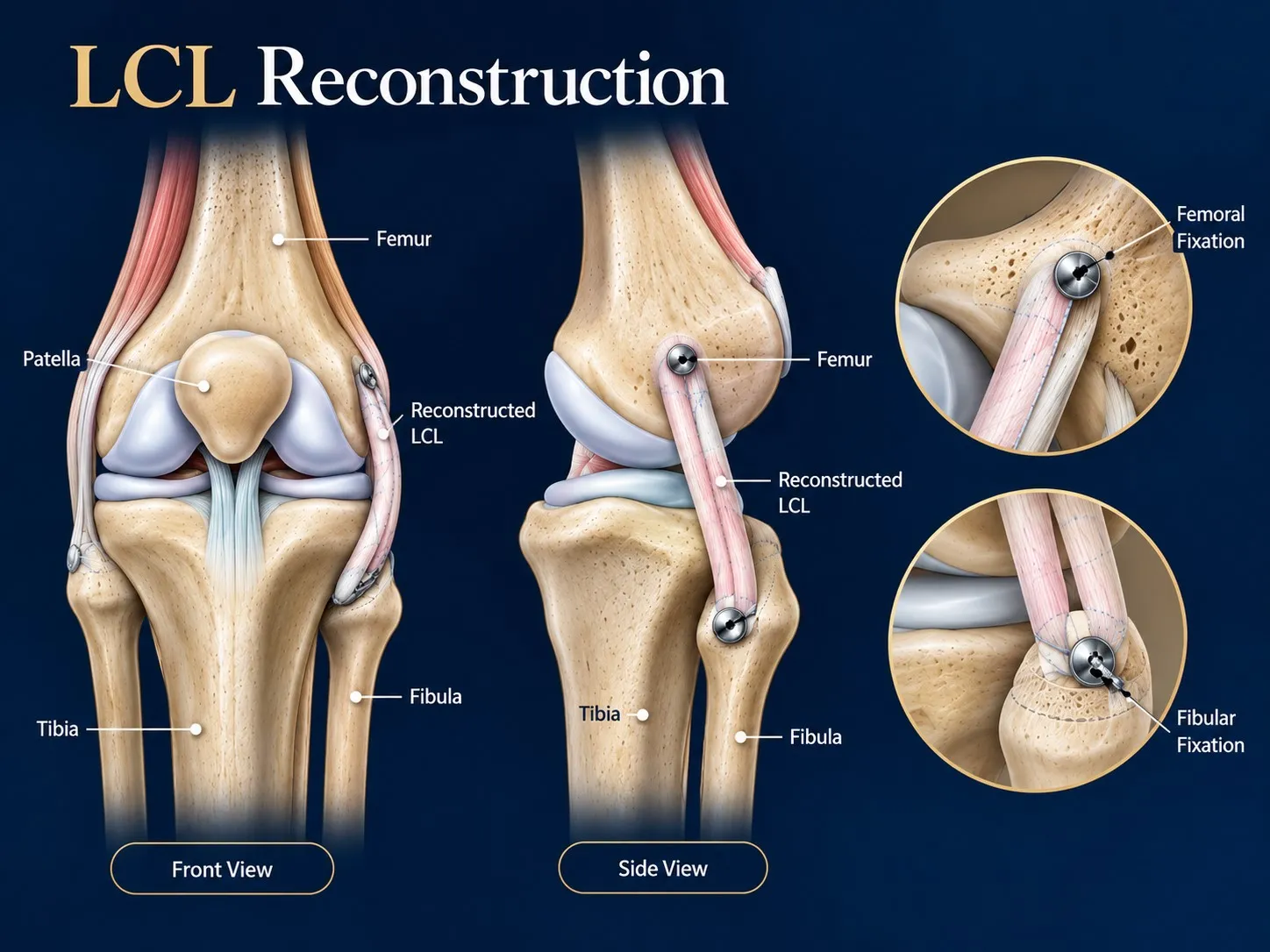
LCL reconstruction is a surgical procedure that restores stability to the outer side of the knee after a severe or complete LCL tear. The surgeon replaces the damaged ligament with a tendon graft and secures it between the femur and fibula. This graft recreates the function of the original ligament and helps control excessive side-to-side movement of the knee.
The graft can come from your own body, called an autograft, or from a screened donor, called an allograft. LCL reconstruction may also be performed with treatment for other knee injuries, such as ACL, PCL, or posterolateral corner (PLC) damage.
LCL reconstruction differs from LCL repair. Repair preserves and reattaches the existing ligament when the tissue is suitable for healing. Reconstruction replaces the damaged ligament with a tendon graft when the original tissue cannot provide enough stability or cannot be repaired successfully.
LCL reconstruction may be recommended when a severe LCL injury causes significant lateral knee instability and cannot be adequately treated with non-surgical care or direct repair. The decision depends on the severity and location of the tear, associated knee injuries, chronicity, and the patient’s functional needs.
The most common medical indications for LCL reconstruction include:
A complete LCL tear may require reconstruction when the ligament cannot provide adequate stability or cannot be successfully repaired.
Reconstruction may be considered when the knee continues to give way despite appropriate bracing, activity modification, and physical therapy.
An LCL tear combined with ACL, PCL, or posterolateral corner (PLC) injuries may require reconstruction to restore overall knee stability.
An older LCL injury may cause chronic instability when the original ligament has not healed adequately and the remaining tissue is unsuitable for direct repair.
Reconstruction may be considered when the damaged ligament is severely disrupted, retracted, or otherwise unsuitable for repair.
Athletes and people with physically demanding activities may need reliable lateral knee stability for running, cutting, pivoting, and other demanding movements.
Patients who continue to experience significant instability or functional limitations after appropriate rehabilitation may be evaluated for reconstruction.
Most Grade 1 injuries and many isolated Grade 2 LCL injuries do not require reconstruction. These injuries can often be managed with bracing, activity modification, and physical therapy when the knee remains stable.
The ideal candidate usually has an LCL injury that causes meaningful knee instability and requires surgical reconstruction. Patient selection also considers activity level, overall health, associated ligament injuries, and the ability to complete postoperative rehabilitation.
The main factors used to determine whether a patient is a good candidate include:
Repeated giving-way episodes or persistent side-to-side instability can support surgical treatment.
An older injury may be suitable for reconstruction when the remaining ligament tissue cannot provide adequate stability or cannot be repaired.
Surgery may be considered when appropriate bracing, activity modification, and physical therapy do not restore adequate knee stability or function.
ACL, PCL, or PLC injuries can affect treatment planning and may require reconstruction as part of a broader knee stabilization procedure.
Athletes and people with physically demanding jobs may need reliable lateral knee stability for running, pivoting, cutting, and other demanding movements.
Candidates should be medically suitable for surgery and able to participate in the required postoperative rehabilitation program.
The surgeon reviews the physical examination, MRI findings, and other tests to determine whether reconstruction is appropriate. The location and quality of the remaining ligament tissue can influence whether repair or reconstruction is selecte
Patients with stable Grade 1 injuries and many isolated Grade 2 injuries generally do not need LCL reconstruction. These injuries often respond well to non-surgical treatment and structured rehabilitation.
LCL reconstruction is performed by replacing the damaged ligament with a tendon graft to restore stability to the outer side of the knee. The surgeon places and secures the graft along the normal course of the LCL. Other injured knee structures may also be treated during the same operation when needed.
The main stages of LCL reconstruction surgery are outlined below.
The surgeon reviews your medical history, examines the knee, and evaluates MRI and X-ray findings. These tests help identify LCL damage and associated ACL, PCL, or PLC injuries.
The procedure is performed under anesthesia. The anesthesia team selects the most appropriate option based on your health and the planned surgery.
The surgeon may use knee arthroscopy to examine the joint, menisci, cartilage, ACL, and PCL. Associated injuries may be treated during the same procedure when necessary.
A tendon graft is prepared to replace the damaged LCL. The graft may come from your own body or from a screened donor.
An incision is made on the outer side of the knee to access the damaged ligament and surrounding structures. The surgeon takes care to protect nearby nerves and blood vessels.
Precise tunnels are created in the femur and fibula at locations that correspond to the normal LCL attachments. Accurate placement helps reproduce the ligament's normal function.
The prepared tendon graft is passed through the bone tunnels along the normal course of the LCL.
The surgeon adjusts the graft tension and secures it with fixation devices such as screws, buttons, or suture anchors. This keeps the graft in position while it heals and incorporates with surrounding tissues.
If other structures are damaged, additional procedures may be performed during the same operation. These can include ACL or PCL reconstruction, PLC reconstruction, or meniscus repair.
After checking knee stability, the surgeon closes the incision and applies a sterile dressing. A hinged knee brace is commonly used to protect the reconstruction after surgery.
Rehabilitation begins after surgery and progresses gradually. Early treatment focuses on protecting the graft and restoring controlled movement. Later stages focus on strength, balance, stability, and functional activities.
The exact technique can vary based on the location and severity of the LCL tear, associated injuries, graft choice, and the surgeon's preferred reconstruction method.
Several graft options are available for LCL reconstruction depending on the patient’s condition, associated injuries, activity level, and surgical plan. The two main choices are autografts, which use the patient’s own tendon, and allografts, which use screened donor tissue.
An autograft uses a tendon taken from another part of the patient’s body. Hamstring and quadriceps tendons may be used depending on the surgical plan.
Advantages:
Limitations:
An allograft uses tendon tissue obtained from a screened tissue donor. It can be useful when several ligaments need reconstruction or suitable autograft tissue is limited.
Advantages:
Limitations:
The surgeon considers several factors when selecting the graft, including:
There is no single graft that is appropriate for every patient. The choice between an autograft and an allograft is individualized according to the injury pattern and surgical needs.
LCL reconstruction offers several important benefits for restoring knee function and stability. By replacing a severely damaged LCL with a tendon graft, the procedure aims to restore lateral knee stability and improve the knee’s ability to function during daily and physical activities.
The major benefits of LCL reconstruction include:
The benefits vary according to the severity of the injury, associated knee damage, surgical technique, and rehabilitation progress. A structured rehabilitation program remains an important part of achieving the desired outcome.
Although LCL reconstruction has a high success rate, every surgical procedure carries potential risks. Most patients recover well with appropriate surgery and rehabilitation, but complications can occasionally occur.
Possible risks and complications of LCL reconstruction are listed below.
Infection can develop around the surgical incision or reconstructed ligament. Increasing redness, warmth, swelling, drainage, fever, or worsening pain can be warning signs.
Bleeding can occur after surgery. Blood may sometimes collect under the skin and cause swelling, bruising, or pain.
Limited mobility after surgery can increase the risk of deep vein thrombosis (DVT). Calf pain, swelling, warmth, or redness may indicate a blood clot.
Scar tissue or delayed rehabilitation can restrict knee movement. Some patients may have difficulty fully bending or straightening the knee.
The knee may remain unstable if the graft does not restore adequate ligament function. Associated injuries, graft stretching, or surgical factors can contribute to instability.
The reconstructed ligament can stretch, tear, or fail to heal properly. A new injury or excessive stress during early recovery can increase this risk.
The common peroneal nerve lies close to the surgical area. Injury or irritation can cause numbness, tingling, weakness, or foot drop.
Vascular injury is rare but can occur during complex ligament reconstruction. Severe swelling, unusual foot color, coldness, or reduced pulses require urgent medical evaluation.
Screws, anchors, or other fixation devices can sometimes cause irritation or discomfort around the knee.
Patients who receive an autograft may experience temporary pain, tenderness, or weakness at the tendon harvest site.
Some patients may continue to experience knee pain after reconstruction. Cartilage damage, meniscus injuries, scar tissue, arthritis, or residual instability can contribute.
Healing may take longer in some patients. Smoking, diabetes, poor nutrition, and other health factors can affect tissue healing.
Anesthesia carries small risks, including nausea, allergic reactions, breathing problems, and cardiovascular complications.
Patients with ACL, PCL, or posterolateral corner injuries may face additional challenges because multiple structures require treatment and rehabilitation.
Severe complications or graft failure may occasionally require additional surgery, such as revision LCL reconstruction.
Following postoperative instructions, protecting the knee, attending physical therapy, and avoiding a premature return to sports can help reduce complication risks. Severe pain, fever, wound drainage, calf swelling, chest pain, sudden shortness of breath, or new foot weakness requires prompt medical attention.
Recovery after LCL reconstruction progresses through several rehabilitation phases. Full recovery typically takes 6 to 12 months, although the exact timeline varies between patients. Recovery may take longer when other knee ligaments are also reconstructed.
| Recovery Phase | Typical Timeline | Main Goals and Milestones |
|---|---|---|
| Early Protection | Weeks 0–6 | Protect the graft, control pain and swelling, use a brace and crutches, and begin gentle knee movement. |
| Early Strengthening | Weeks 6–12 | Gradually increase weight-bearing, improve range of motion, reduce dependence on crutches, and begin progressive strengthening. |
| Functional Recovery | Months 3–6 | Build muscle strength, improve balance and coordination, and resume most routine daily activities. |
| Advanced Rehabilitation | Months 6–9 | Begin running progression, agility exercises, and more demanding functional activities when cleared. |
| Return to Sports | Months 9–12 | Complete sport-specific training and functional testing before returning to high-demand activities. |
Your recovery timeline depends on graft healing, knee stability, rehabilitation progress, and any associated injuries. You should progress through each stage according to your surgeon’s or physical therapist’s guidance rather than using the timeline as a fixed schedule.
Rehabilitation exercises help restore strength, stability, and range of motion after LCL reconstruction. Exercises progress gradually to protect the reconstructed ligament while improving knee function. Your orthopedic surgeon or physical therapist should determine when to start and advance each exercise.
The following exercises are commonly recommended during rehabilitation.
Move your foot up and down repeatedly while sitting or lying down. This exercise promotes circulation and helps reduce swelling during early recovery.
Tighten the muscles at the front of your thigh while keeping your leg straight. Hold the contraction for several seconds, then relax. This helps maintain quadriceps activation and limit muscle weakness.
Slowly slide your heel toward your buttocks to bend the knee, then straighten the leg. Heel slides help restore gentle knee movement and reduce stiffness.
Keep the knee straight and slowly raise the leg from the hip. This exercise strengthens the quadriceps and supports lower-limb control. Perform it only when your rehabilitation protocol allows it.
Perform shallow squats while holding a stable surface for support. Mini squats strengthen the quadriceps and gluteal muscles while improving functional knee control.
Rise slowly onto your toes while holding a stable support. Calf raises strengthen the lower leg and help improve walking mechanics.
Gradually shift your body weight from one leg to the other. These exercises help restore balance and prepare the knee for increased weight-bearing.
Step onto a low platform with the operated leg and slowly return to the starting position. Step-ups improve leg strength and functional control.
Light stationary cycling can improve knee mobility, leg strength, and cardiovascular endurance. Resistance should remain low initially and increase gradually.
Single-leg standing, balance boards, and foam-pad exercises can improve coordination and knee control. These exercises are usually introduced after adequate healing and stability have developed.
Later rehabilitation may include jogging, side shuffles, cone drills, and controlled direction changes. These exercises should begin only after your healthcare provider confirms that the knee is ready.
Advanced rehabilitation may include jumping, hopping, sprinting, cutting, and sport-specific movements. These exercises prepare athletes for a gradual return to higher-demand activities.
Exercises should progress according to graft healing, knee stability, strength, and functional performance rather than a fixed timeline. Avoid running, jumping, twisting, pivoting, and heavy resistance exercises until your surgeon or physical therapist clears them.
Most patients achieve good knee stability and return to normal activities following successful LCL reconstruction. Long-term outcomes depend on the severity of the original injury, associated knee damage, surgical technique, graft healing, and rehabilitation.
The major long-term outcomes of LCL reconstruction include:
Reconstruction can restore stability to the outer side of the knee. It can reduce knee buckling and improve confidence during daily activities.
Many patients regain good knee movement, strength, balance, and functional ability after completing rehabilitation.
Many patients return to recreational activities and sports after adequate rehabilitation. High-demand sports may require additional strength and functional testing before clearance.
A successfully healed graft can provide lasting knee stability. Protecting the graft during recovery and avoiding premature high-impact activities can help maintain its function.
Restoring lateral knee stability can reduce recurrent giving-way episodes and abnormal knee movement.
Restoring normal knee stability may reduce abnormal stress on the meniscus and articular cartilage. Reconstruction cannot completely prevent future joint degeneration.
Many patients report improved knee function and satisfaction after successful reconstruction. Outcomes may be less predictable when multiple ligaments or other knee structures are damaged.
Overall, long-term results depend on proper surgical technique, graft healing, rehabilitation, associated injuries, and protecting the reconstructed knee from future trauma.
The cost of LCL reconstruction depends on the hospital, surgeon’s expertise, graft type, rehabilitation program, and country. Healthcare systems and insurance coverage can also affect the total cost. The main factors include hospital charges, graft costs, surgical fees, and postoperative rehabilitation expenses.
Walking is usually progressed gradually after LCL reconstruction. Early recovery commonly involves a hinged knee brace and crutches while the graft is protected. Weight-bearing and walking are increased as knee stability, healing, and rehabilitation progress under your surgeon or physical therapist’s guidance.
Driving should resume only when your knee function allows safe control of the vehicle. Your surgeon will consider the operated leg, pain, mobility, medication use, and ability to perform emergency movements. The timing can vary depending on your recovery and the type of vehicle you drive.
Many patients can return to recreational activities and sports after adequate rehabilitation. High-demand sports require appropriate strength, balance, knee stability, and functional testing before clearance. Running, agility work, cutting, jumping, and sport-specific exercises are introduced gradually when the knee is ready.
A comfortable sleeping position should protect the reconstructed knee and avoid unnecessary twisting or pressure. A knee brace may be used during the early recovery period, depending on your postoperative instructions. Knee support and appropriate pain management can also help improve comfort while the knee heals.
Yes, an LCL reconstruction can fail if the graft stretches, tears, or does not heal properly. Reinjury, excessive stress during early recovery, associated injuries, or surgical factors can contribute. Following postoperative restrictions, protecting the knee, and completing rehabilitation can help reduce these risks.
Yes, rehabilitation is an important part of recovery after LCL reconstruction. Physical therapy helps restore knee movement, muscle strength, balance, stability, and functional control. Exercises progress gradually according to graft healing and knee function rather than following a fixed schedule.
A successfully healed graft can provide lasting knee stability. Long-term results depend on graft healing, surgical technique, rehabilitation, associated injuries, and protection from future trauma. Avoiding premature high-impact activities during recovery can help maintain graft function and knee stability.