
Specialties › Knee & Leg › Iliotibial Band Syndrome

Iliotibial band syndrome (ITBS) is a common cause of pain on the outer side of the knee. It often affects runners, cyclists, and people who engage in repetitive activities. The pain may start during exercise and worsen with continued activity. Some people also experience discomfort when walking or using stairs.
This article explains the common causes of iliotibial band syndrome and the symptoms it produces. You will also learn how doctors diagnose and treat ITBS, which stretches and exercises may help, and how long recovery may take. We also discuss possible complications, ways to prevent recurring symptoms, and when medical assessment is necessary.
Book a consultation and receive expert orthopedic guidance.
Iliotibial band syndrome (ITBS) is an overuse condition that causes pain along the outer side of the knee. It commonly develops when repetitive knee movements irritate sensitive tissues near the iliotibial band. The condition is especially common among distance runners and cyclists.
The pain usually occurs near the lateral femoral epicondyle, a bony prominence on the outer side of the thigh bone. It often appears during activities that repeatedly bend and straighten the knee. Running downhill, cycling, and walking downstairs may make the symptoms worse.
ITBS was traditionally described as iliotibial band friction syndrome. This explanation suggested that the band repeatedly rubs against the outer knee. Current research also considers compression of sensitive tissues beneath the band as a possible pain mechanism. The exact cause is not fully established.
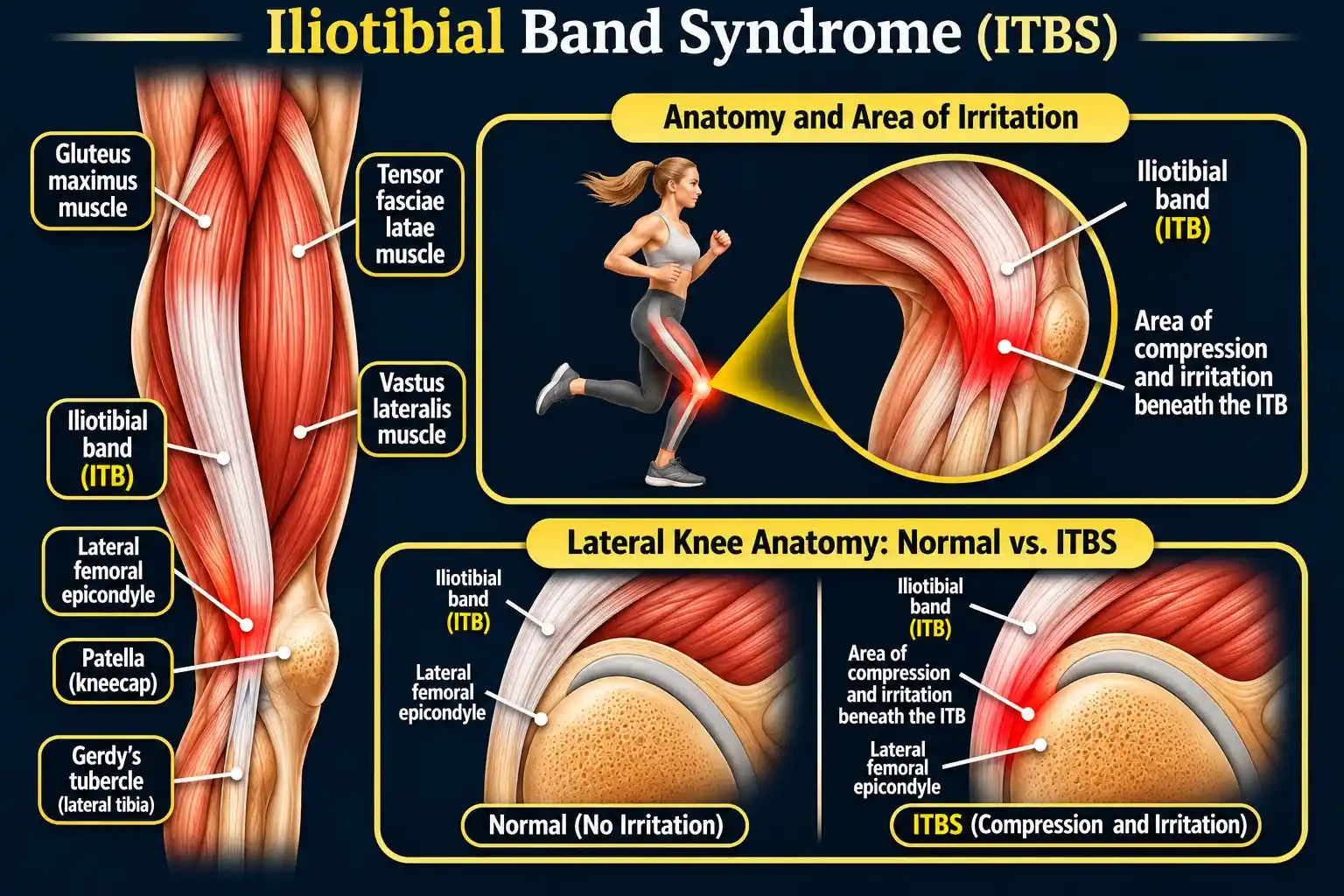
The iliotibial band (IT band) is a thick strip of connective tissue that runs along the outer side of the thigh. It extends from the hip to the upper part of the shinbone, just below the knee. The IT band forms part of the fascia lata, a layer of connective tissue that surrounds the thigh muscles.
Several muscles connect with the IT band. These include the tensor fasciae latae (TFL) and part of the gluteus maximus. Together, these structures help support movement and stability around the hip and knee.
The IT band has several important functions:
The IT band is a strong structure that helps the lower limb manage repeated movements and physical loads.
Iliotibial band syndrome usually develops when repetitive activity places repeated stress on the outer knee. Running, cycling, and other activities involving repeated knee bending may contribute to this irritation. Training errors, muscle weakness, and changes in movement patterns can also play a role.
Common contributing factors include:
Biomechanical factors refer to how the hip, knee, and foot move during physical activity. Certain movement patterns may increase stress around the outer knee.
These factors may include:
These factors do not cause ITBS in every person. Research has not established one biomechanical pattern as the main cause.
ITBS can affect anyone who performs repetitive lower-limb activities. Some people have a higher risk due to their training habits or activity levels.
Common risk groups include:
The main symptom of iliotibial band syndrome is pain on the outer side of the knee. It often develops gradually and becomes more noticeable during physical activity. Runners may first notice discomfort after covering a certain distance. The pain may worsen as exercise continues and improve with rest.
Common symptoms include:
IT band syndrome usually causes a dull ache or sharp pain on the outer side of the knee. Some people describe the sensation as burning, stinging, or a pulling discomfort. The pain may begin mildly and become sharper with repeated knee movements.
The sensation can vary depending on the activity and severity of irritation. Some people feel pain only while running or cycling. Others notice discomfort when walking downstairs, standing for long periods, or bending the knee repeatedly.
Doctors usually diagnose iliotibial band syndrome through a medical history and physical examination. They ask about the location of the pain, when it started, and which activities make it worse. Your training routine, recent activity changes, and previous injuries may also help identify possible causes.
During the physical examination, the doctor may:
The Ober test has traditionally been used to assess hip movement and lateral thigh flexibility. Its reliability and diagnostic value are limited, so it should not be used to confirm ITBS.
Imaging tests are not usually necessary to diagnose typical ITBS. Doctors may recommend them when symptoms are unusual, severe, or persistent. They can also help investigate other possible causes of knee pain.
Common imaging tests include:
Several conditions can cause pain on the outer side of the knee. Their symptoms may resemble iliotibial band syndrome, making a careful examination important.
| Condition | Main Features |
|---|---|
| Lateral Meniscus Injury | Pain along the outer knee joint line, sometimes with swelling, locking, or catching. |
| Patellofemoral Pain Syndrome | Pain around or behind the kneecap, often worse with stairs, squatting, or prolonged sitting. |
| Lateral Collateral Ligament (LCL) Injury | Pain and tenderness along the outer knee, sometimes with swelling or instability after an injury. |
| Biceps Femoris Tendinopathy or Strain | Pain near the outer back of the knee, often aggravated by resisted knee bending or hamstring activity. |
| Proximal Tibiofibular Joint Dysfunction | Pain or discomfort near the upper outer shinbone, close to the knee joint. |
| Common Peroneal Nerve Entrapment | Pain, tingling, numbness, or weakness around the outer knee and lower leg. |
| Greater Trochanteric Pain Syndrome (GTPS) | Pain and tenderness around the outer hip, sometimes extending down the thigh. |
| Bone Stress Injury | Localized bone pain that worsens with weight-bearing activity and may persist after exercise. |
Identifying the correct condition helps doctors choose an appropriate treatment plan. Some people may also have more than one source of knee pain.
Treatment for iliotibial band syndrome focuses on reducing irritation around the outer knee and improving how the hip and leg manage physical activity. Most people improve with conservative treatment, including activity modification, physical therapy, and strengthening exercises.
The treatment approach depends on symptom severity, activity level, and individual needs. Common treatment options include:
Gentle stretching may help improve flexibility in the muscles around the hip and thigh. These exercises can reduce muscle tightness and support comfortable movement. The iliotibial band itself is a strong connective tissue structure and cannot be meaningfully lengthened through conventional stretching.
Possible stretching exercises include:
Stop any stretch that increases knee pain. A physical therapist can help select suitable exercises and adjust them to your symptoms.
Strengthening the hip and gluteal muscles is an important part of ITBS rehabilitation. These exercises may improve pelvic control and lower-limb movement during physical activity.
A physical therapist may recommend exercises such as:
Start with manageable repetitions and increase the difficulty gradually. Exercises should not cause sharp or worsening knee pain.
Surgery is rarely needed for iliotibial band syndrome. Doctors may consider it when symptoms persist despite an adequate course of conservative treatment and rehabilitation.
Depending on the underlying findings and the surgeon's assessment, selected procedures may include:
The choice of procedure depends on the patient's symptoms, examination findings, and response to previous treatment. Recovery after surgery usually takes several months and requires a structured rehabilitation programme.
Recovery from iliotibial band syndrome varies depending on symptom severity, activity level, and response to treatment. Mild cases may improve within a few weeks, while persistent symptoms can take several months to settle. Following an appropriate rehabilitation programme and adjusting activities can support recovery.
Typical recovery estimates include:
These timeframes are general estimates, not fixed recovery stages. Individual progress can vary.
Returning to running or cycling too soon may cause symptoms to return. Your recovery should depend on pain levels, movement control, and the ability to tolerate physical activity.
Before returning to your usual training, you should generally be able to:
Start with shorter, lower-intensity sessions and increase your training gradually. Avoid sudden increases in distance, speed, or workout frequency. If pain returns, reduce your activity and allow more time for recovery.
A doctor or physical therapist can help determine when you are ready to resume your usual activities.
Iliotibial band syndrome usually improves with appropriate treatment and activity modification. Some people may experience persistent or recurring symptoms, especially when they return to strenuous activities too quickly or do not address contributing factors.
Possible complications include:
ITBS does not usually cause permanent damage to the knee joint. Early assessment and appropriate rehabilitation can help reduce the risk of persistent symptoms and activity limitations.
You can reduce the risk of iliotibial band syndrome by managing training loads, improving muscle strength, and allowing enough recovery time. Good training habits help your body adapt to repetitive physical activity. Runners and cyclists can also benefit from reviewing their movement patterns and equipment.
Practical prevention strategies include:
There is no single prevention strategy that works for everyone. A balanced training routine, appropriate strengthening, and adequate recovery can help lower the risk of ITBS.
Mild iliotibial band pain may improve with activity modification and appropriate home care. You should see a doctor if the pain persists, worsens, or interferes with your usual activities. Early assessment can help confirm the diagnosis and rule out other causes of outer knee pain.
Consider medical evaluation if you experience:
Seek prompt medical assessment if you cannot bear weight, have severe swelling, or experience significant knee instability after an injury.
A doctor can examine your knee, identify the cause of your symptoms, and recommend an appropriate treatment plan.
IT band syndrome and IT band friction syndrome are often used to describe the same condition. The term friction syndrome comes from the traditional explanation that the IT band repeatedly rubs against the outer knee. Current research also considers compression of sensitive tissues beneath the band as a possible cause of pain. The exact mechanism is not fully established.
Mild IT band syndrome may improve with rest and changes to physical activity. Reducing activities that trigger pain can help the irritated tissues recover. Gentle strengthening and appropriate rehabilitation may also support recovery. Persistent or recurring symptoms should be assessed by a healthcare professional.
You should avoid running if it causes knee pain or makes your symptoms worse. Continuing to train through pain may prolong recovery. You can try low-impact activities, such as swimming, if they do not cause discomfort. Gradually return to running when you can tolerate daily activities and rehabilitation exercises without increased pain.
The IT band itself is a strong connective tissue structure that does not stretch easily. IT band syndrome is not simply caused by a tight IT band. Repetitive loading and irritation or compression of sensitive tissues near the outer knee may contribute to pain. Muscle function and movement patterns may also play a role.
Yes. Physical therapy is a common treatment for IT band syndrome. A physical therapist can assess your movement patterns, hip strength, and lower-limb control. Your rehabilitation programme may include strengthening exercises, activity modification, and gradual return-to-sport guidance.
Untreated IT band syndrome may cause persistent or recurring outer knee pain. Symptoms can interfere with running, cycling, walking, and other activities. Some people may also change their movement patterns to avoid discomfort. These changes can place additional stress on nearby muscles and joints.
You can gradually return to running or cycling when your symptoms have improved and you can perform daily activities without significant pain. You should also tolerate rehabilitation exercises without worsening symptoms. Start with shorter, lower-intensity sessions and increase training gradually. A doctor or physical therapist can help guide your return based on your recovery.