
Specialties › Knee & Leg › Chondromalacia Patella

Chondromalacia patella affects the cartilage beneath the kneecap. This cartilage helps the patella move smoothly against the femur within the patellofemoral joint. Repeated stress, abnormal patellar tracking, muscle imbalance, structural factors, or a previous knee injury can damage or soften this cartilage.
This article explains everything you need to know about chondromalacia patella. You will learn what causes it, the different grades of cartilage damage, common symptoms, how doctors diagnose the condition, and the available treatment options. We also cover recovery timelines, long-term outlook, differences between chondromalacia, osteoarthritis, and patellofemoral pain syndrome, ways to reduce your risk, and answers to common patient questions.
Book a consultation and receive expert orthopedic guidance.
Chondromalacia patella refers to damage or softening of the cartilage on the underside of the kneecap. This cartilage, called articular cartilage, covers the back of the patella and helps it move smoothly against the femur within the patellofemoral joint.
As the cartilage becomes softened or damaged, its normally smooth surface can become irregular. This can reduce its ability to protect the joint during movement and may cause pain around the front of the knee. Symptoms often become more noticeable when the knee bends or carries increased load.
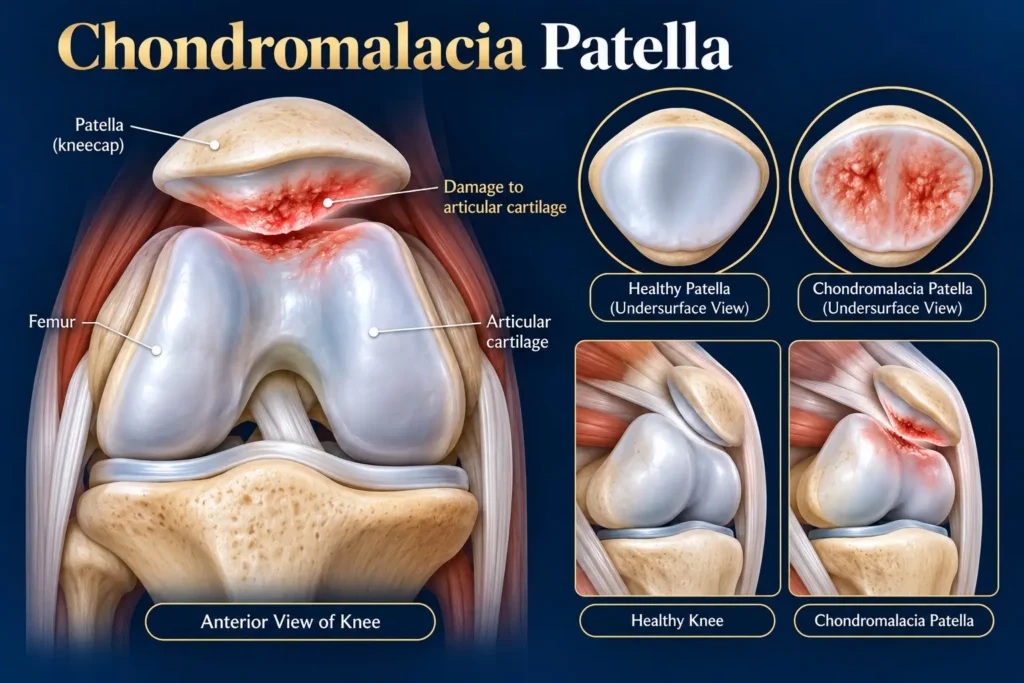
The patellofemoral joint is where the patella, or kneecap, meets the femur. It allows the kneecap to glide along the femur as you bend and straighten your knee. This movement helps distribute forces across the knee during everyday activities and exercise.
The main structures involved include:
During knee bending, the patella gradually moves within the trochlea. It then moves upward through the groove as the knee straightens. This coordinated movement is called patellar tracking. Normal tracking helps distribute pressure across the joint instead of concentrating stress in one area.
Chondromalacia patella can develop when repeated stress, abnormal tracking, or injury increases pressure on the patellar cartilage. Several factors can affect how the kneecap moves and how forces are distributed through the patellofemoral joint.
Common contributing factors include:
These factors can occur together rather than acting alone. Chondromalacia can also develop gradually without one clear traumatic event.
Chondromalacia patella commonly causes pain around or behind the kneecap, especially during activities that load the patellofemoral joint. Symptoms may develop gradually and often become more noticeable with repeated knee bending or prolonged activity.
Common symptoms include:
Symptoms often become worse with stair climbing, squatting, kneeling, running, jumping, cycling, or walking downhill. Sitting with the knee bent for a long time can also cause pain and stiffness, sometimes called the “movie theater sign.”
The severity of symptoms does not always match the extent of cartilage changes. Other problems affecting the patellofemoral joint can also contribute to pain and limited function.
Chondromalacia patella can cause pain during stairs, squats, or prolonged sitting because knee flexion increases pressure between the patella and femur. As the knee bends, contact between these surfaces increases while the quadriceps works to control the movement. This places greater load on the patellofemoral joint, especially during deeper knee flexion.
Prolonged sitting keeps the knee bent and maintains contact between the patella and femur for an extended period. These sustained forces can aggravate irritated cartilage and surrounding tissues, causing anterior knee pain, stiffness, or discomfort when you straighten the knee.
The Outerbridge classification describes chondromalacia patella from Grade 1 to Grade 4 based on the depth and severity of cartilage damage. The grade describes the structural extent of cartilage damage, but it does not always predict how much pain or functional limitation a person will experience.
Doctors diagnose chondromalacia patella using your symptoms, a physical examination, and imaging findings when appropriate. The evaluation also helps rule out other conditions that can cause anterior knee pain.
Doctors usually consider the overall clinical findings rather than relying on one test alone. Arthroscopy can directly assess cartilage, but it is generally reserved for situations where surgery is already being considered rather than used as a routine diagnostic test.
Treatment focuses on reducing symptoms, improving patellar mechanics, strengthening supporting muscles, and addressing the underlying cause. Treatment depends on symptoms, cartilage severity, biomechanics, and response to conservative care.
Conservative treatment is usually the first step for chondromalacia patella. It aims to reduce pain and improve knee function without surgery.
Physical therapy helps improve strength, flexibility, movement control, and patellar mechanics. A therapist can develop an exercise program based on the person's symptoms and functional needs.
Surgery is generally considered when significant symptoms continue despite appropriate conservative treatment or when substantial cartilage damage, recurrent instability, or an underlying structural problem requires correction.
The appropriate treatment depends on cartilage severity, symptoms, biomechanics, the underlying cause, and the response to conservative treatment.
Recovery from chondromalacia patella depends on the severity of cartilage damage, treatment, biomechanics, activity level, and response to rehabilitation. Some people notice symptom improvement within a few weeks, while others need several months of consistent treatment before returning to full activity.
Recovery timelines for different treatments are given below.
| Treatment | Typical Recovery Time | What to Expect |
|---|---|---|
| Activity modification and pain management | Several weeks | Mild symptoms may gradually improve after reducing activities that increase stress on the kneecap and managing pain appropriately. |
| Physical therapy and exercises | 6–12 weeks | Strength, flexibility, patellar control, and tolerance for daily activities may improve with consistent rehabilitation. |
| Persistent or moderate symptoms | 2–6 months | Ongoing rehabilitation may be needed when symptoms persist or biomechanical problems continue to place stress on the patellofemoral joint. |
| Advanced cartilage damage | Several months or longer | More extensive cartilage damage may require longer rehabilitation and additional treatment if symptoms do not improve with conservative care. |
| Recovery after surgery | Several months or longer | Recovery depends on the surgical procedure, cartilage condition, rehabilitation program, and individual healing response. |
Several factors can influence your recovery, including the severity of cartilage damage, activity modification, biomechanics, muscle strength, and individual response to treatment. Your commitment to rehabilitation also plays an important role. Following your physical therapy program, increasing activity gradually, and avoiding activities that repeatedly trigger pain can support symptom improvement and functional recovery.
Cartilage damage may not completely reverse, particularly when the damage is advanced. Still, improving muscle strength and patellar mechanics can reduce symptoms and help restore knee function.
The long-term outlook for chondromalacia patella is generally favorable with appropriate treatment. Many people achieve good symptom relief and return to normal activities. Still, damaged cartilage has limited healing capacity and may leave permanent structural changes. Long-term outcomes vary based on cartilage severity, biomechanics, treatment, and individual response.
Several factors can influence the long-term prognosis:
Surgery may be considered for selected people with persistent symptoms, significant cartilage damage, or an underlying structural problem that does not respond to conservative treatment. Surgery does not necessarily prevent future cartilage degeneration or completely change the long-term outlook.
Overall, many people can remain active and maintain good knee function with appropriate treatment and long-term management. The prognosis depends on the extent of cartilage damage, underlying biomechanics, recurrence of symptoms, and response to rehabilitation.
Chondromalacia patella, osteoarthritis, and patellofemoral pain syndrome can all cause pain around the kneecap. They describe different conditions and underlying problems, even though some symptoms can overlap.
| Feature | Chondromalacia Patella | Osteoarthritis | Patellofemoral Pain Syndrome |
|---|---|---|---|
| Underlying pathology | Damage or softening of the articular cartilage beneath the kneecap | Degenerative changes involving cartilage, bone, and other joint tissues | Pain related to the patellofemoral joint without requiring cartilage damage |
| Cartilage changes | Cartilage softening, fissuring, or loss may occur | Cartilage degeneration can progress to cartilage loss and joint-space narrowing | Demonstrable cartilage damage is not required |
| Typical symptoms | Pain around or behind the kneecap, grinding, and activity-related discomfort | Pain, stiffness, swelling, reduced movement, and activity-related discomfort | Pain around or behind the kneecap during stairs, squatting, running, or prolonged sitting |
| Terminology | Refers primarily to patellar cartilage damage | Includes knee osteoarthritis and patellofemoral osteoarthritis when the patellofemoral compartment is affected | Also called patellofemoral pain syndrome or anterior knee pain in some contexts |
| Relationship to the patellofemoral joint | Specifically affects the cartilage of the patellofemoral joint | May affect the patellofemoral joint, tibiofemoral joint, or both | Symptoms arise from the patellofemoral region without requiring structural cartilage damage |
| Imaging | MRI can help assess cartilage changes | X-rays can show joint-space narrowing and bone changes; MRI can assess cartilage and soft tissues | Imaging may be normal and is often used when another condition needs to be ruled out |
These conditions can overlap, but they should not automatically be treated as interchangeable diagnoses. Chondromalacia patella specifically describes cartilage changes beneath the kneecap, while patellofemoral pain syndrome describes pain around the patellofemoral joint without requiring confirmed cartilage damage. Osteoarthritis is a broader degenerative joint condition that can involve the patellofemoral compartment.
A person can have more than one of these conditions at the same time. For example, patellofemoral osteoarthritis can involve cartilage degeneration beneath the kneecap, while someone with patellofemoral pain syndrome may have pain without significant cartilage damage. Doctors consider symptoms, physical examination findings, biomechanics, and imaging together when determining the diagnosis.
Chondromalacia patella cannot always be prevented, but you can reduce the risk by managing knee stress, maintaining muscle strength, and addressing movement problems early. Controlling excessive or sudden loading can help reduce repeated stress on the patellofemoral joint.
You cannot prevent every case of chondromalacia patella because some structural and individual factors cannot be changed. Still, gradual exercise progression, strength training, good movement mechanics, and careful training-load management can help reduce avoidable stress on the patellofemoral joint.
You may be able to run with chondromalacia patella if your symptoms are controlled and your knee tolerates the activity. Running should depend on your pain, cartilage severity, biomechanics, exercise tolerance, and progress with rehabilitation.
Cycling may be possible with chondromalacia patella, particularly when symptoms remain controlled during low-impact exercise. Stationary cycling can still increase knee flexion and patellofemoral loading, so activity may need modification if it aggravates your symptoms.
Yes, cartilage changes associated with chondromalacia patella can exist without significant pain. Imaging findings do not always match symptoms, and some people may have cartilage damage or MRI findings without substantial clinical symptoms.
Yes, chondromalacia patella can occur with patellar instability. Repeated abnormal patellar tracking or dislocation can increase stress on the cartilage beneath the kneecap and may contribute to cartilage damage over time.
You should seek an orthopedic evaluation for persistent or worsening knee pain, swelling, instability, or significant difficulty with daily activities. A doctor can assess the knee, identify contributing problems, and determine whether further evaluation or treatment is needed.