
Specialties › Knee & Leg › ACL Injury

An ACL injury affects one of the key ligaments that helps keep the knee stable. It often occurs during sudden movements such as turning, stopping, pivoting, or landing from a jump, particularly during sports activities.
This guide explains how ACL injuries occur, the symptoms to watch for, available treatment options, recovery expectations, and ways to reduce the risk of long-term knee problems.
Book a consultation and receive expert orthopedic guidance.
An ACL injury refers to damage to the anterior cruciate ligament, one of the main stabilizing structures inside your knee.
This ligament connects your thigh bone (femur) to your shin bone (tibia). It plays a key role in controlling forward movement and rotation of the knee.
You rely on it during activities like:
When the ligament is overstretched or torn, the knee can lose stability and become painful. In more severe cases, normal movement becomes difficult without proper treatment.
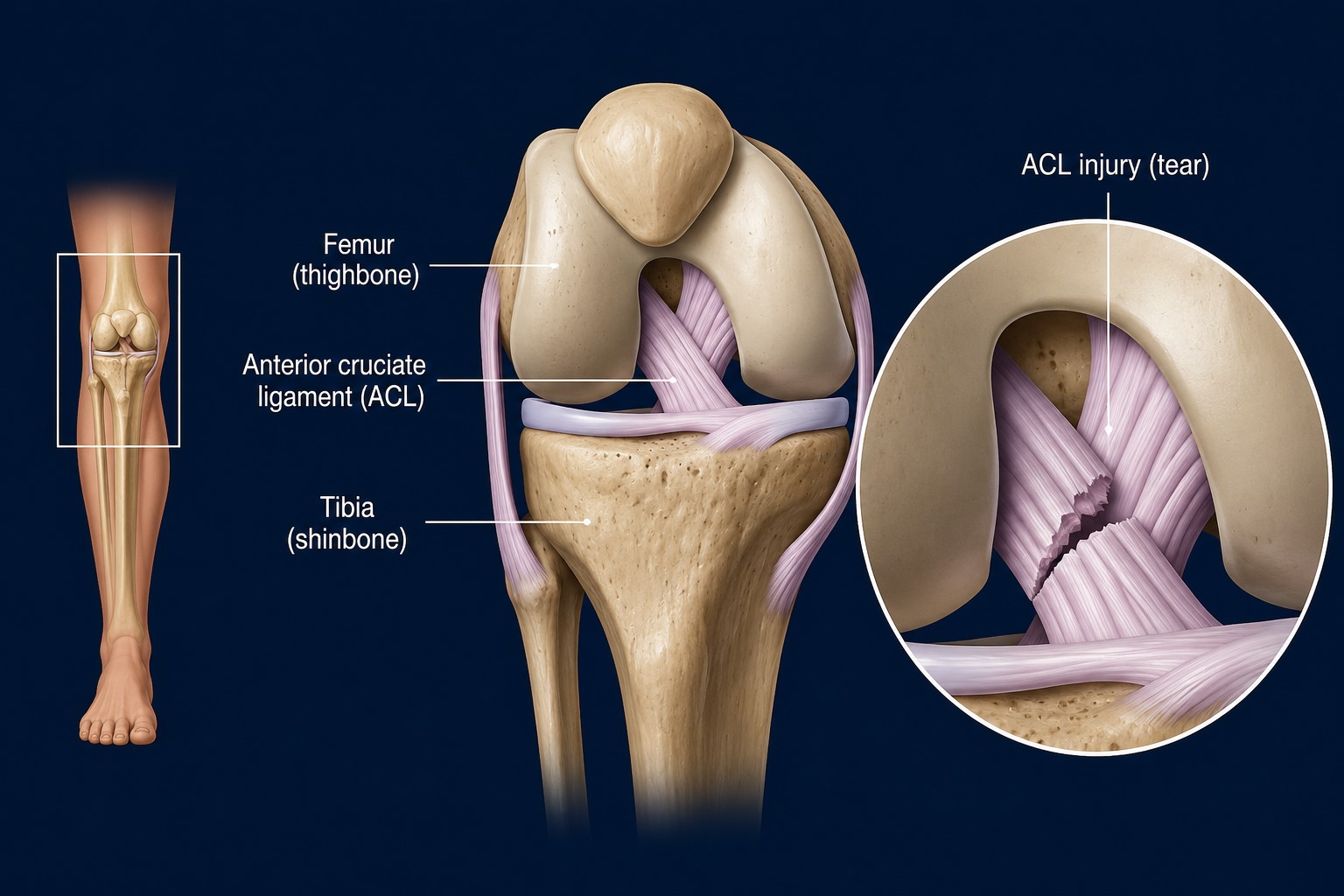
ACL injuries are among the most common knee injuries, especially in athletes.
In the United States, around 100,000 to 200,000 ACL tears occur each year. While the general population risk is about 1 in 3,500, athletes face a much higher risk—closer to 1 in 300.
These injuries are often linked to sports injuries such as:
About 70% of ACL injuries happen without contact, usually from awkward movement rather than collision.
Young athletes between 14 and 25 years old are at the highest risk. Female athletes are also more likely to experience ACL injuries due to differences in anatomy and movement control.
ACL tears occur annually in the United States.
Of ACL injuries happen without direct contact.
Young athletes have the highest injury risk.
Approximate risk among athletes.
ACL injuries are classified based on how much the ligament is damaged. This helps guide treatment and recovery.
The ligament is stretched but not torn. You may feel mild pain and swelling, but the knee remains stable. Most people can still walk, though movement may feel uncomfortable.
The ligament is partially torn. The knee may feel loose or unstable, especially during movement. Pain and swelling are more noticeable, and certain activities become difficult.
The ligament is completely torn. The knee becomes unstable and may not support weight properly. This type of injury often requires surgical treatment, especially for active individuals.
Some injuries involve additional damage, which can affect recovery:
These cases often need more detailed evaluation and treatment planning.
An ACL injury happens when the ligament is pushed beyond its normal limit. This usually occurs during sudden or high-force movements. In many cases, the injury is non-contact, meaning it comes from movement rather than a direct hit.
Turning quickly while your foot is planted can twist the knee.
Rapid deceleration puts stress on the joint.
Landing with a stiff knee increases strain on the ligament.
A force to the side of the knee can push it into an unsafe position.
These movements place intense stress on the ACL, which can lead to a partial or complete tear.
Some factors increase the likelihood of injury. These are often related to movement, body structure, or environment.
Sports that involve jumping, turning, and quick stops carry higher risk:
Your muscles help protect your knee.
Female athletes have a higher risk due to:
A past ACL injury increases the risk of another tear, especially without full recovery.
External conditions can also contribute:
An ACL injury usually shows clear signs within minutes to hours after it happens. The symptoms often make it obvious that something is wrong with the knee.
You may hear or feel a sudden pop at the moment of injury. This is one of the most recognized signs.
The knee often swells within a few hours. This happens due to bleeding inside the joint.
Pain starts quickly and may make it difficult to continue activity. It is often felt deep inside the knee.
The knee may feel loose or unstable, especially when you try to stand, walk, or change direction.
Swelling and pain can make it hard to fully bend or straighten your knee.
You may struggle to put weight on the affected leg, especially in more severe injuries.
The knee may feel sore when touched or pressed.
Diagnosis involves combining your injury history, a physical exam, and imaging tests. Doctors use all three to confirm the condition and rule out other problems.
Your doctor starts by asking how the injury happened. You may be asked:
These details provide important clues.
Your knee is checked for swelling, movement, and stability. It is often compared with the uninjured knee.
If these tests show abnormal movement, it strongly suggests an ACL injury.
MRI (key test): An MRI provides a detailed view of the knee. It shows:
X-ray: An X-ray does not show ligaments but helps rule out:
Ultrasound: Sometimes used for soft tissue evaluation, but less reliable for ACL injuries.
In some cases, a small camera is inserted into the knee to directly view the ligament. This is usually done during treatment rather than diagnosis.
Doctors also check for other conditions that may feel similar, such as:
ACL injury treatment depends on how severe the injury is, how active you are, and what level of activity you want to return to. Some people recover well without surgery. Others need reconstruction to restore knee stability, especially if they plan to return to sports or high-demand activities.
This approach is often suitable for partial tears or individuals with lower activity demands.
Right after the injury, the goal is to control pain and swelling:
This helps reduce inflammation and protect the joint.
Rehabilitation plays a central role in recovery. You’ll work on strengthening the quadriceps and hamstrings, improving balance and coordination, and restoring normal movement patterns. Strong muscles help stabilize the knee and reduce the feeling of giving way.
You may use a knee brace for added stability and crutches to reduce pressure while walking. These supports are especially useful in the early phase.
Pain and swelling can be managed with anti-inflammatory medicines like Ibuprofen when used appropriately.
You should avoid activities such as running, jumping, and sudden direction changes. Gradually returning to activity helps prevent further injury.
Surgery is usually recommended if you have a complete tear, your knee feels unstable, or you want to return to sports or high-level activity.
Arthroscopic surgery is a minimally invasive procedure. Surgeons use a small camera and specialized tools inserted through small incisions. This reduces tissue damage and supports faster recovery.
The damaged ligament is replaced with a tissue graft. Common sources include the patellar tendon, hamstring tendon, and quadriceps tendon. Over time, this graft functions like a new ligament.
The graft is secured using screws or fixation devices, allowing it to heal in place.
Good preparation improves recovery and reduces complications. Pre-surgery rehabilitation (prehab) involves strengthening your knee before surgery to speed up recovery. Focus on quadriceps activation, glute strengthening, and controlled movement exercises (like heel slides). Maintaining strength and mobility before surgery makes a clear difference afterward.
Reduce swelling before surgery using rest, ice, compression, and elevation to calm inflammation. A less swollen knee responds better to surgery. Practice using crutches before surgery to make daily movement easier after the procedure. Medication planning may include stopping certain medications, such as blood thinners or anti-inflammatory drugs, a few days before surgery.
The day before surgery, do not eat or drink after midnight and follow any hygiene instructions (such as antiseptic washing). Prepare your home by setting up a safe recovery space, keeping essentials within reach, clearing walking paths, and arranging support items if needed. Arrange support to drive you home and stay with you for the first 24 hours.
Recovery from an ACL injury takes time and consistent effort. Most people need 6 to 12 months to recover, especially after surgery.
Weeks 1–6: You focus on reducing pain and swelling while restoring basic movement. Regaining full knee extension is a key goal early on.
Months 3–6: You build strength in the quadriceps, hamstrings, and surrounding muscles to support the knee.
Months 6–12: You progress to advanced training, including balance, control, and sport-specific movements.
Most athletes return to sports around 9–12 months, once strength and stability are restored.
Many people return to normal activity with proper rehabilitation. Outcomes depend on:
There is a risk of re-injury, especially if recovery is rushed. In some cases, the graft continues to mature for up to 18 months.
Without proper care, ACL injuries can lead to ongoing issues:
Early treatment and structured rehabilitation help reduce these risks.
You can lower your risk by improving strength, control, and movement habits. Build leg strength by focusing on the quadriceps, hamstrings, glutes, and calves. Improve landing technique by keeping your knees slightly bent, aligning your knees with your feet, and avoiding inward collapse.
Train balance and control by practicing single-leg balance, lateral movements, and agility drills. Use neuromuscular training to improve coordination and movement patterns. Avoid training when fatigued, as fatigue reduces control and increases injury risk.
Warm up properly to prepare your muscles with light activity and stretching. Strengthen your core to improve overall stability. Follow safe training habits by using proper footwear, increasing intensity gradually, and taking rest days. Practice controlled jumping with safe takeoff and landing techniques.
Answers to common questions about ACL injuries, recovery, treatment, and long-term outcomes.
Some ACL tears may show limited healing with proper non-surgical care. Still, many cases require structured treatment, so evaluation is important.
You can often walk after initial swelling improves. The knee may still feel unstable, especially during turning or pivoting.
Yes, re-injury can occur, especially in active individuals. Proper rehabilitation helps reduce this risk.
Most athletes return to their sport after treatment and rehabilitation. Many regain their previous performance level.
Some people may develop instability, reduced movement, or joint wear over time, especially without proper care.
Female athletes have a higher risk due to differences in body structure, movement patterns, and muscle control. Hormonal factors may also contribute.

We use cookies to improve your experience on our site. By using our site, you consent to cookies.
Manage your cookie preferences below:
Essential cookies enable basic functions and are necessary for the proper function of the website.