Calf Strain: Symptoms, Causes, Grades, Treatment and Recovery

Prof. Dr. Haluk Çabuk

Prof. Dr. Haluk Çabuk

Professor of Orthopedics & Traumatology
Medically Reviewed Updated November 14, 2026 24 min read

A calf strain is one of the most common lower-leg muscle injuries. It affects the calf muscles at the back of the lower leg, particularly the gastrocnemius and soleus. The injury can happen during sudden movements, such as sprinting, jumping, or changing direction quickly. It can cause mild muscle fiber damage or develop into a more severe partial or complete muscle tear.

This article explains what calf strains are and what causes them. You will learn about the different injury grades, common symptoms, how doctors diagnose them, and the available treatment options. We also cover rehabilitation exercises, recovery timelines, when physical therapy may be necessary, possible complications, ways to prevent another injury, and answers to common patient questions.

Book Appointment

Need a personalized treatment plan?

Book a consultation and receive expert orthopedic guidance.

What Is a Calf Strain?

A calf strain occurs when muscle fibers in the calf become overstretched or torn, often during sudden movement or forceful activity. It affects one or more muscles at the back of your lower leg, most commonly the gastrocnemius or soleus.

A calf strain is also known as a pulled calf muscle or calf muscle tear. The injury can vary in severity depending on how many muscle fibers are damaged. Mild strains involve minor muscle fiber damage, while more severe injuries can cause a partial or complete muscle tear.

The injury can cause calf pain, tenderness, tightness, swelling, and reduced muscle strength. These symptoms may make everyday activities, such as walking, climbing stairs, running, and pushing off your foot, difficult.

Most mild and moderate calf strains improve with appropriate nonsurgical treatment and progressive rehabilitation. Severe muscle tears may require further medical assessment and, occasionally, surgical treatment.
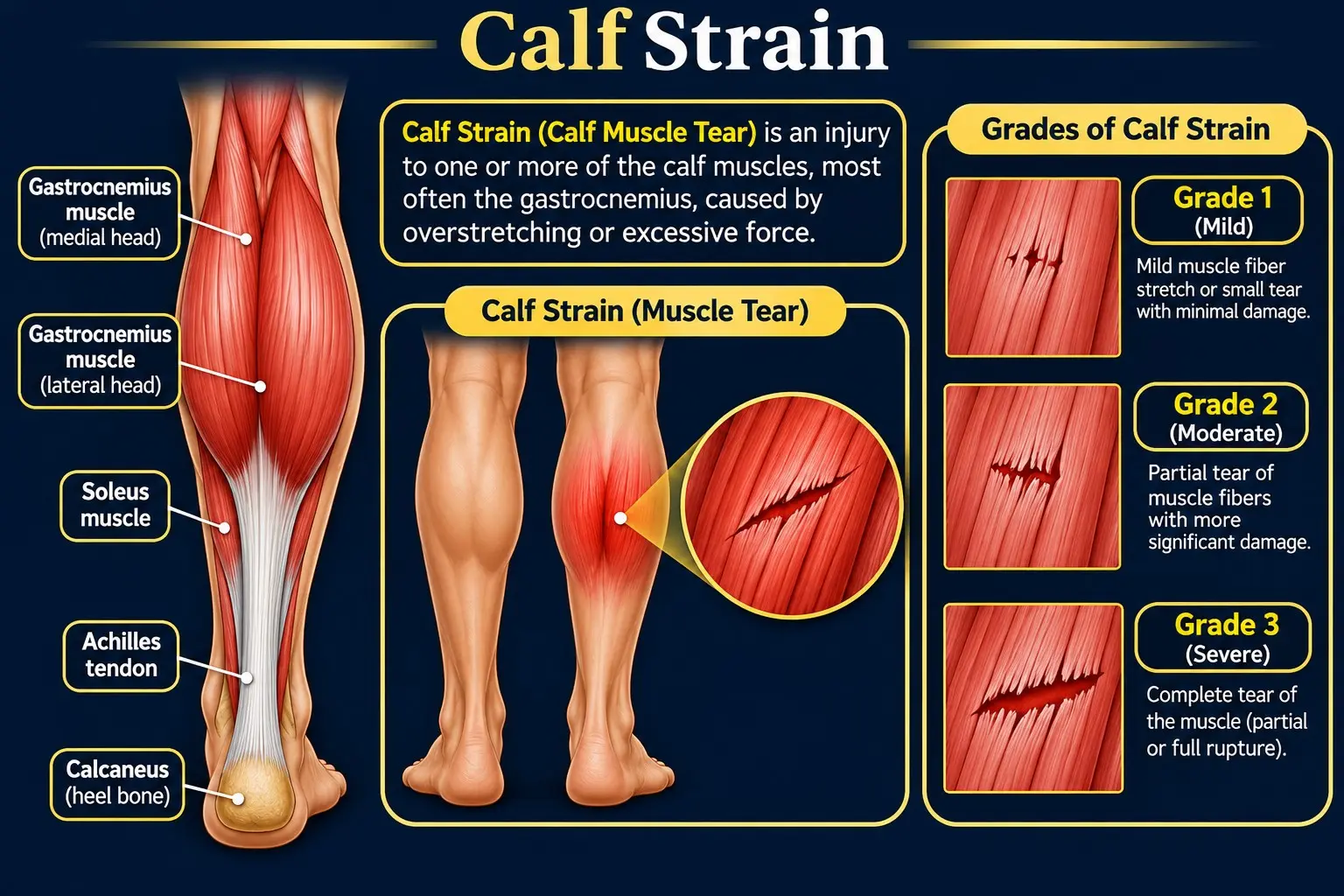
Calf strain showing injury to the calf muscles

What Are the Calf Muscles and How Do They Work?

The calf muscles are located at the back of your lower leg, behind the shinbone (tibia). They help control ankle movement and support everyday activities such as standing, walking, running, and jumping.

The main calf muscles include the gastrocnemius, soleus, and plantaris. The gastrocnemius and soleus work together to form the triceps surae. They connect to the heel bone through the Achilles tendon.

What Are the Main Calf Muscles?

The three main muscles associated with the calf are:

  • Gastrocnemius: This is the large, superficial muscle that gives your calf much of its shape. It has two heads and crosses both the knee and ankle joints. It helps point your toes downward, lift your heel, and generate force during running, jumping, and sprinting.
  • Soleus: This broad, flat muscle lies underneath the gastrocnemius. It connects the tibia and fibula to the Achilles tendon and crosses only the ankle joint. It helps maintain posture, control your lower leg while standing, and support walking and running.
  • Plantaris: This is a small muscle located deep to the gastrocnemius. It is absent in some people and plays a relatively minor role in ankle movement. It may assist with plantar flexion and knee flexion, while the gastrocnemius and soleus perform most of the work.

How Do the Calf Muscles Work?

The calf muscles work together to control movement and support your body during different activities:

  • Ankle Plantar Flexion: The gastrocnemius and soleus help point your toes downward and lift your heel off the ground. This movement allows you to stand on your toes and push your body forward.
  • Walking: During walking, the calf muscles control the forward movement of your lower leg and help push your foot off the ground. The soleus plays an important role in supporting your body throughout each step.
  • Running and Sprinting: The gastrocnemius and soleus generate force during the push-off phase of running. They also help control ankle movement and manage the forces created when your foot contacts the ground.
  • Jumping: The calf muscles contract to lift your heel and propel your body upward. The gastrocnemius contributes to powerful movements, while the soleus helps generate and control force through the ankle.
  • Maintaining Balance and Posture: The gastrocnemius and soleus make continuous adjustments to keep your body stable while standing. They also help control your body's forward movement when you lean or shift your weight.
  • Supporting Blood Circulation: Calf muscle contractions compress the deep veins in your lower leg and help move blood upward toward your heart. This action is known as the calf muscle pump.

The calf muscles work together, but they do not perform exactly the same functions. A calf strain may affect the gastrocnemius, soleus, plantaris, or more than one muscle. The location and severity of the injury can influence your symptoms and ability to move normally.

What Causes a Calf Strain?

A calf strain often occurs when the calf muscles are overloaded during acceleration, jumping, sudden changes of direction, or forceful push-off. These movements place high demands on the gastrocnemius and soleus muscles, particularly when they contract forcefully or stretch beyond their normal range.

The injury develops when muscle fibers become overstretched or contract under excessive force. This can cause minor muscle fiber damage or a partial or complete tear.

Common causes and contributing factors include:

  • Sprinting: Sprinting places high demands on the calf muscles. They generate substantial force during each push-off. A sudden, forceful contraction can overstretch or tear muscle fibers.
  • Rapid Acceleration: Quickly increasing your speed requires the calf muscles to produce more force. Accelerating suddenly from a stationary position or moving into a fast run can trigger an acute strain.
  • Jumping and Landing: Jumping places considerable stress on the calf muscles as they help propel your body upward. Landing also requires these muscles to control movement and absorb force.
  • Sudden Stretching: The calf muscles can become injured when they stretch beyond their comfortable range, particularly during contraction. This can happen when you forcefully push off with your foot while your ankle moves upward.
  • Abrupt Changes in Direction: Sports such as basketball, football, tennis, and pickleball involve quick turns, pivots, and sudden stops. These movements can place unexpected loads on the calf muscles.
  • Sudden Increases in Activity: Quickly increasing your running distance, workout intensity, or training frequency can overload the calf muscles before they adapt. Starting demanding exercise after a period of inactivity can also increase injury risk.
  • Repeated Loading and Overuse: Frequent running, long-distance walking, or climbing steep hills can place repeated stress on the calf muscles. Insufficient recovery between activities may contribute to muscle irritation and injury.
  • Insufficient Warm-Up: Starting intense exercise without preparing your muscles can make sudden movements harder to tolerate. A gradual warm-up helps prepare the calf muscles for physical activity.
  • Muscle Weakness or Limited Flexibility: Reduced calf strength, muscle fatigue, or restricted ankle movement may affect how your lower leg handles physical demands. These factors can contribute to excessive muscle loading during certain activities.

Calf strains can develop suddenly or gradually. Acute injuries usually occur during a specific movement, such as sprinting or jumping. Gradual-onset injuries may develop after repeated muscle loading without adequate recovery.

Who Is at Risk of a Calf Strain?

A calf strain can affect anyone, but certain factors may increase the likelihood of injury. These include previous muscle injuries, inadequate conditioning, training changes, and activities that place high demands on the calf muscles.

Common risk factors include:

  • Older Age: People over 40, particularly competitive masters runners and older athletes, may have a higher risk of calf strains. Age-related changes in muscle quality, elasticity, and strength can affect how muscles tolerate sudden movements.
  • Previous Injury History: A previous calf strain increases the risk of another injury, especially if the muscle has not fully recovered. Previous injuries involving the hamstrings, quadriceps, adductors, or knee may also influence lower-limb movement and physical loading.
  • Muscle Tightness and Poor Conditioning: Tight calf muscles, limited ankle mobility, inadequate warm-ups, and poor physical conditioning may make it harder for the muscles to tolerate sudden force. Insufficient strength and preparation can increase injury risk during demanding activities.
  • Sudden Training Increases: Quickly increasing running distance, workout intensity, or training frequency can overload the calf muscles before they adapt. This is particularly relevant when returning to exercise after a break.
  • Inadequate Recovery and Muscle Fatigue: Repeated intense workouts without sufficient recovery can leave the calf muscles fatigued. Tired muscles may struggle to maintain strength and movement control during sprinting, jumping, or sudden acceleration.
  • Higher Body Mass: Higher body mass can increase the mechanical demands placed on the calf muscles during walking, running, and jumping. However, body mass alone does not determine whether someone will develop a calf strain.

Which Activities and Sports Carry a Higher Risk?

Some activities place greater demands on the calf muscles because they involve repeated loading, explosive movements, or sudden changes in direction.

  • High-Impact and Sprint Sports: Tennis, soccer, basketball, track and field, rugby, and Australian football involve sprinting, jumping, rapid stopping, and sudden changes of direction. These movements increase the demands placed on the calf muscles.
  • Distance Running: Runners repeatedly load their calf muscles during each stride. Quickly increasing running mileage, speed, or hill training can increase muscle demands. Running technique may also influence how different calf muscles are loaded.
  • Jumping and Explosive Activities: Basketball, volleyball, and track-and-field events require powerful calf contractions. Repeated jumping and forceful push-offs can increase stress on the gastrocnemius and soleus muscles.
  • Activities Involving Sudden Acceleration or Stopping: Sports and exercises that require quick bursts of speed, sudden braking, or pivoting can place unexpected stress on the calf muscles.

Having these risk factors does not mean you will definitely develop a calf strain. Your injury risk depends on several factors, including previous injuries, muscle conditioning, training habits, recovery, and the physical demands of your activities.

What Are the Symptoms of a Calf Strain?

A calf strain can cause sudden pain in the back of the lower leg, tenderness, swelling, and difficulty walking or pushing off the foot. Symptoms may develop immediately during the injury or become more noticeable over the following hours.

The type and severity of symptoms depend on how much muscle damage has occurred. Common symptoms of a calf strain include:

  • Calf Pain: You may experience sharp, stabbing, or pulling pain in the back of your lower leg. Some people describe the sensation as feeling like someone kicked or struck their calf. Pain may increase when walking, running, climbing stairs, or pushing off the foot.
  • Muscle Tightness: The affected calf may feel stiff, tight, or knotted. You may also experience muscle spasms or cramping, particularly when moving your ankle or stretching the calf.
  • Swelling: Swelling may develop around the injured muscle. Its severity depends on the extent of muscle damage. More significant muscle tears can cause noticeable swelling in the calf.
  • Bruising: Damaged muscle fibers and small blood vessels can cause bruising or skin discoloration. Bruising may appear around the injured area or extend toward the ankle and foot as blood moves through surrounding tissues.
  • Muscle Weakness: You may notice reduced strength when standing on your toes, raising your heel, climbing stairs, or pushing your foot off the ground. More severe injuries can make walking difficult.
  • Restricted Movement: Pain and tightness can limit ankle movement, particularly when pulling your toes upward or pointing them downward. Bending your knee may also become uncomfortable if the gastrocnemius muscle is affected.
  • Popping or Snapping Sensation: Some people hear or feel a sudden pop when the injury occurs. This can happen with a more significant muscle tear, although not every severe strain produces this sensation.

Calf strain symptoms vary depending on the affected muscle and the extent of tissue damage. Mild injuries may cause only slight pain and tightness, while more severe tears can cause significant bruising, weakness, and difficulty bearing weight.

Severe pain, significant muscle weakness, extensive swelling, or an inability to walk warrants prompt medical assessment. These symptoms may indicate a more serious muscle injury or another condition affecting the lower leg.

What Are the Different Grades of Calf Strains?

Calf strains are classified into three grades based on the extent of muscle damage and its effect on strength and movement. The grading system helps doctors understand the severity of the injury and determine an appropriate treatment and rehabilitation plan.

The three grades of calf strains are:

  1. Grade 1 (Mild Strain): A small number of muscle fibers become overstretched or microscopically damaged. This causes mild pain, tightness, and tenderness, with little or no loss of muscle strength or movement.
  2. Grade 2 (Moderate Strain): A partial muscle tear damages more muscle fibers. You may experience noticeable pain, swelling, bruising, and reduced muscle strength. Walking, climbing stairs, and pushing off the foot may become difficult.
  3. Grade 3 (Severe Strain): A complete or near-complete muscle tear causes significant pain, swelling, bruising, and severe muscle weakness. You may struggle to walk or bear weight, and a visible or palpable gap may sometimes appear in the injured muscle.

The severity of a calf strain is determined through clinical assessment of your symptoms, muscle strength, movement, and physical examination. Ultrasound or MRI may help confirm the extent of muscle damage when necessary.

How Is a Calf Strain Diagnosed?

A doctor can usually diagnose a calf strain through your injury history and a physical examination. They will ask how the injury happened, when symptoms started, and which movements make the pain worse.

During the examination, the doctor may:

  • Check for tenderness: They will press different areas of your calf to identify pain and tenderness.
  • Assess swelling and bruising: They will look for visible signs of muscle damage.
  • Test muscle strength: They may ask you to push your foot downward against resistance.
  • Check ankle movement: They will assess how comfortably you can move your ankle.
  • Assess walking ability: They may observe how you walk and whether you can push off your foot.
  • Perform specific tests: A Thompson test may help distinguish a calf strain from an Achilles tendon rupture.

When Are Imaging Tests Needed?

Most calf strains do not require imaging tests for diagnosis. A doctor may recommend imaging when the injury is severe, the diagnosis is uncertain, or symptoms do not improve as expected.

Common imaging tests include:

  • Ultrasound: This can show muscle fiber damage, partial tears, swelling, and fluid collection. It can also help assess other possible causes of calf pain.
  • MRI: This provides detailed images of the calf muscles and surrounding soft tissues. It can help identify the location and extent of a muscle tear.
  • Vascular ultrasound: A doctor may request this test if they suspect deep vein thrombosis (DVT), a blood clot in a deep vein.

Your doctor will choose the appropriate tests based on your symptoms and examination findings. An accurate diagnosis helps determine the injury's severity and guide your treatment plan.

How Is a Calf Strain Treated?

Treatment for a calf strain depends on the severity of the injury and your symptoms. Most mild and moderate strains improve with nonsurgical treatment and a gradual rehabilitation program.

The main goals are to reduce pain and swelling, protect the injured muscle, restore movement, and rebuild strength. Returning to normal activities too quickly can increase the risk of another injury.

1. Protect the Injured Calf and Manage Symptoms

During the first 24–72 hours after a calf strain, focus on protecting the injured muscle and managing pain and swelling. Avoid activities that increase calf pain, including running, jumping, and forceful push-offs.

You can help manage symptoms through the following measures:

  • Activity Modification: Reduce or temporarily stop activities that cause pain. Avoid pushing through sharp pain or significant discomfort.
  • Ice: Apply an ice pack to the affected area for 10–20 minutes at a time to help relieve pain and swelling. Wrap the ice pack in a towel to protect your skin. Allow your skin to return to its normal temperature between applications.
  • Compression: A compression bandage may help control swelling. It should feel supportive without restricting circulation.
  • Elevation: Raise your leg when resting to help reduce swelling.
  • Pain Relief: Appropriate over-the-counter pain medication may help manage discomfort. Ask a healthcare professional or pharmacist which option is suitable for you.

After this initial period, continue protecting the injured muscle and gradually restore movement as your symptoms allow. Avoid returning to strenuous activities while walking or basic calf movements remain painful.

2. Restore Movement and Gradually Rebuild Strength

Once the initial pain and swelling begin to settle, gradual movement helps restore normal calf function. Your doctor or physiotherapist can guide you through exercises based on your injury severity and recovery progress.

Rehabilitation usually progresses from gentle ankle movements to more demanding strengthening exercises. The aim is to restore flexibility, muscle strength, and the ability to tolerate everyday activities.

Some people may also benefit from a temporary heel lift. This raises the heel slightly and reduces the stretch placed on the calf muscle during walking. A healthcare professional can advise whether it is appropriate for your injury.

3. When Is Surgery Necessary?

Most calf strains heal without surgery. Severe injuries involving complete or near-complete muscle tears may require assessment by an orthopedic or sports medicine specialist.

Surgery is occasionally considered for selected severe tears. The decision depends on the location and extent of the damage, functional limitations, and individual circumstances.

What Exercises Help a Calf Strain Recover?

Calf rehabilitation exercises help restore ankle movement, muscle strength, and functional ability. The appropriate exercises depend on the injury grade and your stage of recovery.

A physiotherapist may introduce exercises gradually, starting with gentle movements and progressing as your symptoms improve.

Common rehabilitation exercises include:

  • Ankle Mobility Exercises: Gentle ankle movements help maintain and restore movement. These may include pointing your toes downward and pulling them upward.
  • Isometric Calf Contractions: You tighten your calf muscles without moving your ankle. This helps activate the muscles while limiting joint movement.
  • Double-Leg Heel Raises: You raise both heels while standing and then lower them slowly. This helps rebuild basic calf strength.
  • Straight-Knee Heel Raises: You perform heel raises with your knees straight. This places greater emphasis on the gastrocnemius muscle.
  • Bent-Knee Heel Raises: You perform heel raises with your knees slightly bent. This places greater emphasis on the soleus muscle.
  • Single-Leg Heel Raises: You raise one heel at a time to improve strength and control in the injured calf.
  • Resistance Band Plantar Flexion: You push your foot downward against a resistance band. This helps strengthen the calf muscles.

Your physiotherapist may gradually increase the difficulty of these exercises as your strength and tolerance improve. Later stages may include functional activities that prepare you for running, jumping, and sports.

Do not start or progress exercises based only on a fixed timeline. Your symptoms, strength, and ability to perform each movement should guide rehabilitation. Stop an exercise if it causes sharp pain or significantly worsens your symptoms.

When Do You Need Physical Therapy for a Calf Strain?

Physical therapy can help restore calf strength, flexibility, movement, and function after a muscle strain. Many mild injuries improve with basic care and gradual activity. Moderate and severe strains may need a more structured rehabilitation program.

A doctor or physiotherapist may recommend physical therapy in the following situations:

  • Moderate or Severe Calf Strains: Grade 2 and Grade 3 injuries involve greater muscle damage. Guided rehabilitation helps restore strength and function safely.
  • Persistent or Worsening Symptoms: You may need professional assessment if pain, swelling, or stiffness does not improve as expected.
  • Difficulty With Everyday Activities: Physical therapy can help if you still struggle with walking, climbing stairs, standing on your toes, or pushing off your foot.
  • Recurrent Calf Strains: Repeated injuries may indicate ongoing weakness, limited flexibility, or problems with movement. A physiotherapist can assess these issues and develop a rehabilitation plan.
  • Difficulty Returning to Sports: Athletes may need supervised exercises to rebuild calf strength, improve movement control, and prepare for running, jumping, and sudden changes of direction.

How Can Physical Therapy Help?

A physiotherapist assesses your calf strength, ankle movement, flexibility, and functional ability. They then develop a rehabilitation program based on your injury severity and recovery progress.

Your program may include:

  • Mobility Exercises: Gentle movements help restore normal ankle and calf movement.
  • Progressive Strengthening: Gradually increasing exercise resistance helps rebuild gastrocnemius and soleus strength.
  • Functional Training: Activities such as walking, heel raises, and controlled hopping prepare your calf for everyday demands and sports.
  • Return-to-Sport Guidance: Your physiotherapist helps assess whether your calf can tolerate more demanding activities before you resume full training.

The goal is to restore normal calf function and reduce the risk of another strain. Your return to activity should depend on your strength, symptoms, and ability to perform functional movements rather than time alone.

How Long Does a Calf Strain Take to Heal?

The recovery time for a calf strain depends on the severity of the injury, the amount of muscle damage, and your rehabilitation progress. Mild strains usually heal faster, while severe tears can take several months to recover.

The approximate recovery timelines for different calf strain grades are:

  • Grade 1 (Mild): 1–3 Weeks – Minor muscle fiber damage usually heals within a few weeks. You may experience mild pain and tightness but retain most of your normal strength and movement.
  • Grade 2 (Moderate): 3–6 Weeks – Partial muscle tears require more time to heal. Some people need 4–8 weeks or longer to regain full strength and function, depending on the extent of the injury.
  • Grade 3 (Severe): 3–6 Months or Longer – Complete or near-complete muscle tears require a longer recovery period. Severe injuries may take several months to regain strength and normal function. Some cases need additional specialist treatment.

What Factors Affect Calf Strain Recovery Time?

Several factors can influence how quickly your calf muscle heals:

  • Injury Severity: Greater muscle damage generally requires more time to heal.
  • Treatment Approach: Appropriate early care and a gradual rehabilitation program support recovery.
  • Previous Injuries: A history of calf strains may increase the risk of further injury and affect recovery.
  • Muscle Strength and Flexibility: Reduced strength or limited flexibility can make rehabilitation more challenging.
  • Rehabilitation Progress: Consistent, progressive exercises help restore muscle strength and function.
  • Activity Level: Returning to running, jumping, or sports too early can delay recovery or cause another strain.

These timelines are approximate. Your actual recovery may be shorter or longer depending on the injury and your individual progress.

What Are the Possible Complications of a Calf Strain?

Most calf strains heal with appropriate treatment and rehabilitation. However, some injuries can lead to complications, particularly when muscle damage is severe or recovery is incomplete.

Possible complications include:

  • Recurrent Calf Strain: Returning to running, sports, or strenuous activities too early can increase the risk of injuring the same muscle again.
  • Persistent Pain and Weakness: Some people continue to experience calf pain, reduced strength, or difficulty performing physical activities after the initial injury.
  • Stiffness and Reduced Flexibility: The injured calf may remain tight or lose some flexibility, making ankle movement and everyday activities more difficult.
  • Scar Tissue Formation: Healing muscle fibers may develop scar tissue. This can sometimes affect muscle flexibility and function.
  • Delayed Recovery: Severe muscle damage, inadequate rehabilitation, or premature return to activity can prolong recovery.
  • Hematoma: A significant muscle tear can cause bleeding within the surrounding tissue. This may lead to a collection of blood called a hematoma.
  • Myositis Ossificans: Rarely, bone tissue may develop within an injured muscle following trauma. This condition can cause persistent pain, swelling, and restricted movement.

When Should You Seek Medical Attention?

Not all calf pain and swelling result from a muscle strain. Other conditions, including deep vein thrombosis (DVT), Achilles tendon injuries, and compartment syndrome, can cause similar symptoms.

Seek prompt medical assessment if you experience:

  • Possible Deep Vein Thrombosis (DVT): Unexplained calf pain, increasing swelling, warmth, or redness may indicate a blood clot in a deep vein.
  • Possible Achilles Tendon Rupture: Sudden pain near the back of your ankle, a popping sensation, or difficulty pushing off your foot may indicate an Achilles tendon injury.
  • Possible Compartment Syndrome: Rapidly increasing pain, severe tightness or swelling, numbness, or weakness may indicate dangerous pressure building inside the muscle compartment.

Seek emergency medical care if you develop chest pain, shortness of breath, or cough up blood. These symptoms may indicate a pulmonary embolism, which can occur when a blood clot travels to the lungs.

Early assessment helps identify serious conditions and ensures you receive appropriate treatment.

How Can You Prevent Another Calf Strain?

You can reduce the risk of another calf strain by improving muscle strength, maintaining flexibility, and managing your training load. Proper preparation and recovery also help protect your calf muscles during physical activity.

The following measures can help prevent future injuries:

  • Warm Up Before Exercise: Begin with light activity, such as walking or gentle jogging, before more demanding exercise. A proper warm-up prepares your calf muscles for increased activity.
  • Increase Training Gradually: Avoid sudden increases in exercise intensity, distance, or duration. Give your muscles time to adapt to new training demands.
  • Strengthen Your Calf Muscles: Include exercises that target both the gastrocnemius and soleus. Heel raises and resistance band exercises can help improve calf strength.
  • Maintain Muscle Flexibility: Regular calf mobility and stretching exercises can help maintain normal ankle movement and muscle flexibility.
  • Allow Adequate Recovery: Give your muscles enough time to recover between demanding training sessions. Avoid exercising intensely when your calves feel excessively tired or sore.
  • Wear Suitable Footwear: Choose footwear that provides appropriate support for your activities. Replace worn-out shoes when necessary.
  • Complete Your Rehabilitation: Do not return to intense exercise or sports until your injured calf has regained adequate strength and function. Follow your rehabilitation plan and progress gradually.
  • Address Other Movement or Strength Problems: Weakness or movement limitations elsewhere in your lower limbs may affect how your calf muscles work. A physiotherapist can assess these issues and recommend suitable exercises.

If you have experienced repeated calf strains, consider getting a professional assessment. Identifying underlying strength or movement problems can help reduce the risk of another injury.

FAQs About Calf Strains

1. What Is the Difference Between a Calf Strain and a Calf Tear?

A calf strain involves overstretched or damaged muscle fibers. A calf tear means some or all muscle fibers have torn. Both terms describe the same type of injury, but the severity can vary.

2. Can a Calf Strain Heal on Its Own?

Yes. Most mild calf strains heal with activity modification and gradual rehabilitation. Moderate and severe tears may require medical assessment and structured treatment.

3. Should You Stretch a Pulled Calf Muscle?

Avoid forceful stretching during the early stages of recovery. Gentle ankle movements may help maintain mobility. Introduce calf stretching gradually as symptoms improve.

4. Why Does Your Calf Still Hurt After a Strain?

Ongoing pain may result from incomplete healing, muscle weakness, stiffness, or returning to intense activities too early. Persistent or worsening pain needs medical assessment.

5. What Does a Pulled Calf Muscle Feel Like?

A pulled calf muscle usually causes sudden pain, tightness, or a sharp pulling sensation. Some people feel a popping sensation when injured. Severe tears may cause significant bruising, swelling, and difficulty walking.

6. Can You Still Walk or Run With a Calf Strain?

Mild strains may allow walking with some discomfort. Moderate and severe injuries can make walking difficult. Avoid running while it causes pain, and return gradually as your strength and function recover.

7. When Can You Return to Running or Sports After a Calf Strain?

You can return to running and sports when your calf has regained adequate strength and function. You should be able to walk normally and perform heel raises without significant pain. Start with light running and gradually progress to sprinting and sport-specific activities.