Patellofemoral Pain Syndrome: Symptoms, Causes, Diagnosis, Treatment and Recovery

Prof. Dr. Haluk Çabuk

Prof. Dr. Haluk Çabuk

Professor of Orthopedics & Traumatology
Medically Reviewed Updated October 18, 2026 18 min read

Patellofemoral pain syndrome (PFPS) is a common cause of anterior knee pain. It affects the area around or behind the kneecap, especially during activities that place stress on the patellofemoral joint. The condition is sometimes called runner’s knee and can develop with repeated loading, changes in activity, or altered movement patterns.

This article explains everything you need to know about patellofemoral pain syndrome. You will learn how the patellofemoral joint works, what causes PFPS, its common symptoms, how doctors diagnose it, and the available treatment options. We also cover recovery, long-term outlook, prevention, when surgery may be considered, how PFPS differs from patellofemoral arthritis, and answers to common patient questions.

Book Appointment

Need a personalized treatment plan?

Book a consultation and receive expert orthopedic guidance.

What Is Patellofemoral Pain Syndrome?

Patellofemoral pain syndrome is pain around or behind the kneecap that commonly occurs during activities that load the patellofemoral joint. It is a common cause of anterior knee pain and is sometimes called runner’s knee.

The condition affects the area where the patella (kneecap) meets the femur (thighbone). As you bend and straighten your knee, the patella normally glides through a groove at the end of the femur. Repeated stress, changes in activity, or altered movement patterns can increase stress around this joint and contribute to pain.
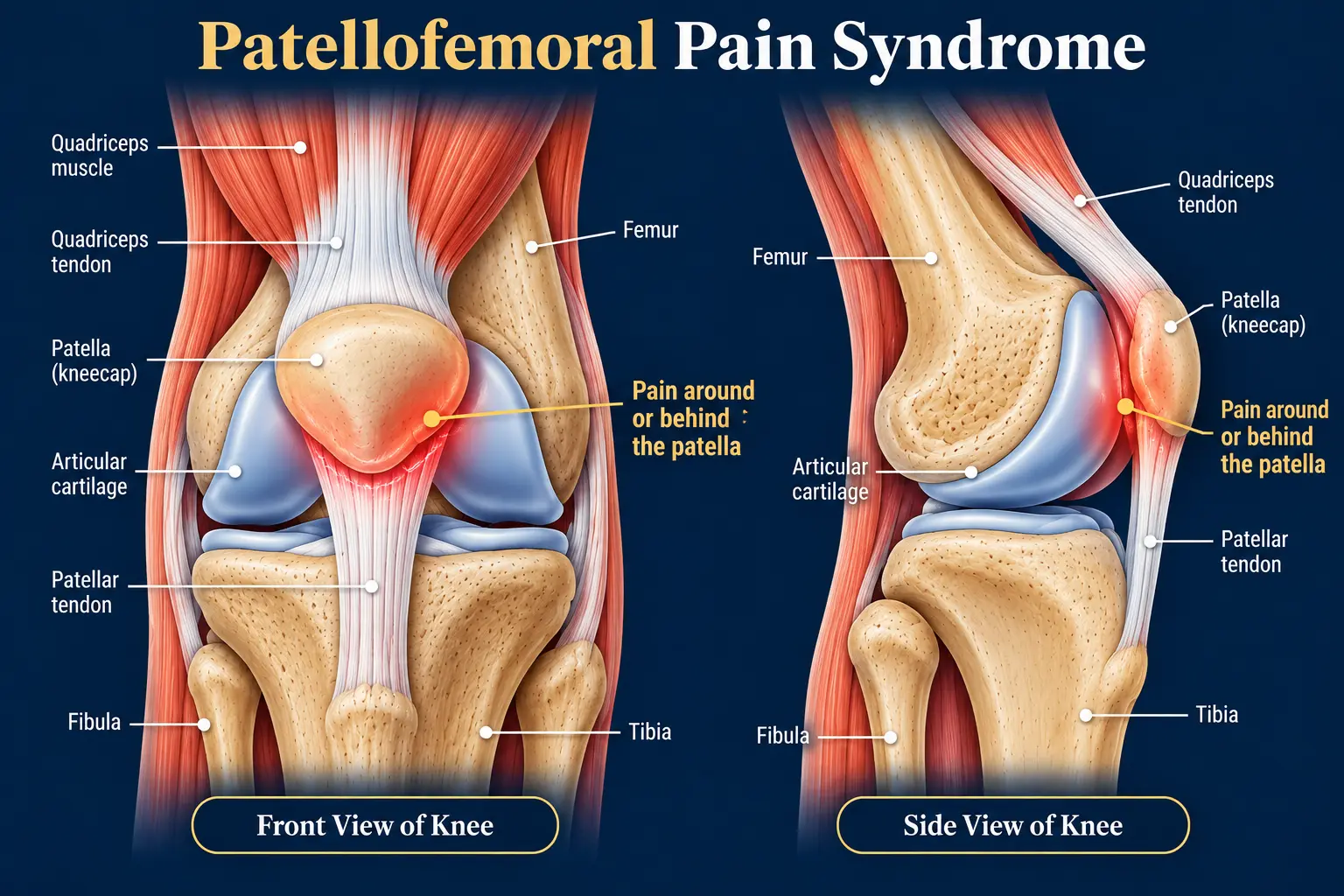
Patellofemoral Pain Syndrome Knee Guide

How Does the Patellofemoral Joint Work?

The patellofemoral joint connects the patella (kneecap) with the femur (thighbone). It helps the knee move efficiently during walking, running, squatting, climbing stairs, and other activities. As the knee bends and straightens, the patella glides along the trochlea, a groove at the lower end of the femur.

The main structures involved include:

  • Patella: The kneecap sits in front of the knee and helps the quadriceps produce force during knee extension.
  • Femur: The thighbone forms the upper part of the knee joint. Its lower end contains the trochlea, which guides patellar movement.
  • Trochlea: This groove provides a path for the patella as the knee bends and straightens.
  • Quadriceps: These muscles at the front of the thigh help straighten the knee and work with the patella as part of the knee’s extensor mechanism.
  • Patellar tracking: This describes how the patella moves within the trochlear groove. Normal tracking helps the knee move smoothly and distribute forces across the joint.

As the knee bends, the patella generally moves downward along the trochlea. As the knee straightens, it moves upward. Contact between the patella and femur increases as the knee bends, especially during activities that place greater loads on the joint.

What Causes Patellofemoral Pain Syndrome?

Patellofemoral pain syndrome can develop when changes in activity, biomechanics, or muscle function increase stress around the patellofemoral joint. PFPS usually develops from several contributing factors rather than one specific injury. These factors can affect how the knee handles repeated loading and how the patella moves during activity.

Common contributing factors include:

  • Overuse: Repetitive running, jumping, squatting, or stair climbing can repeatedly load the patellofemoral joint.
  • Activity changes: A sudden increase in exercise frequency, duration, intensity, or running distance can overload the knee before the tissues adapt.
  • Increased training load: Adding hills, speed work, heavier resistance, or high-impact activities too quickly can increase stress around the kneecap.
  • Muscle weakness: Weakness in the quadriceps, hip, or gluteal muscles can affect lower-limb control and increase stress around the patellofemoral joint.
  • Muscle tightness: Tight hamstrings, calves, or other muscles around the thigh and lower leg can affect normal knee movement.
  • Biomechanics: Changes in how the hip, knee, or foot moves can alter how forces are distributed through the patellofemoral joint.
  • Lower-limb alignment: Differences in leg alignment, foot mechanics, or kneecap position can influence patellar movement and joint loading.
  • Previous knee problems: Previous injury, pain, or changes in knee movement may affect how the patellofemoral joint functions during activity.
  • Prolonged knee bending: Sitting with the knee bent for long periods can increase pressure within the patellofemoral joint and aggravate symptoms in some people.

The exact combination of contributing factors varies between individuals. PFPS does not have one single cause, and an abnormal movement pattern or alignment factor does not necessarily mean it will cause pain.

What Are the Symptoms of Patellofemoral Pain Syndrome?

Patellofemoral pain syndrome commonly causes pain around the kneecap that worsens during activities that increase patellofemoral loading. The pain is usually felt around or behind the kneecap and may develop gradually. Repeated knee bending or activities that place greater stress on the joint can make symptoms more noticeable.

Common symptoms include:

  • Kneecap pain: A dull ache or discomfort around, behind, or at the front of the kneecap.
  • Pain during loaded activities: Pain may worsen with stairs, squatting, running, jumping, lunging, or kneeling.
  • Pain with prolonged sitting: Keeping the knee bent for a long time can cause aching or discomfort. This is sometimes called the “movie theater sign.”
  • Stiffness: The knee may feel stiff after prolonged sitting or periods of inactivity.
  • Crepitus: Some people notice clicking, popping, crackling, or grinding around the kneecap when bending or straightening the knee.
  • Mild swelling: Some people may develop mild swelling after activity, although significant or repeated swelling is less typical of uncomplicated PFPS.

Symptoms can vary between individuals. True mechanical locking is not typical of PFPS and may point to another knee problem, such as a meniscus injury or loose body.

How Is Patellofemoral Pain Syndrome Diagnosed?

Doctors diagnose patellofemoral pain syndrome primarily from the symptom history and physical examination. The diagnosis is based on the typical pattern of pain and whether familiar pain can be reproduced during activities that load the knee.

  1. Symptom history: The doctor asks about your activity level, recent training changes, and when the pain occurs. They may also ask about previous knee problems, swelling, catching, or locking.
  2. Physical examination: The doctor examines the knee for tenderness around the kneecap and assesses knee movement. They may gently press or move the patella to identify familiar pain. Squatting can also help reproduce typical patellofemoral pain.
  3. Patellar assessment: The doctor evaluates patellar tracking and how the kneecap moves within the trochlear groove. They may also check quadriceps and hip strength, muscle flexibility, and lower-limb alignment.
  4. Functional testing: Functional tests show how the knee responds during weight-bearing activities. The doctor may observe squatting, stepping, walking, or other movements that reproduce symptoms. These tests also help assess knee control and lower-limb movement.
  5. Excluding other conditions: The doctor considers other causes of anterior knee pain, including meniscus injuries, tendon problems, cartilage injuries, and osteoarthritis. Significant swelling, true locking, or symptoms after a major injury may require further evaluation.
  6. Imaging when clinically appropriate: Imaging is not routinely required for uncomplicated PFPS. X-rays, MRI, or other imaging may be considered when symptoms persist, follow a significant injury, or suggest another condition. X-rays can assess bones and alignment, while MRI can examine cartilage, menisci, ligaments, tendons, and other soft tissues.

PFPS is primarily a clinical diagnosis. Doctors combine the patient's symptoms with physical and functional examination findings rather than relying on a single imaging test.

How Is Patellofemoral Pain Syndrome Treated?

Treatment focuses on reducing aggravating loads, improving strength and movement control, and gradually restoring activity. PFPS is mainly treated with a combination of activity modification, physical therapy, strengthening, and pain management. The approach depends on your symptoms, contributing factors, activity demands, and functional limitations.

  1. Activity modification and relative rest: Reduce or temporarily avoid activities that aggravate symptoms, such as running, jumping, deep squatting, repeated stairs, or prolonged sitting with the knees bent. Complete rest is usually unnecessary. Activities can be increased gradually as pain and function improve.
  2. Pain relief: Acetaminophen or nonsteroidal anti-inflammatory drugs (NSAIDs), such as ibuprofen or naproxen, may provide short-term pain relief when appropriate. Medication should be used according to medical advice and individual health considerations.
  3. Ice and heat: An ice pack applied to the front of the knee for about 15–20 minutes after activity may help reduce discomfort. Heat may also provide comfort for some people, particularly before activity when stiffness is present.
  4. Physical therapy and strengthening: Physical therapy is a central part of rehabilitation. Exercises commonly target the quadriceps and hip or gluteal muscles to support knee control and patellar movement.
  5. Early strengthening exercises: Initial exercises may include straight-leg raises, wall-sit holds, and other controlled strengthening movements. Exercises should progress gradually to avoid placing excessive stress on the patellofemoral joint.
  6. Stretching and flexibility: Stretching may help when muscle tightness contributes to symptoms. A rehabilitation program may address tight hamstrings, quadriceps, calves, or the iliotibial band when appropriate.
  7. Movement control: Rehabilitation may address how the hip, knee, and foot move during squatting, walking, running, or stepping. Improving movement control can help reduce excessive stress on the patellofemoral joint.
  8. Supportive treatments: Patellar taping or a supportive brace may provide temporary pain relief or help some patients perform exercises more comfortably. These options are generally used alongside rehabilitation rather than as a replacement for strengthening and activity modification.
  9. Gradual return to activity: As pain, strength, movement control, and function improve, activity can be increased progressively. Training volume and intensity should increase gradually rather than returning suddenly to previous activity levels.

Overall, conservative treatment and rehabilitation are the main approaches to PFPS. The combination of activity modification, physical therapy, strengthening, flexibility work, pain management, and supportive treatments should be adjusted to the individual's symptoms and functional needs.

When Is Surgery Considered for Patellofemoral Pain Syndrome?

Treatment for patellofemoral pain syndrome is generally conservative, with activity modification, physical therapy, and progressive strengthening forming the main approach. Specialist assessment may become relevant when symptoms remain severe and persistent despite appropriate non-surgical treatment or when an underlying structural abnormality is suspected.

Surgery is considered a last resort for selected patients with severe symptoms that do not improve after an adequate course of non-surgical treatment. Some clinical sources use around six months of dedicated conservative treatment as a general reference point, but the appropriate timeframe varies between patients.

Surgical treatment may be considered when:

  • Failed Conservative Care: Physical therapy, activity modification, bracing, pain-relief measures, and other non-surgical treatments have not provided sufficient improvement after several months of appropriate treatment.
  • Persistent Structural Abnormality: A significant structural problem, such as severe patellar malalignment, abnormal patellar tracking, a tight lateral retinaculum, or focal cartilage damage, continues to contribute to symptoms.
  • Disabling Chronic Pain: Persistent pain substantially interferes with daily activities, exercise, work, or sports despite comprehensive conservative treatment.
  • Recurrent Patellar Instability: Repeated patellar dislocation or instability may require specialist assessment and, in selected cases, surgical stabilization.

The specific procedure depends on the identifiable structural problem rather than the PFPS diagnosis alone. Possible surgical approaches include:

  • Arthroscopic Debridement: Arthroscopy may be used in selected cases to address specific damaged or irregular cartilage areas or another identifiable intra-articular problem.
  • Lateral Release: In carefully selected patients with documented excessive lateral patellar tension, releasing tight lateral soft tissues may help improve patellar movement.
  • Realignment Procedures: Procedures such as a tibial tubercle osteotomy may be considered for specific alignment or patellar tracking abnormalities.
  • Patellar Stabilization: Procedures involving the medial patellofemoral ligament (MPFL) may be considered when recurrent patellar instability is the underlying problem.

These procedures are not routine treatments for uncomplicated PFPS. A specialist should first confirm the diagnosis, identify the contributing structural problem, and determine whether the potential benefits of surgery outweigh its risks.

Overall, surgical treatment is reserved for selected patients with persistent, function-limiting symptoms and an identifiable problem that has not responded adequately to appropriate conservative care.

How Long Does Patellofemoral Pain Syndrome Take to Improve?

Patellofemoral pain syndrome usually improves gradually with appropriate treatment, but the recovery timeline varies between individuals. Some people notice symptom improvement within several weeks, while others need several months of rehabilitation. Recovery can depend on how long symptoms have been present, contributing factors, activity demands, response to treatment, and consistency with rehabilitation.

Approximate recovery patterns may include:

  • Early symptom improvement: Some people may notice reduced pain within 3 to 4 weeks after starting an appropriate treatment and rehabilitation program.
  • Milder symptoms: Some mild cases may improve substantially within 6 to 8 weeks with relative rest, activity modification, and appropriate strengthening.
  • Persistent or chronic symptoms: Symptoms that have been present for a long time may require several months of consistent rehabilitation and gradual activity progression.

Several factors can affect how quickly symptoms improve:

  • Symptoms: The severity, duration, and pattern of pain can influence recovery.
  • Contributing factors: Muscle weakness, muscle tightness, movement patterns, training load, and lower-limb mechanics may affect symptom improvement.
  • Rehabilitation: Consistent physical therapy and progressive strengthening of the quadriceps and hip muscles can support recovery.
  • Activity modification: Reducing aggravating activities while maintaining appropriate movement can help the knee gradually tolerate greater loads.
  • Healing and adaptation: Muscles and other tissues need time to adapt to changes in loading and movement.
  • Individual response: People respond differently to the same treatment, so recovery cannot be reduced to one universal timeline.

Symptoms can return if running, jumping, or other demanding activities increase too quickly. A gradual return to activity and continued attention to strength and movement control can help support long-term function. If symptoms remain persistent or worsen despite appropriate rehabilitation, further assessment may be appropriate.

What Is the Long-Term Outlook for Patellofemoral Pain Syndrome?

The long-term outlook for patellofemoral pain syndrome varies between individuals. Symptoms may improve with appropriate treatment, but PFPS can also become a persistent condition rather than one that always resolves on its own. Long-term studies have reported ongoing pain or functional limitations in some adults and adolescents after several years.

The long-term outlook may include:

  • Symptom Improvement: Many people experience meaningful improvement with structured rehabilitation, activity modification, and appropriate management of contributing factors.
  • Persistent Symptoms: More than half of adults in some long-term studies continued to report pain or functional limitations several years after diagnosis. This does not mean every person with PFPS will develop chronic symptoms.
  • Adolescent Outlook: Young people may also experience persistent symptoms. Some long-term studies have reported ongoing symptoms in up to 78% of adolescents.
  • Recurrence: Symptoms may return after improvement, particularly when running, jumping, or other high-load activities are increased too quickly.
  • Chronic Knee Pain: Persistent PFPS can contribute to ongoing anterior knee pain and limitations with exercise, sports, or daily activities.
  • Patellofemoral Osteoarthritis: Chronic patellofemoral pain has been associated with an increased risk of later patellofemoral osteoarthritis. PFPS does not mean that a person will inevitably develop arthritis.
  • Individual Variability: Long-term outcomes differ between individuals. Some people improve substantially, while others experience recurring or persistent symptoms despite treatment.

Several factors may influence the long-term outlook. Longer symptom duration, particularly symptoms lasting more than 12 months, higher baseline pain severity, and lower baseline knee function have been associated with a greater likelihood of persistent symptoms.

Structured rehabilitation can support better function. Physical therapy commonly focuses on strengthening the quadriceps, hip, and gluteal muscles, improving movement control, and managing activity loads appropriately.

Overall, PFPS can improve with consistent rehabilitation and appropriate load management, but it should not always be considered a short-term condition. Persistent or worsening symptoms may require further assessment to identify contributing factors or another knee condition.

How Can Patellofemoral Pain Syndrome Be Prevented?

You cannot prevent every case of patellofemoral pain syndrome. Still, gradually increasing activity, strengthening the lower-body muscles, managing workload, and addressing contributing factors can help reduce excessive stress on the patellofemoral joint.

Practical prevention strategies include:

  • Use Gradual Training Progression: Increase workout intensity, running mileage, or activity duration gradually. A commonly used guideline is to increase training load by no more than about 10% per week, although the appropriate progression varies between individuals.
  • Manage Workload: Avoid sudden increases in training frequency, duration, or intensity. Introduce hills, speed work, jumping, and other high-impact activities progressively.
  • Perform Strength Training: Strengthen the quadriceps, hip, and gluteal muscles to support knee control and lower-limb movement.
  • Improve Biomechanics: Use controlled movement during running, squatting, lunging, and jumping. Address movement patterns that repeatedly increase stress around the kneecap.
  • Warm Up and Stretch: Perform a light dynamic warm-up before exercise. Stretching the quadriceps, hamstrings, and calves afterward may help when flexibility limitations contribute to symptoms.
  • Wear Appropriate Footwear: Choose supportive footwear that suits your activity. Replace excessively worn shoes when they no longer provide adequate support or cushioning.
  • Manage High-Impact Surfaces: When appropriate, reduce repeated running or jumping on very hard surfaces. Alternating with softer surfaces or lower-impact activities such as swimming or cycling can vary the mechanical load.
  • Address Contributing Factors: Manage muscle weakness, muscle tightness, lower-limb movement problems, or other factors that may increase patellofemoral stress.
  • Listen to Early Symptoms: Allow adequate recovery after demanding sessions and avoid repeatedly training through increasing front knee pain. Temporarily reducing aggravating activities may help prevent symptoms from becoming persistent.
  • Progress Activity Gradually After a Break: When returning to exercise after illness, injury, or inactivity, rebuild activity levels progressively rather than immediately returning to your previous training volume.

Overall, prevention focuses on helping the knee gradually adapt to physical demands. Training progression, strength training, workload management, appropriate movement mechanics, supportive footwear, and early attention to symptoms can all help reduce the risk of PFPS

Is Patellofemoral Pain Syndrome the Same as Patellofemoral Arthritis?

Patellofemoral pain syndrome and patellofemoral arthritis can both cause anterior knee pain around or behind the kneecap, but they describe different conditions. PFPS primarily refers to pain associated with the patellofemoral joint, while patellofemoral arthritis involves structural cartilage degeneration and other degenerative changes within the joint.

Feature PFPS Patellofemoral Arthritis
Underlying pathology Pain associated with patellofemoral loading and contributing factors such as activity changes, muscle weakness, or movement mechanics Degenerative changes affecting the patellofemoral joint
Cartilage degeneration Not required for diagnosis Typically involves cartilage loss or degeneration
Symptoms Anterior knee pain that often worsens with running, stairs, squatting, jumping, or prolonged sitting Anterior knee pain that may worsen with stairs, squatting, walking, or other weight-bearing activities
Stiffness Stiffness may occur, particularly after prolonged sitting, but significant morning stiffness is less typical Stiffness is more common and may occur after periods of rest or inactivity
Crepitus Clicking, popping, or grinding may occur Grinding or crackling may occur as degenerative joint changes develop
Imaging Imaging may be normal and is not routinely required for diagnosis X-rays may show joint-space narrowing or other degenerative changes
Terminology Patellofemoral pain syndrome, often called runner’s knee Patellofemoral osteoarthritis or patellofemoral arthritis

The two conditions can have overlapping symptoms, so pain around the kneecap does not automatically indicate either diagnosis. PFPS can occur without significant cartilage damage, while patellofemoral arthritis involves structural joint degeneration. A clinical evaluation and, when appropriate, imaging can help determine the underlying cause of symptoms.

FAQs About Patellofemoral Pain Syndrome

Can Patellofemoral Pain Syndrome Go Away on Its Own?

Yes, patellofemoral pain syndrome can improve, especially when aggravating activities are reduced and contributing factors are addressed. Recovery varies between individuals, and some people need structured rehabilitation, strengthening, and gradual activity modification to achieve lasting symptom improvement.

Can You Run With Patellofemoral Pain Syndrome?

You may be able to continue running with PFPS, but this depends on your symptoms, training load, strength, and functional capacity. Reducing aggravating activity and gradually increasing running as symptoms and movement control improve can help support a safer return to running.

Can Patellofemoral Pain Syndrome Cause Knee Swelling?

Mild swelling can occur after activity, but significant or recurrent knee swelling is less typical of uncomplicated PFPS. Noticeable swelling or joint effusion may suggest another knee condition and should be assessed rather than automatically attributed to PFPS.

When Should You See a Doctor for Patellofemoral Pain Syndrome?

You should seek professional assessment when knee pain persists, worsens, or limits daily activities despite appropriate rehabilitation. Significant swelling, true locking, instability, or symptoms following a major injury also warrant further evaluation to check for other knee problems.