
Specialties › Knee & Leg › MCL Injury

An MCL injury affects the medial collateral ligament, a strong band of tissue that stabilizes the inner side of the knee. The injury can range from a mild sprain to a partial or complete tear. It often happens after a direct blow, sudden twist, awkward landing, or other force that pushes the knee inward.
This article explains everything you need to know about MCL injuries. You will learn what causes them, the different injury grades, common symptoms, who is at risk, how doctors diagnose the injury, and the available treatment options. We also cover rehabilitation, recovery timelines, when surgery may be considered, ways to reduce your risk of another injury, the long-term outlook, and answers to common patient questions.
Book a consultation and receive expert orthopedic guidance.
An MCL injury is a stretch, partial tear, or complete tear of the medial collateral ligament on the inner side of the knee. The MCL connects the femur (thighbone) to the tibia (shinbone) and helps keep the knee stable during movement.
The ligament mainly prevents the knee from moving too far inward. It also helps control rotation and supports knee stability during activities such as walking and running. An MCL sprain means the ligament is stretched or has minor fiber damage, while a partial or complete tear involves greater damage to the ligament.
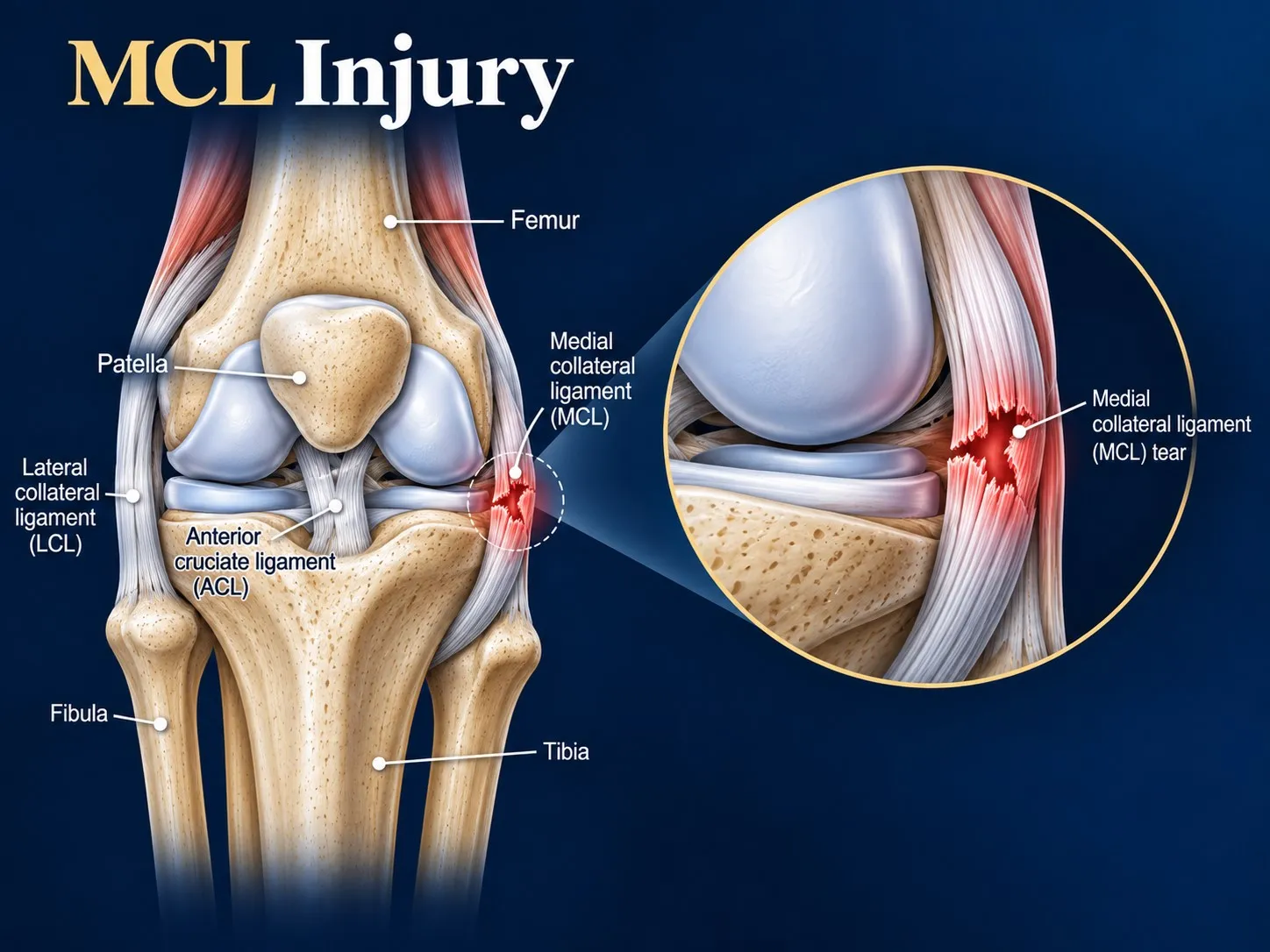
An MCL injury usually occurs when excessive force stresses the ligament on the inner side of the knee. The injury often happens when a force pushes the knee inward while the foot remains planted.
The most common causes of MCL injuries are listed below.
MCL injuries are classified into three grades based on the extent of ligament damage and knee instability.
The three grades of MCL injuries are described below.
MCL injury symptoms can vary according to the severity of ligament damage. Mild injuries may cause localized pain, while severe tears can cause instability and difficulty walking.
The most common symptoms of an MCL injury include:
Several factors can increase the risk of an MCL injury. Contact sports, pivoting activities, previous knee injuries, and poor knee stability can raise the risk.
Doctors diagnose an MCL injury through medical history, physical examination, and imaging when necessary. The evaluation helps determine the severity of ligament damage and identify associated knee injuries.
Doctors combine physical examination findings with imaging when needed. This approach helps determine the injury's severity and guide treatment.
Treatment for an MCL injury depends on the injury grade, knee stability, and associated injuries. Most isolated MCL injuries heal without surgery through protection, bracing, activity modification, and rehabilitation.
Conservative treatment is commonly used for Grade 1 and Grade 2 injuries and many isolated Grade 3 tears.
Surgery is not routinely required for isolated MCL injuries. Doctors may consider it when severe instability persists or when the MCL injury occurs with other significant knee injuries.
The appropriate treatment depends on the individual injury pattern. An orthopedic specialist can determine the most suitable approach after assessing knee stability and associated injuries.
Surgery is generally considered when an MCL injury causes persistent instability or involves complex knee damage. Most isolated MCL injuries heal with bracing, activity modification, and physical therapy.
The decision to operate depends on the injury pattern, knee stability, associated injuries, and response to non-surgical treatment.
No. A Grade 3 MCL tear does not automatically require surgery. Many isolated complete MCL tears can heal with appropriate bracing and rehabilitation.
Surgery becomes more relevant when significant instability persists, the tear pattern is unsuitable for healing, associated injuries require surgery, or conservative treatment does not restore adequate knee function.
MCL rehabilitation focuses on restoring knee motion, strength, stability, and functional movement. A structured program gradually protects the healing ligament while helping the knee return to normal function.
The program depends on the injury grade, treatment approach, and individual progress. Patients who undergo MCL repair or reconstruction may progress more slowly to protect the healing ligament or graft.
The main stages of MCL rehabilitation are outlined below.
MCL recovery time varies according to the injury grade and whether other knee structures are involved. Most isolated MCL injuries heal without surgery, but severe or combined injuries may require longer rehabilitation.
The timeline below provides typical ranges rather than fixed deadlines. Recovery also depends on pain, swelling, knee stability, range of motion, muscle strength, and functional progress.
| MCL Injury Grade | Typical Recovery Time | General Recovery Progress |
|---|---|---|
| Grade 1 | 1–3 weeks | Pain and swelling usually improve quickly, followed by gentle strengthening and a gradual return to normal activities. |
| Grade 2 | 3–6 weeks | Bracing and rehabilitation may be needed while knee motion, strength, and stability gradually improve. |
| Grade 3 | 6–12 weeks or longer | Complete tears require longer protection and rehabilitation, especially when instability or other injuries are present. |
| After MCL Surgery | Several months | Recovery progresses gradually through protection, strengthening, functional training, and return-to-activity stages. |
The main recovery milestones for an MCL injury include:
Yes. Grade 3 injuries involve complete ligament tears and generally require more rehabilitation than Grade 1 or Grade 2 injuries. Many isolated Grade 3 MCL injuries can still heal successfully without surgery.
Recovery may take longer when persistent instability occurs or when an ACL, PCL, meniscus, or other knee injury is also present. Surgical treatment can extend rehabilitation because the repaired ligament or graft needs additional protection.
Recovery should be based on functional milestones rather than the calendar alone. A healthcare professional can determine when the knee is ready for increased activity.
Although not every MCL injury can be prevented, several strategies can reduce injury risk. Strengthening the muscles around the knee, improving balance, and using proper movement techniques can support knee stability.
The following strategies may help reduce the risk of MCL injuries.
The long-term outlook for an MCL injury is generally influenced by injury severity, associated damage, and rehabilitation. Most isolated MCL injuries have a favorable outlook with appropriate treatment and structured rehabilitation, while associated injuries can make recovery more complex.
Several factors can influence long-term knee function:
With appropriate rehabilitation, many people can regain normal knee function and return to their usual activities. Persistent instability or associated knee damage can make long-term recovery more difficult.
The cost of MCL injury treatment varies according to the treatment required, healthcare provider, location, and insurance coverage. Expenses may include imaging, physical therapy, bracing, medications, or surgery.
Yes, you may still be able to bend your knee with a torn MCL. Pain, swelling, and injury severity can limit knee flexion, but the ability to bend your knee does not determine whether the MCL is torn.
An inadequately treated MCL injury can lead to persistent knee instability, recurrent injury, and altered movement. Some mild MCL injuries may heal with activity modification and gradual rehabilitation, while more significant injuries may require medical evaluation and structured treatment.
Return to sports should depend on symptoms, knee strength, stability, range of motion, and functional recovery. Athletes should gradually progress through running, agility, jumping, cutting, and sport-specific exercises before returning to full activity.
Supporting the injured knee in a comfortable position may reduce nighttime discomfort. Avoid positions that increase pain or place unnecessary stress on the knee.
Yes. Residual knee instability or incomplete rehabilitation can affect movement and increase the risk of another knee injury. Associated ligament or meniscus injuries can also influence long-term knee stability.
Yes. An MCL injury can occur with an ACL tear, particularly after significant knee trauma. Combined ligament injuries can affect diagnosis, treatment decisions, rehabilitation, and recovery time.
Driving should wait until pain, knee movement, weight-bearing ability, and reaction control allow safe vehicle operation. The affected leg and type of vehicle should also be considered.
Activities that place excessive stress on the healing MCL should be avoided during recovery. Pivoting, cutting, contact sports, running, and other demanding movements should be reintroduced gradually as strength and knee stability improve.
An MCL can be injured again after healing, particularly if knee stability, strength, or movement control has not fully recovered. Completing rehabilitation and progressing gradually toward demanding activities can help reduce reinjury risk.