
Specialties › Knee & Leg › Patellar Tendinitis

Patellar tendinitis is a common overuse condition that affects the patellar tendon, which connects the kneecap to the shinbone and helps straighten the knee. Repeated jumping, running, squatting, or landing can place excessive stress on the tendon and cause localized pain below the kneecap.
This article explains everything you need to know about patellar tendinitis, also known as jumper’s knee. You will learn what causes it, who is at risk, common symptoms, how doctors diagnose the condition, and the available treatment options. We also cover surgical treatment, recovery time, long-term outlook, and answers to common patient questions.
Book a consultation and receive expert orthopedic guidance.
Patellar tendinitis is an overuse condition affecting the tendon that connects the kneecap to the shinbone. The patellar tendon connects the patella to the tibia and helps transfer force from the quadriceps to straighten the knee.
Repeated or excessive loading can place stress on the tendon and lead to localized pain. Activities such as jumping, running, squatting, and repeated landing can increase the load on the patellar tendon.
Patellar tendinitis is commonly called jumper’s knee because it often affects athletes who perform repeated jumping movements. Patellar tendinopathy is another term used for persistent tendon symptoms, particularly when structural changes are involved.
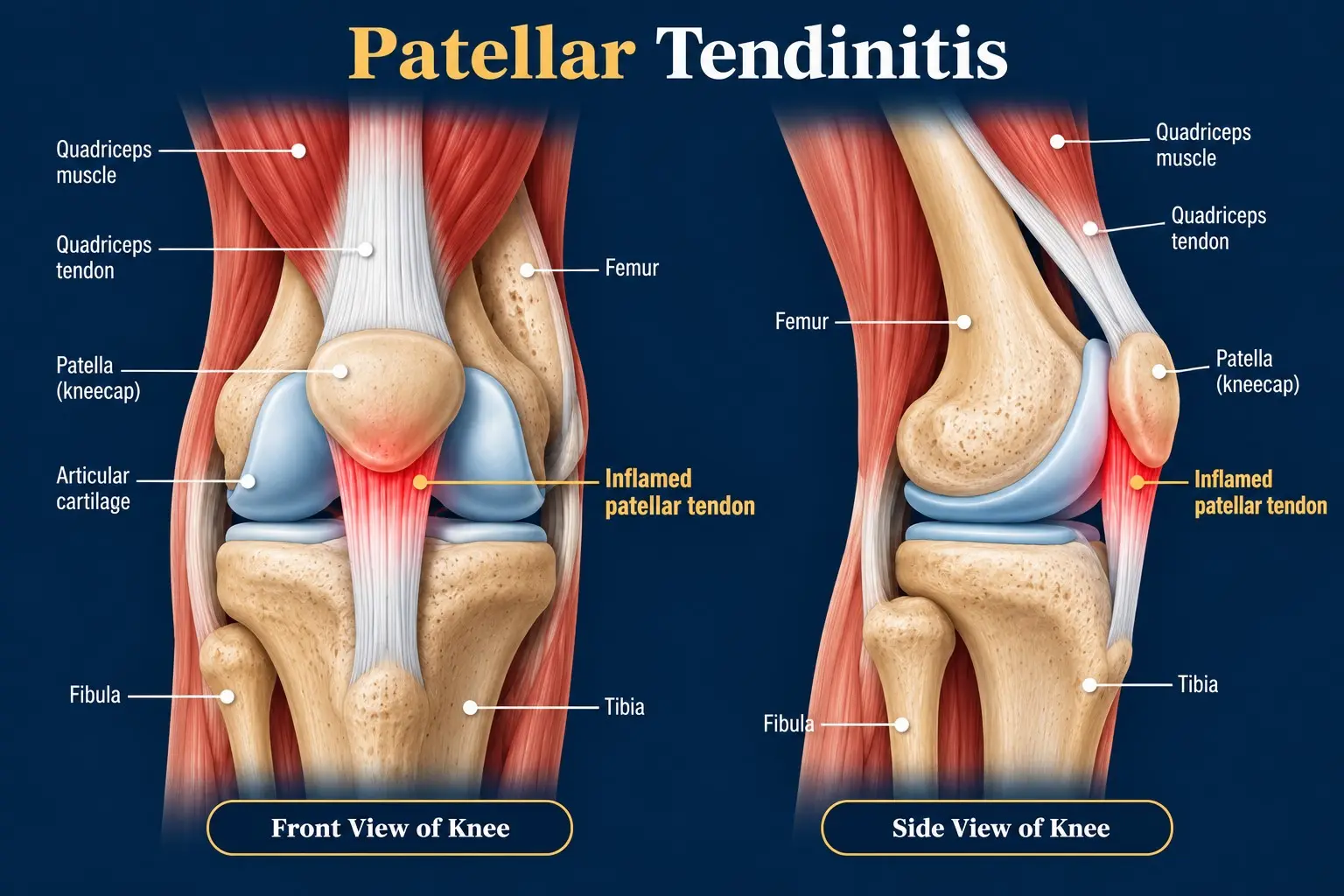
The patellar tendon is a strong band of connective tissue that connects the kneecap to the shinbone. It forms an important part of the knee’s extensor mechanism and works with the quadriceps to straighten the knee and control leg movement.
When the quadriceps contracts, it pulls on the quadriceps tendon and patella. The patella transfers this force through the patellar tendon to the tibia, allowing you to straighten your leg. This mechanism also helps with walking, standing up, climbing stairs, running, jumping, and controlling the knee during landing.
Patellar tendinitis commonly develops when repeated loading places excessive stress on the patellar tendon. When the tendon cannot adapt to the demands placed on it, irritation and reduced load tolerance can develop, leading to symptoms.
Common causes and contributing factors include:
Patellar tendinitis commonly causes pain below the kneecap that worsens with activities that load the patellar tendon. Symptoms often develop gradually and may become more noticeable as tendon loading increases.
Common symptoms include:
The symptom pattern can change as tendon loading increases. Pain may initially occur only after strenuous activity, then appear during exercise and eventually interfere with daily movements.
True mechanical locking is not typical of patellar tendinitis. If the knee repeatedly becomes stuck or cannot fully bend or straighten, another knee problem may be involved.
Doctors diagnose patellar tendinitis primarily from the symptoms, activity history, and physical examination. The assessment focuses on the location and pattern of pain, tenderness around the patellar tendon, and how the knee responds to tendon-loading activities.
Pain around or below the kneecap can have several causes. A doctor may consider conditions such as:
The exact location of pain, activity-related symptoms, previous injuries, knee movement, and strength findings help doctors distinguish these conditions. Imaging may be used when the diagnosis remains uncertain or another structural problem is suspected.
Treatment focuses on reducing excessive tendon loading, managing symptoms, and progressively rebuilding tendon capacity. Conservative treatment usually combines relative rest, activity modification, pain management, and progressive rehabilitation. The approach depends on symptom severity, activity demands, and how the tendon responds to rehabilitation.
Treatment may take several weeks to several months, especially when symptoms have been present for a long time. A gradual rehabilitation program helps restore tendon capacity while limiting excessive loading and reducing the risk of symptoms returning.
Patellar tendon surgery is generally reserved for chronic patellar tendinopathy that does not improve with appropriate non-surgical treatment and progressive rehabilitation. Surgery may be considered after several months of unsuccessful conservative care, particularly when persistent symptoms or significant tendon damage limits function.
The main surgical approaches include:
The choice of procedure depends on the severity, location, and type of tendon problem, along with symptoms, functional demands, and the response to previous treatment. Surgery is not usually recommended based on imaging findings alone.
Patellar tendinitis recovery time varies from person to person. Mild symptoms may improve within several weeks, while persistent patellar tendinopathy can require several months of progressive rehabilitation and load management.
Several factors can affect how quickly you recover:
Mild cases may improve within 2–4 weeks, while moderate cases can take 6–12 weeks. Persistent or chronic cases may require 3–6 months or longer of structured rehabilitation. These timeframes are general ranges, not guarantees for every person.
Symptom relief can occur before the tendon has fully adapted to higher physical demands. Returning to running, jumping, or competitive sports usually requires a gradual progression as strength, function, and tendon load tolerance improve.
The long-term outlook for patellar tendinitis is generally favorable with appropriate management. Many people improve with structured rehabilitation and progressive tendon loading. One five-year follow-up study reported that about 76% of patients felt recovered or significantly improved, although some continued to experience symptoms or functional limitations.
Research also suggests that around 71% to 76% of athletes may return to their desired sports or activities after structured rehabilitation and load management. These figures come from study populations and do not predict the outcome for every individual.
Several factors can affect long-term recovery:
Persistent or recurrent symptoms may require reassessment to confirm the diagnosis and review training load, rehabilitation, and other contributing factors. A healthcare professional may discuss options such as extracorporeal shockwave therapy or platelet-rich plasma in persistent cases, although their effectiveness can vary.
Maintaining appropriate strength, progressing tendon loading gradually, and allowing adequate recovery can support long-term function and help reduce the risk of recurrence.
Patellar tendinitis may improve when aggravating activities are reduced, and the tendon is allowed to recover. Persistent symptoms often need structured rehabilitation, progressive tendon loading, and activity modification rather than rest alone.
Return to sports should be gradual rather than based on a fixed date. Progress when pain is controlled, strength and function have improved, the tendon tolerates increasing loads, and rehabilitation milestones are being met. The demands of your specific sport also affect the progression.
Walking tolerance depends on your symptoms and how much the activity loads the tendon. If walking increases your pain, reducing or modifying the activity may help control symptoms while maintaining comfortable movement.
Biking may be suitable if it does not aggravate your symptoms. Your tolerance can vary, so reduce the activity or resistance if cycling increases patellar tendon pain.
Persistent tendon loading can allow symptoms to continue and may reduce the tendon’s ability to tolerate physical demands. Long-standing symptoms may require more gradual rehabilitation, especially if high-impact activity continues without appropriate load management.
Surgery is rarely needed for patellar tendinitis. It may be considered when persistent symptoms or significant tendon damage do not improve after appropriate non-surgical treatment and progressive rehabilitation.
Yes. Symptoms can recur when high-impact activities resume too quickly, training volume increases suddenly, or strengthening stops before the tendon has regained adequate capacity. Gradual load progression and continued strength work can help support long-term tendon function.
No. Early symptoms may appear mainly during or after demanding exercise. As tendon problems progress, pain may begin earlier during activity and can eventually interfere with everyday movements.