Loose Bodies in the Knee: Symptoms, Causes, Diagnosis, Treatment and Recovery

Prof. Dr. Haluk Çabuk

Prof. Dr. Haluk Çabuk

Professor of Orthopedics & Traumatology
Medically Reviewed Updated October 16, 2026 13 min read

A loose body in the knee is a fragment of bone, cartilage, or other tissue that moves freely inside the knee joint. It can develop when damaged cartilage or bone breaks away from the joint surface or when certain knee conditions produce tissue fragments.

This article explains what loose bodies in the knee are and what causes them. You will learn about common symptoms, how doctors diagnose them, and the available treatment options. We also cover when a loose body may need removal, how it can be removed, possible complications, recovery after removal, whether loose bodies can come back, and answers to common patient questions.

Book Appointment

Need a personalized treatment plan?

Book a consultation and receive expert orthopedic guidance.

What Are Loose Bodies in the Knee?

Loose bodies in the knee are fragments of bone, cartilage, or other tissue that move freely within the joint. These fragments can break away from the joint surface after cartilage or bone damage. They may float within the knee or become temporarily trapped between the joint surfaces.

A loose body is also called an intra-articular body because it is located inside the knee joint. Some loose bodies are made mainly of cartilage, while others contain both bone and cartilage and may be called osteochondral fragments.

Loose bodies can vary in size and number. Some do not cause any symptoms, while others can interfere with normal knee movement and cause pain, swelling, clicking, catching, or intermittent locking.
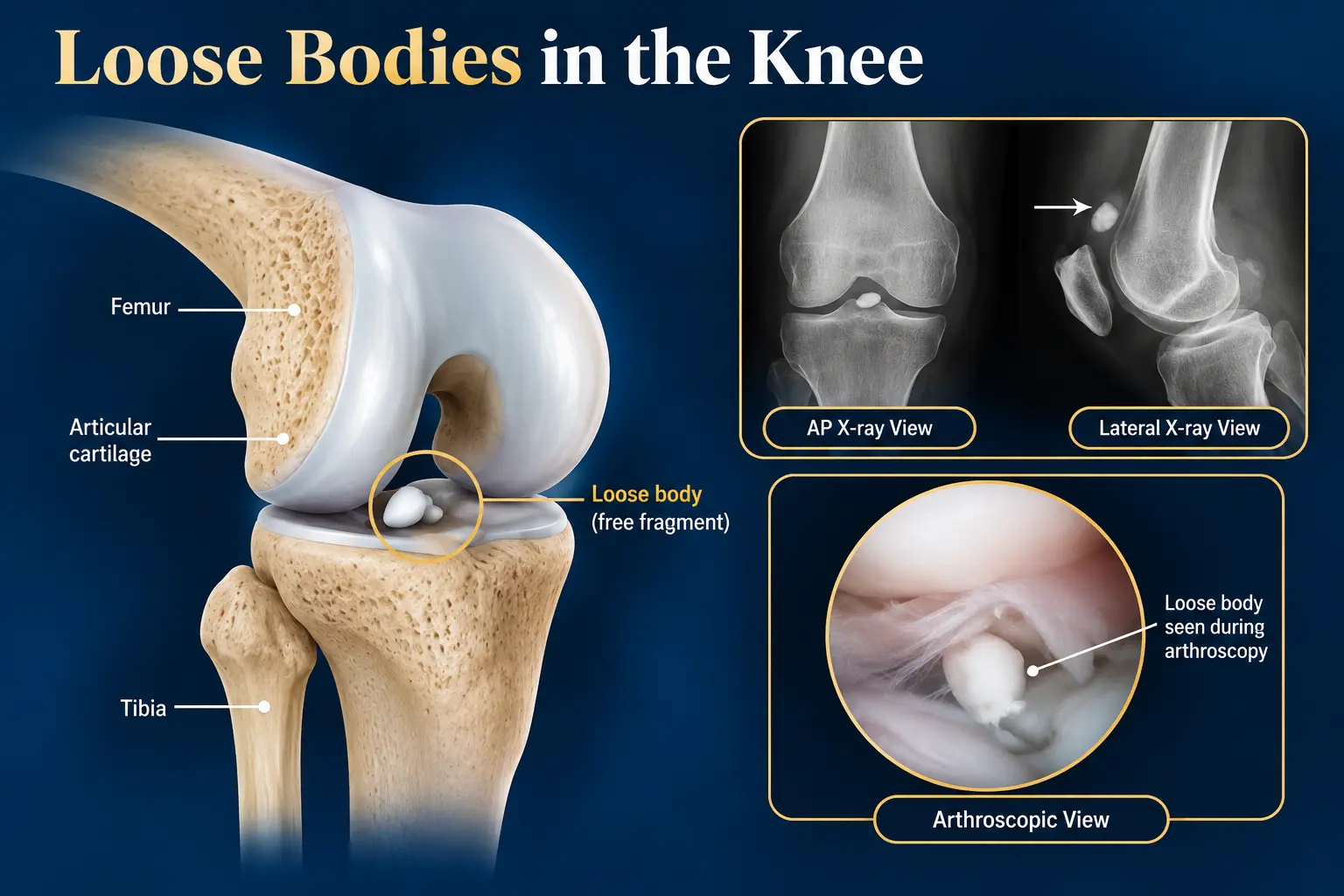
Loose Bodies in the Knee Infographic

What Causes Loose Bodies in the Knee?

Loose bodies in the knee can form when bone, cartilage, or osteochondral tissue breaks away from the joint surface. They can also develop when certain conditions cause abnormal tissue to form inside the joint.

Common causes include:

  • Osteoarthritis: Cartilage gradually breaks down as the joint degenerates. Small pieces of cartilage or bone can separate from the damaged joint surface.
  • Joint degeneration: Progressive joint degeneration can weaken cartilage and the underlying bone. Small fragments may then separate and become loose inside the knee.
  • Osteochondritis dissecans: This condition affects the bone beneath the cartilage. A damaged area can weaken and separate, leaving a fragment of bone and cartilage within the joint.
  • Trauma: A fall, strong impact, sports injury, or twisting event can damage the joint surface. This damage may chip or detach bone, cartilage, or both.
  • Cartilage damage: Severe damage to the articular cartilage can cause pieces to break away from the joint surface and move within the knee.
  • Bone damage: Injury or degeneration can damage the bone beneath the cartilage. A piece of bone may separate from the joint surface and become a loose fragment.
  • Synovial chondromatosis: This rare condition causes the joint lining to form multiple cartilage nodules. Some can detach, become calcified, and develop into loose bodies.

What Are the Symptoms of Loose Bodies in the Knee?

Loose bodies in the knee can cause pain, swelling, catching, locking, and restricted joint movement. Symptoms can come and go as the loose body changes position inside the joint.

Common symptoms include:

  • Knee pain: Pain may occur when the loose body moves or becomes trapped between the joint surfaces.
  • Swelling: Irritation of the joint lining can cause fluid to build up inside the knee.
  • Stiffness: Swelling or irritation can make the knee feel stiff, especially after activity or periods of inactivity.
  • Clicking or popping: A loose body may cause clicking or popping as it moves during knee movement.
  • Catching: The knee may briefly catch or stick when the loose body interferes with normal movement.
  • Knee locking: A loose body can become trapped between the joint surfaces and temporarily prevent the knee from fully bending or straightening.
  • Restricted movement: A loose body can limit the knee’s range of motion when it blocks normal joint movement.

Symptoms vary based on the size, number, location, and mobility of the loose body. A small fragment may cause few or no symptoms, while a mobile fragment in a sensitive location may cause repeated catching, locking, or restricted movement.

How Are Loose Bodies in the Knee Diagnosed?

Doctors diagnose loose bodies using the symptoms, physical examination, and imaging findings when appropriate. The evaluation helps identify a possible loose body and determine whether it is affecting normal knee movement.

  1. Medical history: The doctor asks about previous knee injuries and symptoms such as pain, catching, or locking. These details can help determine whether a mobile fragment may be interfering with knee movement.
  2. Physical examination: The doctor examines the knee for swelling, tenderness, restricted movement, or a palpable moving lump. The examination can also help identify mechanical symptoms linked to a loose body.
  3. X-ray: X-rays can identify many loose bodies that contain bone or mineralized tissue. Small fragments made entirely of cartilage may not appear clearly on an X-ray.
  4. MRI scan: MRI provides detailed images of the soft tissues inside the knee. It can help identify cartilage fragments and assess related damage to the cartilage, meniscus, ligaments, and other structures.

The doctor combines the examination and imaging findings to determine whether a loose body is present and identify the underlying cause of the symptoms.

How Are Loose Bodies in the Knee Treated?

Treatment depends on the cause of the loose body, its effect on knee movement, and the severity of symptoms. Small or non-locking loose bodies may be managed with observation and conservative treatment. This approach is often considered part of loose bodies in knee non surgical treatment when symptoms are mild and the fragment does not significantly interfere with joint movement. Persistent mechanical symptoms may require surgical removal.

The treatment pathway generally includes:

  • Observation: Small, dormant, or asymptomatic loose bodies may not require immediate removal. Doctors may monitor the condition when the fragment does not cause significant pain, swelling, catching, or locking.
  • Non-Surgical Treatment: Conservative care may help manage mild symptoms when immediate removal is not necessary. Non-surgical treatment for loose bodies in the knee may include:
    • Physical therapy to maintain joint flexibility and strengthen the muscles around the knee.
    • Anti-inflammatory medications (NSAIDs) when appropriate to help reduce pain and swelling.
    • Activity modification to reduce movements that aggravate symptoms.
    • Weight management when appropriate to reduce physical stress on the knee joint.
  • Treatment of the Underlying Cause: Doctors may also treat the condition that produced the loose body. This may include managing osteoarthritis, cartilage damage, osteochondritis dissecans, or another joint condition.
  • Loose Body Removal: Persistent pain, recurrent swelling, catching, or knee locking may indicate the need for surgery. Removing the fragment can relieve mechanical symptoms and may help prevent continued irritation or damage to the joint surfaces.
  • Knee Arthroscopy: Arthroscopic removal is the commonly preferred surgical approach for symptomatic loose bodies. The surgeon uses a small camera and specialized instruments through small incisions to locate and extract the fragment. Arthroscopy also allows the surgeon to examine the surrounding cartilage and other joint structures.
  • Open Arthrotomy: Open surgery may be considered when a loose body is very large or cannot be safely removed through arthroscopy. It requires a larger incision and is used less commonly.

Overall, treatment depends on whether the loose body is causing symptoms or interfering with normal joint movement. Conservative care may be appropriate for selected mild or non-locking cases, while mechanical symptoms such as persistent catching or locking may require loose body removal.

When Does a Loose Body Need to Be Removed?

A loose body does not always need to be removed. Doctors may consider removal when the fragment causes persistent symptoms or interferes with normal knee movement.

Removal may be considered when:

  • Persistent pain: Pain continues despite appropriate conservative treatment.
  • Knee locking: The loose body repeatedly blocks the knee from fully bending or straightening.
  • Catching: The knee repeatedly catches or sticks during movement.
  • Recurrent swelling: The loose body repeatedly irritates the joint and causes swelling.
  • Functional limitation: Mechanical symptoms make it difficult to perform normal activities or move the knee normally.

The decision depends on the symptoms, the location and characteristics of the loose body, and the findings from the clinical evaluation and imaging. Persistent mechanical symptoms may make surgical removal appropriate, while small or asymptomatic loose bodies may be monitored.

How Are Loose Bodies Removed From the Knee?

Symptomatic loose bodies are most commonly removed using knee arthroscopy, a minimally invasive procedure that allows the surgeon to locate and remove the fragment. In selected cases, open surgery may be needed when the loose body is too large or difficult to remove through arthroscopy.

The main approaches include:

  • Arthroscopic removal: Knee arthroscopy uses a small camera to view the inside of the joint. Specialized instruments can then remove the loose body through small incisions. This is the most common approach for accessible symptomatic loose bodies.
  • Open arthrotomy: Open surgery uses a larger incision to access the knee joint directly. It may be considered for very large, complex, or difficult-to-access loose bodies that cannot be safely removed through arthroscopy.
  • Fragment repair when appropriate: Some osteochondral fragments contain both bone and cartilage. In selected cases, the surgeon may consider fixing the fragment rather than removing it when it remains suitable for preservation.

The choice of procedure depends on the loose body’s size, location, composition, and accessibility, along with the overall condition of the knee.

What Are the Possible Complications of Loose Bodies in the Knee?

Loose bodies do not always cause complications. A symptomatic or untreated fragment can interfere with normal knee movement and irritate the joint. Repeated contact with the joint surfaces may damage the smooth articular cartilage and contribute to further joint degeneration.

Possible complications include:

  • Articular cartilage damage: A loose bone or cartilage fragment can become trapped between the moving joint surfaces. Repeated contact may wear or damage the smooth articular cartilage.
  • Osteoarthritis: Continued mechanical irritation and cartilage damage may contribute to joint degeneration and secondary osteoarthritis, particularly when the knee already has joint damage.
  • Mechanical locking: A loose fragment can become wedged between the joint surfaces and prevent the knee from fully bending or straightening.
  • Chronic joint swelling and inflammation: Repeated irritation can inflame the joint lining and cause recurrent swelling, fluid buildup, or inflammatory flare-ups.
  • Persistent pain: A loose body can cause pain when it moves inside the joint or becomes trapped between the joint surfaces.
  • Knee Buckling or Giving Way: Sudden pain or mechanical blocking from a loose body can cause the knee to buckle or give way. This may increase the risk of falls or additional injuries.
  • Restricted joint movement: Recurrent locking, swelling, or pain can make it difficult to fully bend or straighten the knee.

Treatment can also involve surgical risks. These may include infection, bleeding, stiffness, persistent pain or swelling, blood clots, or injury to nearby nerves or blood vessels. These complications are not inevitable and depend on the procedure and individual clinical factors.

What Is Recovery Like After Loose Body Removal?

Recovery after loose body removal varies between individuals. The recovery process depends on the procedure, the condition of the knee, and whether the surgeon performs additional cartilage or other repairs.

  1. Immediate postoperative care: Mild soreness and swelling are common during the first few days. Care may include rest, ice, compression, and elevation. Surgical dressings should be changed as directed, and the small incisions should remain clean and protected.
  2. Weight-bearing and mobility: After standard loose body removal without major additional repairs, many patients can bear weight as tolerated soon after surgery. Crutches or a cane may help during the first few days while swelling decreases and normal quadriceps function returns.
  3. Early movement and rehabilitation: Gentle movement and simple exercises may begin soon after surgery. These exercises help prevent stiffness and restore knee range of motion. The rehabilitation plan may include quadriceps sets, straight-leg raises, and other exercises recommended by the healthcare team.
  4. Weeks 2–4: Many patients experience noticeable improvement during this period. Some can stop using crutches or other assistive devices and return to light daily activities or desk work as their pain and mobility improve.
  5. Weeks 2–6: Rehabilitation focuses more on rebuilding muscle strength and restoring normal knee function. Patients can gradually resume non-strenuous daily activities as pain, swelling, and movement allow.
  6. Months 2–3 and beyond: Full strength and higher-impact activities may return within a few months after uncomplicated arthroscopic removal. Athletes and highly active individuals should return to sports after adequate range of motion, strength, and function have been restored without significant pain.

Recovery may take longer when cartilage repair, osteochondral fixation, meniscus repair, or another major procedure is performed. Cartilage damage, osteoarthritis, swelling, muscle weakness, and rehabilitation progress can also affect recovery.

FAQs About Loose Bodies in the Knee

Can Loose Bodies in the Knee Go Away on Their Own?

Loose bodies in the knee generally do not disappear on their own once a bone or cartilage fragment has detached. Symptoms may come and go depending on the fragment’s size, location, and movement inside the joint.

Can Loose Bodies Come Back After Removal?

Loose bodies can recur when the underlying condition continues to produce new fragments. This can occur with conditions such as osteoarthritis, cartilage damage, or synovial chondromatosis. Recurrence is not inevitable.

Can You Walk With a Loose Body in Your Knee?

Yes, some people can walk with a loose body, especially when it causes few symptoms. Walking ability can change when the fragment causes pain, catching, locking, or restricted movement. Its location and mobility can also affect how much it interferes with walking.

Can a Loose Body Cause Knee Locking?

Yes. A loose body can become trapped between the joint surfaces and temporarily prevent the knee from fully bending or straightening. This mechanical obstruction can cause locking or catching, particularly when the fragment moves into a position that interferes with normal joint movement.

Can a Loose Body Cause Knee Swelling?

Yes. A loose body can irritate the joint lining as it moves inside the knee. This irritation can cause fluid to build up and lead to swelling or recurrent joint effusion, particularly when the fragment repeatedly contacts the joint surfaces.

Can You Exercise With a Loose Body in the Knee?

Exercise decisions depend on symptoms and mechanical limitations. Activities that increase pain, catching, locking, or knee loading may need modification. Physical therapy can help maintain flexibility and strengthen the muscles around the knee when conservative treatment is appropriate.