
Specialties › Knee & Leg › Meniscal Transplant

A meniscal transplant is a surgical procedure that replaces a severely damaged or missing meniscus with a donor meniscal allograft. It may be considered when substantial meniscal tissue has been lost and persistent knee pain or activity-related symptoms remain. The transplanted meniscus aims to restore some cushioning and load-sharing function in the knee.
This article explains everything you need to know about meniscal transplantation. You will learn why the procedure is performed, who may be a candidate, how doctors evaluate the knee, and how the donor meniscus is selected and prepared. We also cover the surgical procedure, potential benefits and risks, recovery and rehabilitation, long-term outcomes, graft survival, the possible effect on knee arthritis, and answers to common patient questions.
Book a consultation and receive expert orthopedic guidance.
A meniscal transplant is a surgical procedure that replaces a damaged or missing meniscus with a donor meniscal allograft. The donor meniscus comes from a screened human tissue donor and is carefully matched to the patient’s knee.
The procedure provides a form of meniscus replacement when the original meniscus has been severely damaged or removed. The transplanted tissue aims to restore some of the knee’s cushioning and load-sharing function. It may help reduce pain and improve knee function in appropriately selected patients.
A meniscal transplant does not recreate a completely normal native meniscus. It also does not guarantee pain relief or prevent future joint degeneration. The main goal is to restore some meniscal function and support the health of the knee after substantial meniscal loss.
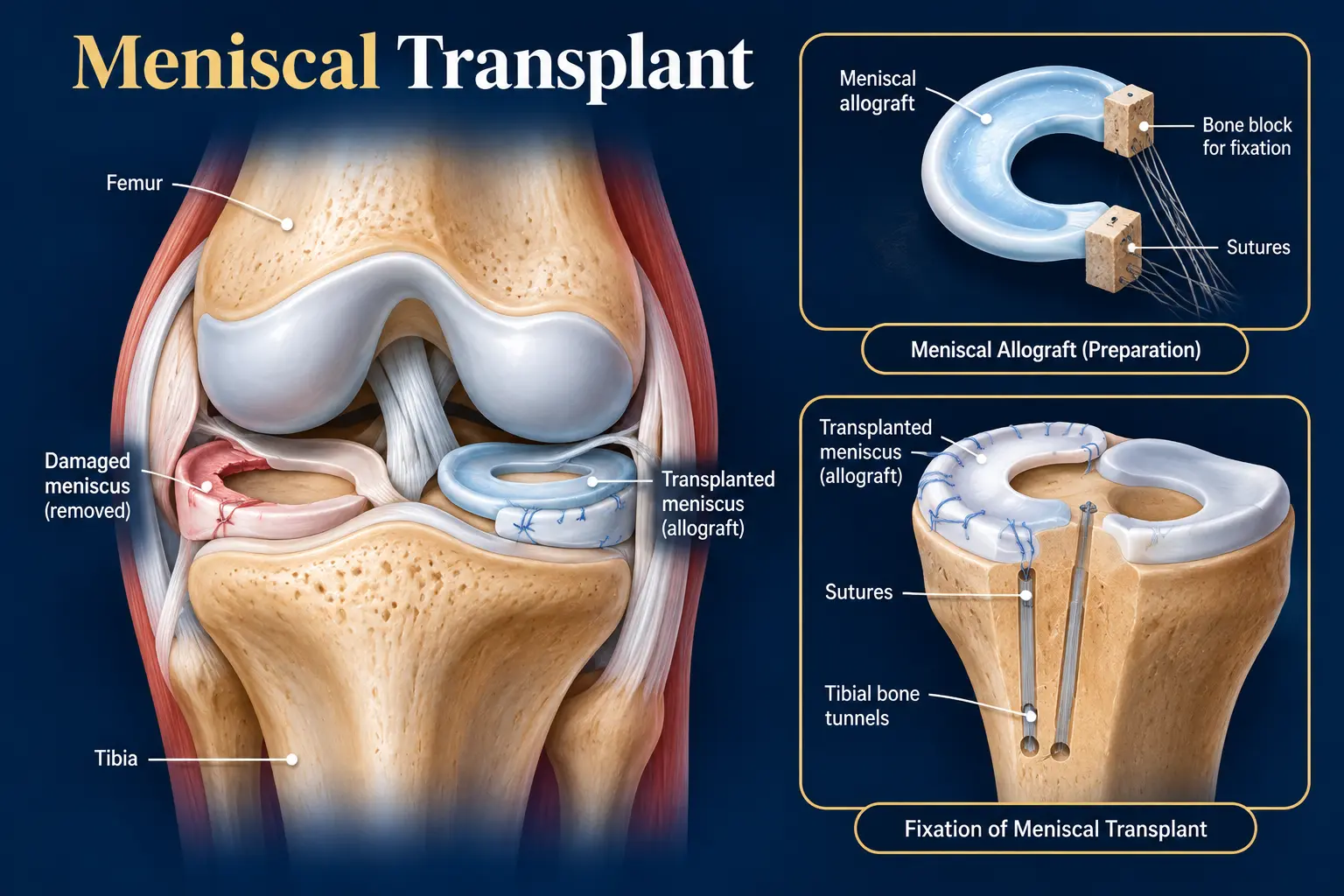
The meniscus is a C-shaped piece of fibrocartilage between the femur and tibia. Each knee has two menisci: the medial meniscus on the inner side and the lateral meniscus on the outer side. Together, they help distribute forces and protect the knee during movement and weight-bearing activities.
The main functions of the meniscus include:
The medial meniscus is generally less mobile than the lateral meniscus. The lateral meniscus moves more freely during knee motion, but both contribute to normal knee function.
Meniscal transplant surgery is performed to treat symptomatic meniscal deficiency after substantial meniscus loss. When a large portion of the meniscus has been removed or no longer functions properly, the knee can lose important cushioning and load-sharing functions. A donor meniscus aims to restore some of these functions and support joint preservation.
Substantial meniscus loss can increase stress on the articular cartilage and may contribute to persistent post-meniscectomy pain, especially during weight-bearing activities. Meniscal transplantation does not recreate a normal meniscus or guarantee prevention of osteoarthritis. It is mainly intended to restore some meniscal function and address persistent symptoms after significant meniscal loss.
A candidate for meniscal transplantation typically has symptomatic meniscal deficiency after substantial meniscal tissue loss. The remaining knee should also have suitable cartilage, alignment, ligament stability, and overall health to support the transplant and rehabilitation.
Important candidate factors include:
Meniscal transplantation may be unsuitable with advanced osteoarthritis, extensive cartilage loss, severe uncorrected malalignment, uncontrolled ligament instability, active knee infection, severe inflammatory joint disease, or medical conditions that make surgery or rehabilitation unsafe. Some of these factors can be addressed as part of a broader treatment plan.
Before meniscal transplantation, the surgeon performs a detailed evaluation to confirm that meniscal deficiency is causing the symptoms. The assessment also checks whether the remaining knee structures can support a transplanted meniscus.
The donor meniscus is selected and prepared through a controlled process that focuses on graft sizing, matching, tissue quality, safety, and surgical readiness. Meniscal allografts typically come from screened deceased human tissue donors and are processed through an authorized tissue-bank system.
Accurate graft sizing and matching help the transplanted meniscus fit the patient’s knee anatomy and sit in the appropriate position. An improperly sized or positioned graft may not restore normal load distribution and can affect graft function.
Meniscal transplant surgery involves preparing the knee and positioning a donor meniscal graft to restore meniscal function. The surgical technique varies according to the patient’s anatomy, graft type, and other knee problems that may require treatment.
Meniscal transplant surgery may improve symptoms and restore some meniscal function in carefully selected patients. Outcomes vary between individuals and depend on factors such as cartilage condition, knee stability, alignment, graft condition, and rehabilitation.
After meniscal transplant surgery, the knee enters a protected healing phase. Recovery focuses on protecting the graft while gradually restoring knee movement, strength, and function. The exact plan varies based on graft fixation, healing, and any additional procedures performed.
Recovery after a meniscal transplant usually takes several months. Many patients need around 6 to 12 months to progress toward higher-level activities, but the timeline varies based on the procedure, graft healing, rehabilitation progress, range of motion, and other clinical factors.
A typical recovery progresses through these stages:
These timeframes are approximate. Recovery may take longer when additional procedures, cartilage damage, ligament problems, or other clinical factors affect rehabilitation. Return to sports depends on functional recovery rather than time alone.
The long-term outlook after meniscal transplantation varies between patients. Many patients experience meaningful improvements in pain and knee function, but joint degeneration can still progress. Studies in the provided source report 10-year graft survival rates of approximately 73% to 80%, while reported 15-year survival rates vary more widely.
Long-term outcomes may include:
Several factors can influence long-term outcomes, including cartilage condition, knee alignment, ligament stability, graft size and position, age, activity level, previous surgery, associated injuries, and rehabilitation progress.
Meniscal transplantation restores some load distribution and shock absorption after substantial meniscal tissue loss. The procedure aims to reduce abnormal joint loading and support cartilage protection, but current evidence does not show that it definitively prevents or delays knee osteoarthritis.
Several factors can affect the potential for joint preservation:
Meniscal transplantation is best understood as a joint-preservation strategy, not a guaranteed way to prevent osteoarthritis. Its established goals include reducing symptoms, improving knee function, and restoring some meniscal function while potentially supporting cartilage protection.
Meniscal transplant, meniscus repair, and meniscectomy are different procedures for different meniscal problems. The main difference is whether the surgeon replaces missing tissue, repairs existing tissue, or removes damaged tissue.
| Treatment | Main Purpose | Meniscal Tissue | Typical Clinical Context |
|---|---|---|---|
| Meniscal Transplant | Restore meniscal function after substantial tissue loss | Missing or severely deficient tissue is replaced with a donor graft | Selected patients with symptomatic meniscal deficiency after substantial meniscal loss |
| Meniscus Repair | Preserve and heal the patient's native meniscus | Existing torn tissue is repaired and preserved | Repairable tears with suitable tissue quality and healing potential |
| Meniscectomy | Remove damaged or unstable tissue causing symptoms | Damaged tissue is removed while healthy tissue is preserved when possible | Irreparable tears or unstable tissue causing persistent symptoms |
| Partial Meniscectomy | Remove only the damaged portion | Part of the native meniscus remains | Irreparable tears where preserving healthy meniscal tissue is possible |
Meniscus repair focuses on preserving the patient's existing tissue when the tear has suitable characteristics for healing. Meniscectomy removes damaged or unstable tissue, while partial meniscectomy removes only the affected portion. A meniscal transplant is different because it replaces absent or severely deficient tissue with a donor meniscal allograft.
The appropriate approach depends on the meniscal problem, tissue quality, symptoms, and condition of the rest of the knee.
The cost of meniscal transplant surgery varies by location and individual treatment needs. Expenses may include surgeon and hospital fees, donor graft costs, associated procedures, insurance coverage, and postoperative rehabilitation. A single universal price does not apply to every patient.
Return to sports depends on healing, knee strength, stability, range of motion, functional testing, and rehabilitation progress. Patients should return gradually after meeting appropriate rehabilitation milestones and receiving clinical clearance rather than following a fixed date.
Walking and weight-bearing usually progress according to the surgeon’s rehabilitation protocol. Patients commonly use crutches and may wear a knee brace during early recovery. Weight-bearing restrictions vary according to the surgical technique, graft fixation, and individual healing.
You can usually consider driving when you have adequate mobility, leg control, reaction ability, and are no longer affected by medications that impair driving. The timing depends on functional recovery and should follow your surgeon’s advice or medical clearance.
Sleep can be uncomfortable during early recovery because of knee pain and swelling. Your surgeon may recommend a specific sleep position or continued brace use. As swelling and discomfort improve, sleep generally becomes easier during the rehabilitation process.
If symptoms persist or the graft fails, the surgeon may reassess the knee with an examination and imaging. Treatment depends on the cause and may include continued rehabilitation, additional treatment, or revision surgery when appropriate. Graft failure does not automatically require one specific procedure.
Contact your surgical team if you develop worsening symptoms, significant swelling, fever, wound problems, or unexpected changes in recovery. These symptoms may require medical assessment to identify complications such as infection or problems with healing.