
Specialties › Knee & Leg › Multi-Ligament Knee Injuries

A multi-ligament knee injury is a serious knee injury that affects two or more major ligaments. It can involve the ACL, PCL, MCL, LCL, or several ligaments at the same time. The injury often occurs after high-energy trauma, a severe sports injury, a significant fall, twisting force, or knee dislocation.
This article explains everything you need to know about multi-ligament knee injuries. You will learn what causes them, the common symptoms, how doctors diagnose the injury, and the available treatment options. We also cover ligament repair and reconstruction, rehabilitation exercises, recovery timelines, possible complications, and answers to common patient questions.
Book a consultation and receive expert orthopedic guidance.
A multi-ligament knee injury occurs when two or more major ligaments of the knee are damaged during the same traumatic event. The four major stabilizing ligaments are the ACL, PCL, MCL, and LCL. Damage to multiple ligaments can make the knee significantly unstable and difficult to support.
An isolated ligament injury affects only one major ligament. For example, an isolated ACL tear involves the ACL without significant injury to the other major ligaments. A multi-ligament knee injury is different because several stabilizing structures are damaged at the same time. The injury may also affect blood vessels, nerves, cartilage, menisci, or other surrounding structures.
Multi-ligament knee injuries often occur after high-energy trauma, such as motor vehicle accidents, severe falls, or major sports injuries. They can require more complex treatment and longer rehabilitation than isolated ligament injuries.
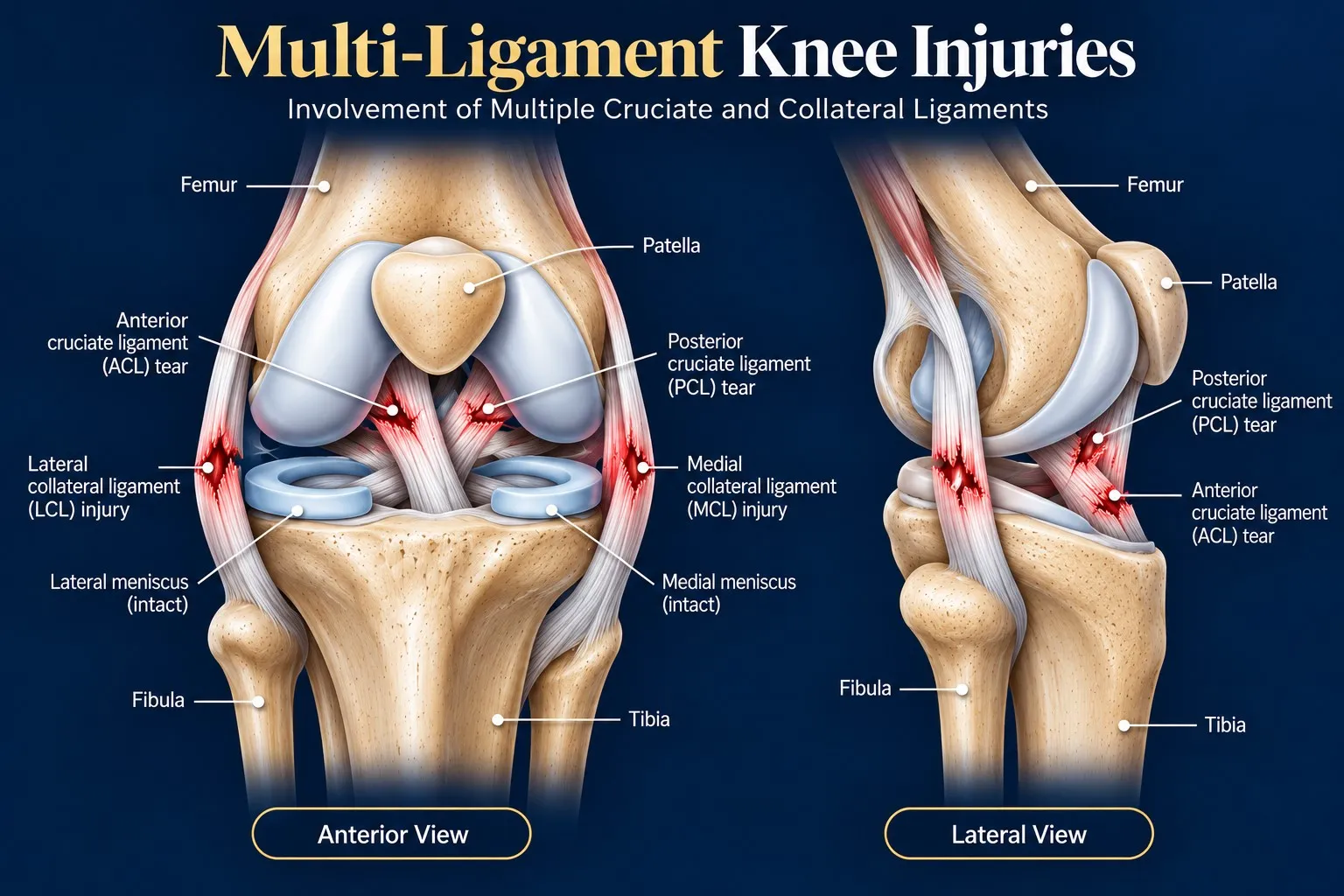
Multi-ligament knee injuries usually result from high-energy trauma or forces that push the knee beyond its normal range of motion. These forces can stretch or tear several stabilizing ligaments during the same injury.
Common causes include:
Symptoms may include severe pain, swelling, instability, and difficulty bearing weight after a significant knee injury. The exact symptoms can vary depending on which ligaments and surrounding structures are damaged.
Common symptoms include:
A cold, pale, numb, weak, or difficult-to-move foot after a major knee injury requires urgent medical attention because it may indicate nerve or blood vessel involvement.
Diagnosis requires a detailed examination because multiple ligaments and other knee structures may be injured at the same time. Doctors assess the injury mechanism, knee stability, and possible damage to nerves and blood vessels before deciding on further tests.
Treatment for a multi-ligament knee injury depends on the ligament pattern, knee stability, associated injuries, patient factors, and timing. The main treatment options include:
The first step is to protect the knee and address urgent problems. Treatment may include immobilization, pain control, ice, elevation, and temporary avoidance of weight-bearing. A dislocated knee usually requires prompt reduction to restore alignment and protect circulation and nerve function.
Doctors urgently address blood vessel or nerve injuries when present. A popliteal artery injury may require vascular repair or reconstruction before definitive ligament treatment. Compartment syndrome may also require emergency treatment.
Selected patients may recover without surgery when ligament injuries are partial and the knee remains reasonably stable. Treatment can include bracing, activity modification, pain management, and structured physical therapy.
Repair may be appropriate for certain acute injuries, particularly when a ligament pulls away from its attachment with good-quality tissue. The surgeon reattaches the native ligament to restore stability.
Reconstruction replaces severely damaged ligaments with tendon grafts. It may involve the ACL, PCL, MCL, LCL, or posterolateral corner, depending on the injury pattern.
Some patients undergo multiple ligament procedures during one operation. Others need staged treatment because of severe swelling, soft-tissue damage, vascular injuries, or other factors affecting surgical safety.
Surgeons may also treat meniscus tears, cartilage damage, fractures, or other structural injuries. Addressing these problems helps restore overall knee function and stability.
Rehabilitation is essential after both surgical and non-surgical treatment. Physical therapy gradually restores motion, strength, balance, walking ability, and functional knee stability.
Multi-ligament rehabilitation uses progressive exercises to restore knee motion, muscle control, strength, balance, and functional movement. Your exercise program depends on the injured ligaments, surgical procedures, associated injuries, healing progress, and rehabilitation protocol.
Gentle heel slides and assisted knee movements help restore mobility while protecting healing ligaments and reducing stiffness.
Quadriceps sets and other early activation exercises help maintain muscle function and limit weakness during protected rehabilitation.
Gradual strengthening targets the quadriceps, hamstrings, gluteal muscles, and hip muscles as the healing knee allows increased loading.
Weight-shifting, supported single-leg activities, and balance exercises help restore joint-position awareness and improve knee control.
Step-ups, controlled squats, lunges, and similar exercises gradually prepare the knee for everyday weight-bearing activities.
Stationary cycling, swimming, or other approved activities can improve cardiovascular fitness while limiting excessive stress on healing structures.
Later rehabilitation may introduce controlled direction changes, lateral movements, and coordination drills when adequate strength and stability return.
Jumping and landing exercises may be introduced during advanced rehabilitation to develop power, control, and safe landing mechanics.
Athletes gradually practice running, cutting, pivoting, jumping, and other movements required for their particular sport.
Exercise progression should follow functional milestones rather than a universal timeline. Your rehabilitation team determines when each exercise is appropriate based on your healing and knee stability.
Complications can result from the original trauma, prolonged instability, surgery, or the rehabilitation process. The risk depends on the severity of the injury and the structures involved.
Scar tissue and prolonged immobilization can limit knee motion. This can make it difficult to fully bend or straighten the joint.
The knee may continue giving way when injured ligaments heal poorly, grafts fail, or rehabilitation does not restore adequate stability.
Surgical reconstruction carries a risk of superficial or deep infection around the incision, joint, or reconstructed ligament.
Severe trauma can damage nerves, particularly the common peroneal nerve. This may cause numbness, weakness, tingling, or foot drop.
Damage to the popliteal artery can reduce blood flow to the leg. This requires urgent medical assessment and treatment.
Severe trauma can cause dangerous pressure buildup within the leg. This can restrict circulation and damage muscles and nerves.
Reduced mobility after a major injury or surgery can increase the risk of blood clots forming in the deep veins.
Reconstructed ligaments can stretch, loosen, rupture, or fail to heal properly. These problems may cause renewed knee instability.
Excessive scar tissue inside the knee can cause significant stiffness and restricted movement. It may make it difficult to return to normal activities.
Associated meniscus or cartilage damage can contribute to persistent swelling, pain, and mechanical symptoms. These injuries may also contribute to later joint degeneration.
Severe cartilage damage, meniscal injury, or persistent instability can increase the risk of developing arthritis over time.
Screws, anchors, or other fixation devices can occasionally cause irritation, loosening, breakage, or localized pain after reconstruction.
Multi-ligament knee injury recovery time varies according to the injuries and whether other knee structures are involved. Recovery is often longer than recovery from an isolated ligament injury. Many patients require 9–12 months for substantial recovery, while complex injuries may continue improving for 18 months or longer.
| Recovery Phase | Typical Timeline | Main Goals |
|---|---|---|
| Initial protection | Weeks 0–6 | Protect healing structures, control swelling, and restore safe motion |
| Early rehabilitation | Weeks 6–12 | Progress weight-bearing, improve motion, and activate muscles |
| Strengthening | Months 3–6 | Build strength, balance, endurance, and walking ability |
| Advanced rehabilitation | Months 6–9 | Develop functional strength, coordination, and movement control |
| Return to demanding activities | Months 9–12+ | Progress toward work, sports, or other high-demand activities |
| Complex recovery | 12–18+ months | Address persistent deficits and continue functional improvement |
Recovery may take longer when the injury involves severe ligament tears, fractures, cartilage or meniscus damage, nerve or vascular injuries, additional surgeries, or persistent stiffness. Your rehabilitation progress and individual healing also affect how quickly you recover.
Recovery should follow functional milestones rather than the calendar alone. Your healthcare team determines when it is appropriate to progress weight-bearing, strengthening, running, or sports activities.
You may be able to bend your knee, but swelling, pain, instability, and postoperative restrictions can limit movement. Your rehabilitation plan will guide when and how much knee motion is appropriate during healing.
Brace duration varies according to the injured ligaments, surgical procedure, knee stability, and rehabilitation protocol. Your healthcare team will determine when it is safe to reduce or stop brace use.
Driving depends on your operated leg, braking ability, mobility, pain, medication use, and overall control of the knee. You should return to driving only after your clinician confirms that you can safely control the vehicle.
You may return to sports after adequate strength, stability, coordination, and functional recovery have been achieved. Your healthcare team should assess your progress and determine when running, cutting, pivoting, and other demanding movements are appropriate.